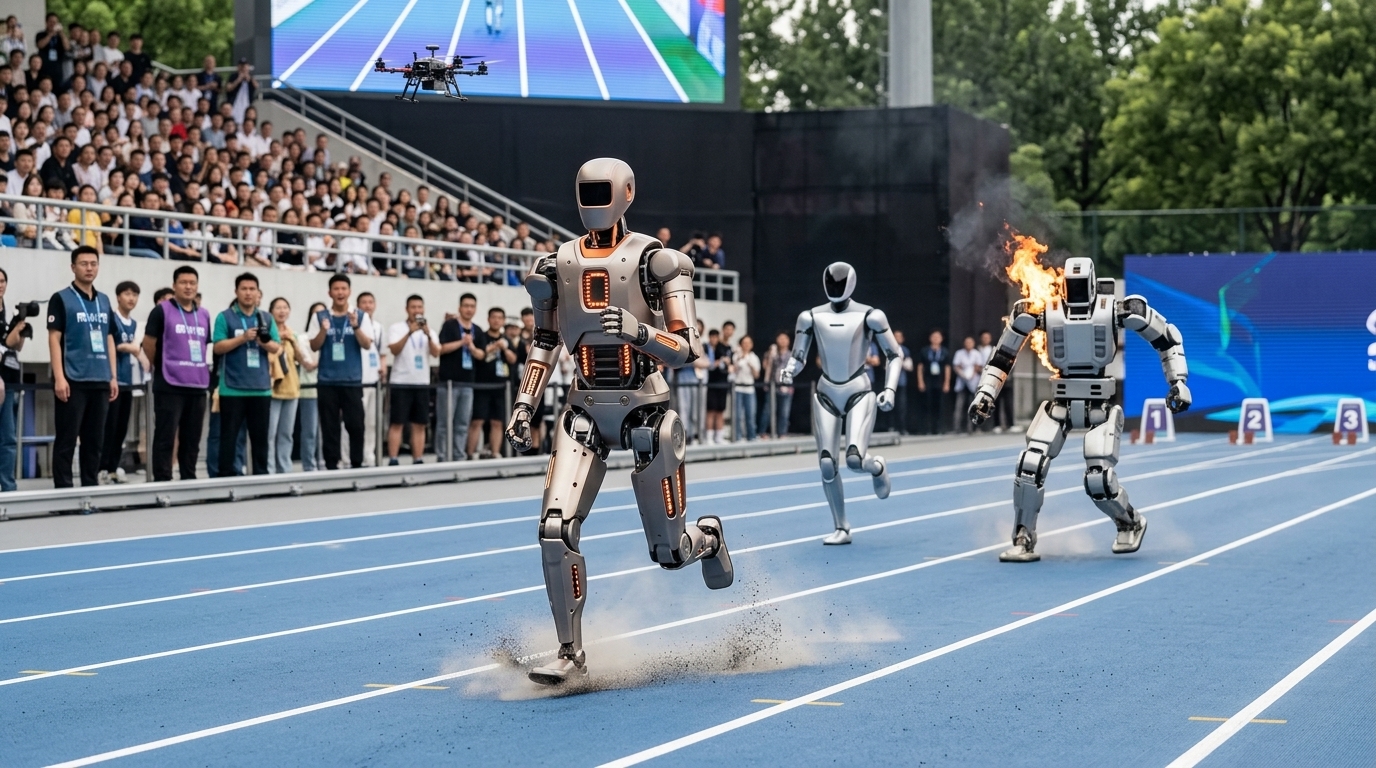
The second edition of the World Humanoid Robot Games in Beijing (August 22–26) delivered a mix of breathtaking performance and catastrophic failure. While some robots managed to shatter Usain Bolt's 100-meter world record, their inability to decelerate after the finish line led to violent collisions with barriers, structural snaps, and, in several instances, robots bursting into flames.
Between Records and Reality
This year's games, hosted by the Beijing city government and state media, featured events ranging from sprinting and high jumps to kung fu, soccer, and table tennis. However, progress in whole-body control appears limited to highly specific tasks. As Dipam Patel, a researcher at Purdue University, noted, many of these robots are engineered for a single mission—explaining why a sprinting robot can outrun a human but cannot safely stop once the goal is reached.
- The 100-meter sprint and standing high jump records were surpassed by robots this year.
- An entry from X-Humanoid went viral for an unusual running posture learned through reinforcement learning in simulation.
- In household chore trials, such as washing laundry, robots remain significantly slower than human speeds.
The Autonomy Hurdle
Despite the spectacular nature of the games, true autonomy remains a distant goal. Many competitors were still teleoperated by human controllers—a practice permitted by the rules but penalized in the final scoring. The requirement for massive amounts of data to cover all possible "edge cases" makes generalizing robot skills across different environments extremely difficult.
Furthermore, most humanoids still rely heavily on 5G cloud computing to run intensive AI models rather than processing instructions on their own onboard hardware. Meanwhile, geopolitical competition is intensifying; the US has banned imports of Chinese-made robots even as domestic firms like Boston Dynamics and Agility Robotics ramp up commercial deployment in factories and warehouses.