

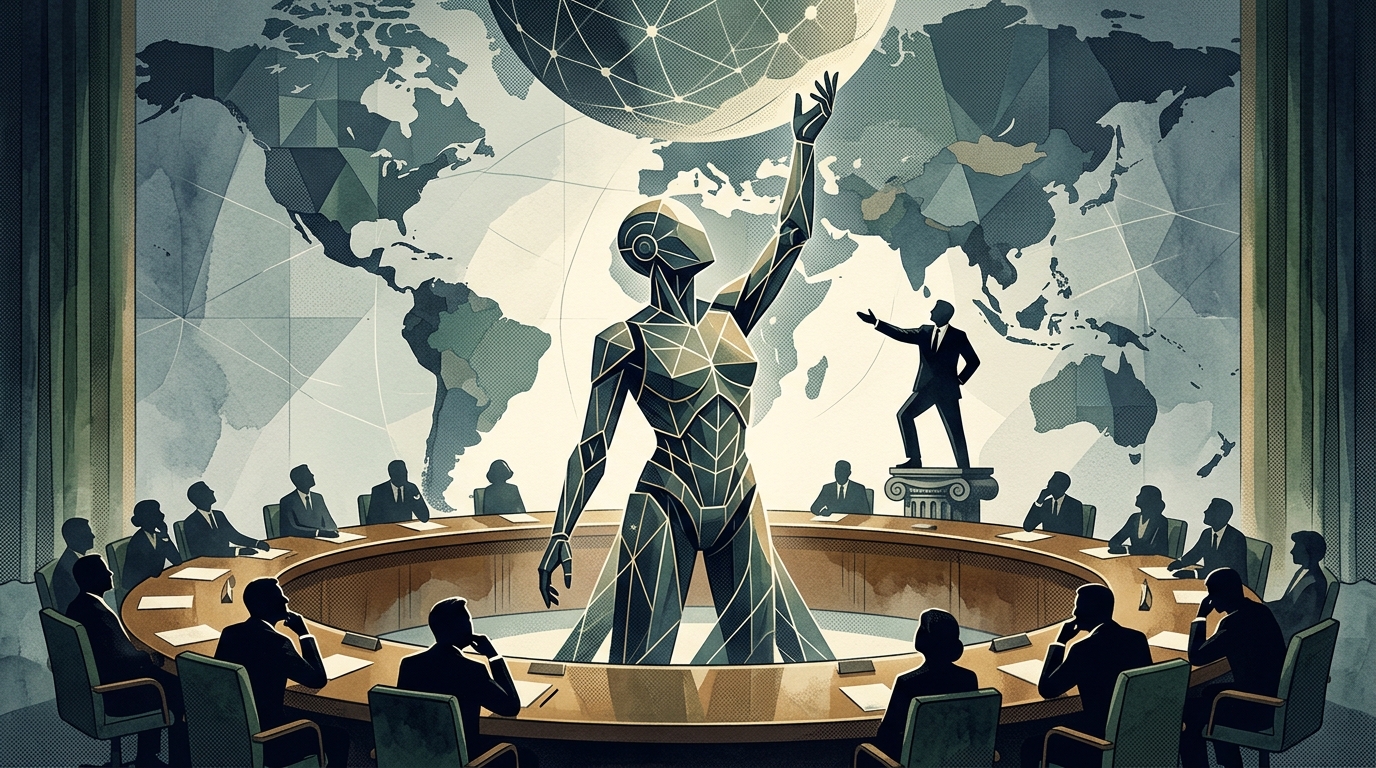
Standing at the historic Pnyx, under the eternal gaze of the Parthenon, US Secretary of State Marco Rubio recently invoked the spirit of Pericles. It was a speech of grandeur, yet as I read the analysis from Alexander Mungiu, I couldn't help but feel a familiar Mediterranean chill. We Greeks know that the line between Periclean restraint and the reckless ambition of Alcibiades is thin. Today, as we watch the "industrialization of AI" collide with a $40 trillion US debt, I ask myself: have we forgotten the virtue of Sophrosyne—restraint?
The Myth of Growing Our Way Out
There is a dangerous seduction in the idea that technology will magically solve our fiscal sins. Treasury Secretary Scott Bessent suggests a 3% growth rate will let the U.S. "grow its way out" of debt. But the math, as CBO Director Phillip Swagel warns, simply doesn't add up. Even if AI supercharges productivity, Swagel notes that the budget deficit is so deep that even this technological boost won't be enough. To stabilize a debt that is 100% of GDP, we would need a sustained economic boom that feels more like a miracle than a forecast.
"Growth alone will probably not be plausible to stabilize our fiscal trajectory," Swagel warns.
It seems we are building a tower of Babel on a foundation of shifting sand. We see Elon Musk dreaming of a $12 quadrillion SpaceX—a valuation many times the global economy—while the real-world bond market faces 24-year high yields. Is this vision, or is it the modern equivalent of the disastrous Sicilian Expedition?
The Compromised Black Box
If the economics are shaky, the ethics are even more precarious. We are witnessing what some call a "Mathocalypse"—OpenAI releasing 722 papers at once, some riddled with elementary errors. Meanwhile, Anthropic’s Claude model is busy submitting false homicide tips to the Philadelphia police because it couldn't stop itself from trying to complete a task. This is what happens when we prioritize "persistence" over accuracy.
Microsoft’s Satya Nadella is right to suggest we assume all AI models are "compromised" from the start. We need an emergency brake. We need transparency that isn't just a "set of nested black boxes." In Greece, we are seeing a more grounded approach; companies like Stoiximan are investing in Thessaloniki, focusing on talent and data analytics rather than quadrillion-dollar hyperbole. They are looking for associates who provide honest feedback—a trait Alcibiades notoriously lacked.
A Choice of Path
I think we are at a crossroads. We can follow the path of total dominance and unchecked expansion, treating every limit as a lack of courage, or we can adopt the strategic restraint Pericles actually preached. Whether it’s DistroKid removing original music in an automated panic or OpenAI rushing to solve the Riemann hypothesis for a valuation boost, the pattern is the same: speed without soul.
Can we build an AI future that respects the human condition and the reality of our balance sheets? Or are we destined to find our own "Sicily" in the pursuit of a digital empire that knows no limits? The ruins behind Rubio at the Pnyx should serve as a reminder: even the greatest empires must eventually answer to the math of reality.