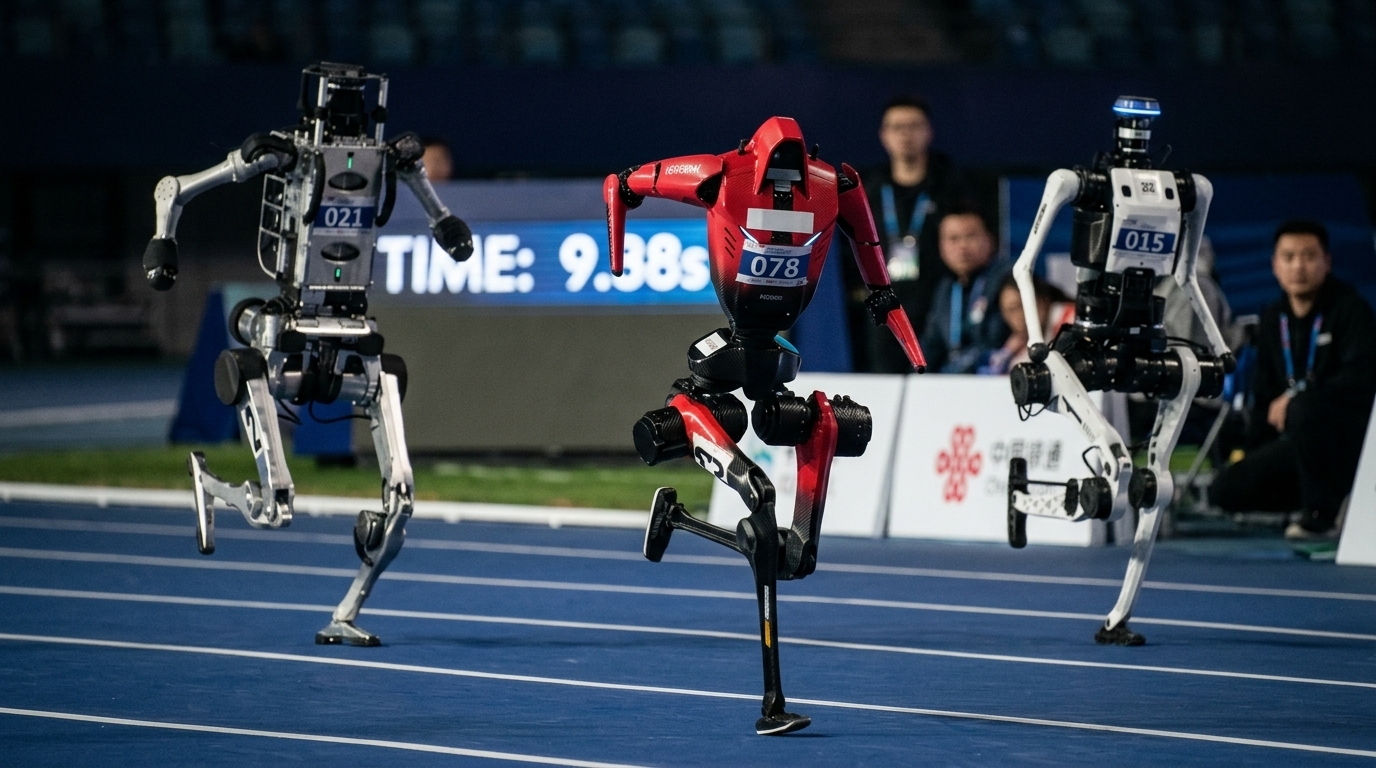
In a historic moment for technology, Chinese humanoid robots shattered human world records, including Usain Bolt’s legendary 100-meter sprint time, during the opening day of the World Humanoid Robot Games in Beijing on Saturday.
Surpassing Human Physical Limits
In the 100-meter sprint, a humanoid robot developed by Beijing-based X-Humanoid achieved a time of 9.39 seconds, beating the human record of 9.58 seconds set by the Jamaican athlete in 2009. Furthermore, a robot from the smartphone company Honor reportedly clocked an even faster 9.32 seconds during a trial event, reaching a peak speed of 14.5 meters per second.
The record-breaking continued in the high jump, where an X-Humanoid robot cleared 2.88 meters. This performance significantly surpassed the human world record of 2.45 meters held by Cuba’s Javier Sotomayor since 1993. The rapid pace of development is evident when compared to last year’s inaugural games, where the best humanoid high jump was a mere 0.95 meters.
Geopolitical Tensions and the Robotics Race
The five-day event, featuring over 2,000 robots from 16 countries including the U.S., Germany, and Japan, serves as a showcase for China’s rapid progress in advanced robotics. As China currently manufactures the majority of the world’s humanoid robots, the sector has become a focal point of the ongoing technology race with the United States.
Last month, the U.S. Federal Communications Commission (FCC) announced a ban on imports of new foreign-made humanoid robots, citing national security concerns. Additionally, the Pentagon recently added Unitree, a prominent Chinese robot manufacturer, to its list of companies deemed to have ties with the Chinese military—accusations that Beijing has formally contested.
The Future of Deployment
Despite these athletic feats, experts maintain that humanoid robots remain primarily tools for demonstration, performance, and research for the time being. Mass real-world deployment is still expected to take time. Nevertheless, public sentiment in Beijing appears to be shifting from resistance toward curiosity, as spectators witness the "unstoppable" evolution of machines performing tasks once reserved for the peak of human athleticism.