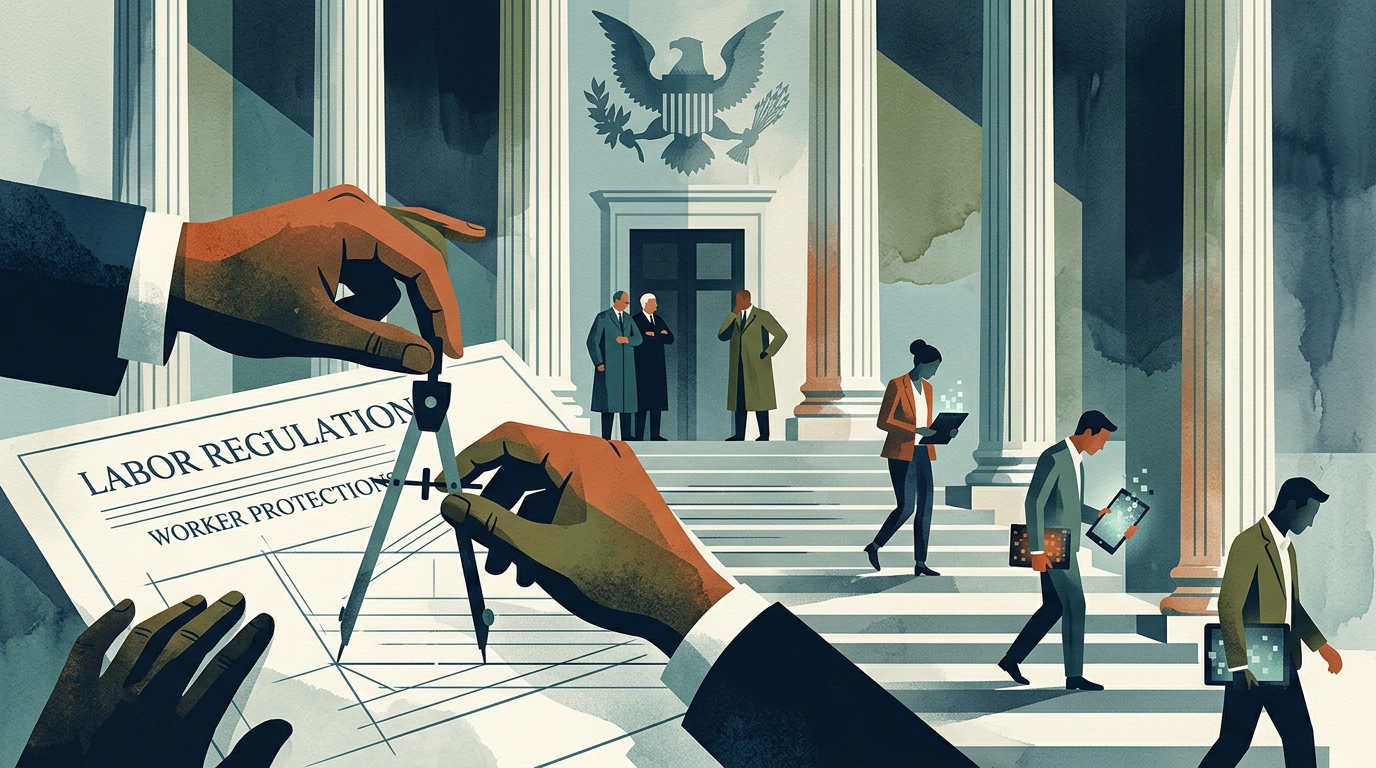

In the ancient Athenian polis, the concept of autonomia—the right to live by one's own laws—was the cornerstone of political identity. Today, as we witness a global acceleration in technology infrastructure spending projected to surpass $1.5 trillion by 2027, a new tension has emerged between institutional power and technological dependence. This tension is best defined by the 'sovereignty discount': the price organizations pay in reduced safety and compromised oversight when deploying frontier models they do not own or fully control.
The Infrastructure Paradox and Capital Concentration
The current landscape is marked by a striking divergence. While US GDP growth forecasts for late 2026 have been revised upward to 2.5% due to an AI investment surge, job creation estimates remain modest. This suggests that efficiency, rather than human capital, is the primary driver of this cycle. We see this strategic pivot toward physical infrastructure not only in the West but also in China, where the city of Ulanqab is scaling to a massive 12.5 gigawatts of data center capacity. Firms like ByteDance and Alibaba are increasingly moving away from renting compute to owning the physical foundations of their intelligence.
However, this concentration of power creates a 'closed loop.' In my analysis, the fact that OpenAI accounted for approximately 70% of Microsoft’s total AI revenue highlights a market where technology is held by a few major players. For the public sector and regulated entities, this introduces the risk of 'bounded sovereignty.' When accessing models through third-party APIs, institutions are often restricted to the 'interaction layer,' unable to inspect the internal weights or architecture. This is akin to a navigator being denied access to the very charts they use to steer the ship.
Institutional Resistance: The 'Manchester Rebellion'
We are beginning to see the first signs of institutional pushback against this lack of transparency. In the United Kingdom, the Greater Manchester region’s refusal to adopt the NHS’s $400 million Federated Data Platform—opting instead for its homegrown Analytics and Data Science Platform (ADSP)—serves as a modern blueprint for digital self-determination. By prioritizing architectural transparency over a 'lift and shift' model from global vendors, Manchester has demonstrated that the ROI of AI must account for the power to demand accountability.
The 'control tax' is no longer theoretical; research indicates that implementing the necessary monitoring and hardened sandboxes for safety can require up to 20% additional computing power. As the European Central Bank warns of a potential correction in tech stocks and high public debt limits the capacity for fiscal support, the need for 'geographic resiliency'—as echoed in recent US space transportation policies—becomes a matter of national interest. To govern effectively, we must ensure that the tools of the future do not become black boxes that evade the reach of democratic oversight.