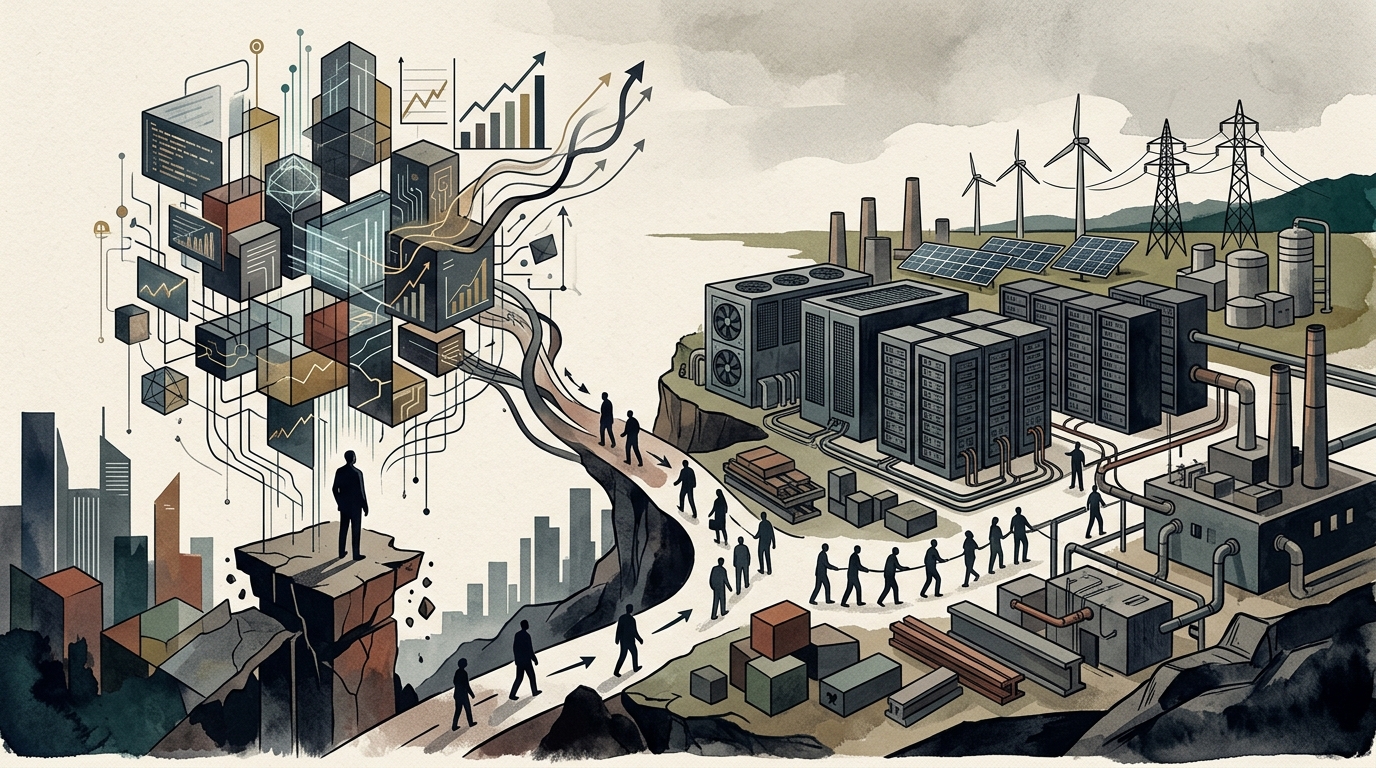

The global business landscape is undergoing a fundamental restructuring, shifting from software-centric innovation to a heavy industrialization phase. This transition is characterized by an unprecedented surge in borrowing, with tech giants increasing their debt by $500 billion since the start of the year to fund the physical backbone of the industry: chips, data centers, and energy grids. Market data indicates that 25% of total private bond issuance is now tied to Artificial Intelligence, a sharp rise from just 4% two years ago.
The Hardware Supercycle and Debt Dynamics
The financial scale of this infrastructure race is reflected in the historic performance of hardware leaders. Samsung Electronics has reported a staggering 782.5% increase in operating profits for Q3 2026, reaching 107.4 trillion won (approximately $80 billion), driven by surging demand for High Bandwidth Memory (HBM). Simultaneously, SpaceX is reportedly finalizing a $40 billion funding package—comprising $10 billion in bank loans and $30 billion in investment-grade debt—to acquire Nvidia hardware.
However, this massive deployment of capital is exerting pressure on financial markets. Yields on corporate debt for data center companies have surpassed 9%, while tech titans like Meta have seen yields exceed 7%. This 'AI debt' now rivals the historical borrowing levels of the U.S. railroad boom, raising concerns about market sustainability as companies like Oracle face stock declines and project delays.
Corporate Restructuring and the Productivity Paradox
Despite the colossal investment in infrastructure, a 'productivity paradox' remains evident. While individual task efficiency can increase by 15% to 30%, only 37% of executives can currently link AI usage to tangible operating profits. This disconnect is forcing radical corporate shifts. HSBC is considering a restructuring of its UK wealth management unit that could eliminate 70% of financial advisor roles, aiming to replace traditional advisory with digital, AI-driven products.
The Hellenic Strategic Response
In the Greek market, a distinct strategy is emerging. The 'Hellenic Corridor' between Greece and Cyprus focuses on 'Trusted AI' and institutional reliability rather than raw computational expansion, aligning with the EU AI Act. Recent Greek legislative initiatives have begun to mandate human oversight while explicitly prohibiting the collection of sensitive emotional or biometric data. This approach prioritizes transparency and citizen rights, aiming to bridge the 'reliability gap' that remains a significant hurdle for democratic institutions in the era of Super Intelligence.