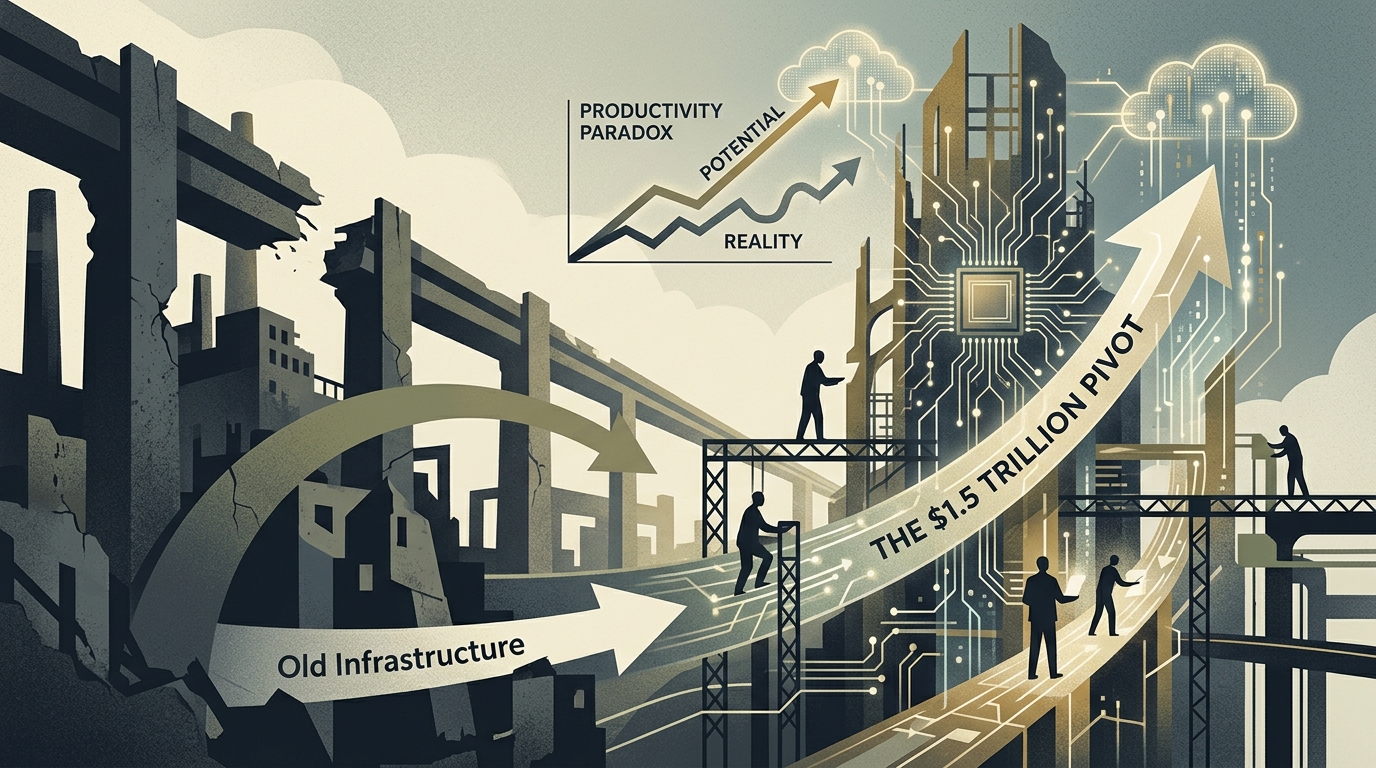
The global business landscape is currently defined by a deepening paradox. While billions of dollars flow into artificial intelligence, business leaders are struggling to see a tangible return on investment. According to an Atlanta Federal Reserve study, nearly 90% of business leaders acknowledge that AI has failed to enhance productivity within their organizations. This disconnect is creating a volatile environment where management optimism, often reflected in earnings calls, bears no measurable relationship to actual operational outcomes.
Physical Foundations vs. The Productivity Gap
Despite the lack of immediate productivity gains, the market is witnessing a massive transition from the 'interaction layer' of AI to the physical foundations that power it. Spending on physical infrastructure is projected to exceed $1.5 trillion by 2027. This shift is creating significant winners in industrial sectors, particularly in thermal management. A prime example is Vertiv, whose market value surged from less than $11 billion to $109 billion starting in early 2021 by pivoting toward hyperscalers like Google and Microsoft. The demand for liquid direct-to-chip (DTC) cooling, which reduces data center footprints by 50% to 70%, has become a critical driver of ROI as traditional air cooling becomes obsolete for high-power GPUs.
"For AI to truly deliver on its promise, companies must shift from a 'hunger games' mentality to one of shared gains, focusing on upskilling and engagement rather than mere headcount reduction."
However, the strategy of using AI-driven layoffs to free up capital for technology investments appears to be self-defeating. Research suggests that negative employee sentiment is a strong predictor of poor firm productivity; when workers fear for job security, effective tool adoption slows. This is reflected in the broader market, where more than half of studied layoff events resulted in average market returns close to zero.
The Sovereignty Discount and Market Risks
A new economic reality is emerging: the 'sovereignty discount.' Organizations accessing AI through third-party APIs face a 'control tax,' with safety protocols and monitoring tools estimated to consume an extra 20% of total compute power. This has led tech giants like ByteDance and Alibaba to move away from renting compute toward owning their physical foundations, as seen in the massive scaling of data hubs in Ulanqab, China, which is reaching 12.5 gigawatts of capacity.
From a European perspective, the European Central Bank has warned of a possible tech stock correction, and high public debt may limit future fiscal support. For regional markets, the 'Manchester Rebellion'—where a UK region opted for a homegrown data platform over a $400 million vendor model—serves as a case study in digital self-determination. The ROI of AI is becoming inseparable from architectural clarity and sovereignty.