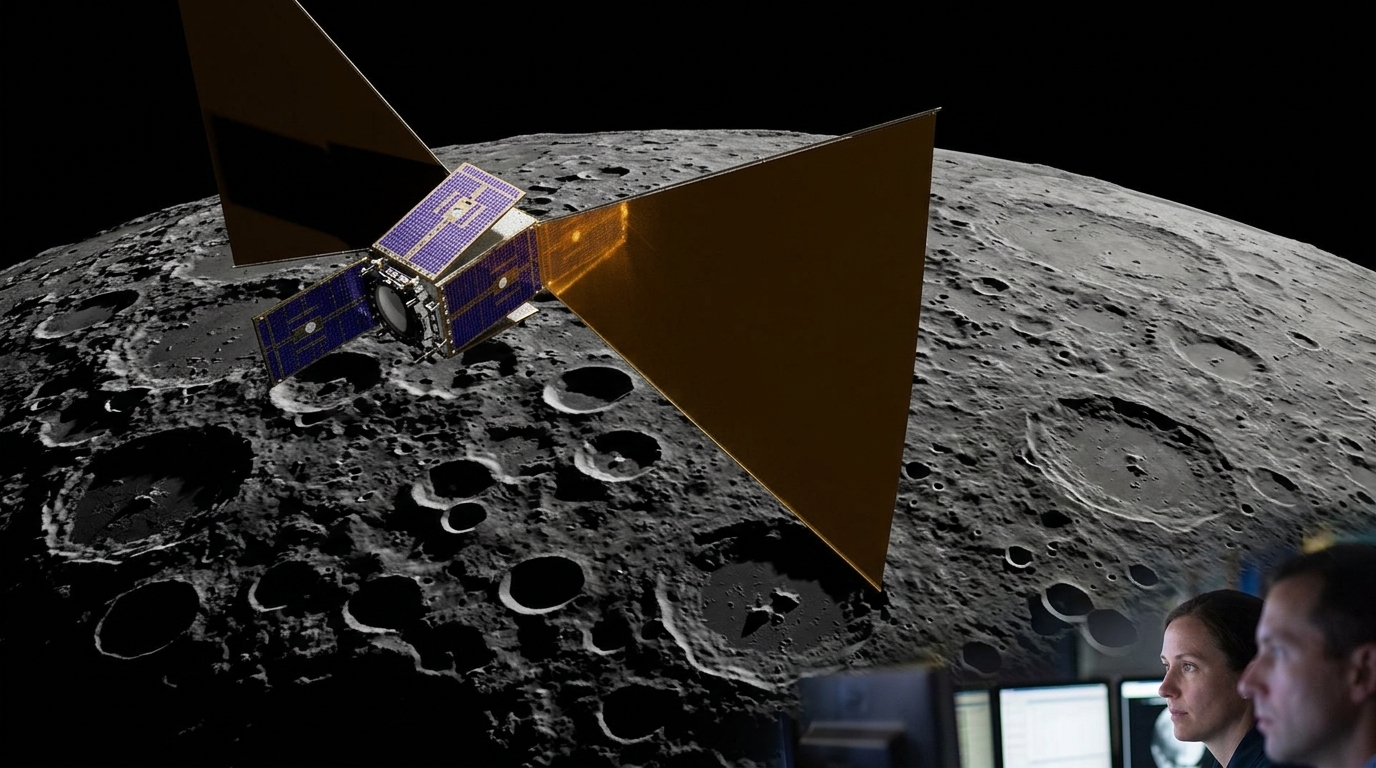
Scientists are planning an ambitious mission involving a suitcase-sized microsatellite to orbit the Moon and explore the origins of the Cosmos. The mission, dubbed CosmoCube, will utilize the radio-silence of the Moon's far side to detect extremely faint signals dating back to when the Universe was still in its infancy.
Searching for the '21cm Line'
The primary objective of CosmoCube is to locate the so-called '21cm line,' a radio frequency signal emitted by neutral hydrogen atoms. As this signal travels through time, its wavelength expands due to redshift, allowing scientists to track its intensity relative to the cosmic microwave background radiation.
According to Professor Eloy de Lera Acedo of the University of Cambridge, this signal acts as a 'thermometer' for the physical temperature of gas in the early Universe. The research will focus on the 'Cosmic Dark Ages' (380,000 years after the Big Bang) and the 'Cosmic Dawn,' continuing through the end of the epoch of reionization, approximately one billion years post-Big Bang.
Why the Moon is Essential
Detecting these signals from Earth is nearly impossible due to human-made interference from FM radios and aircraft communications, as well as distortions caused by Earth's ionosphere. The far side of the Moon acts as a natural shield against this noise.
However, the mission faces significant hurdles. Professor Phil Bull warns that other planned lunar missions may carry their own radio noise to the Moon, turning the endeavor into a race against time. CosmoCube, with an estimated budget of approximately €50 million, is expected to launch in about five years, having already secured initial funding of over €2 million from the UK Space Agency.