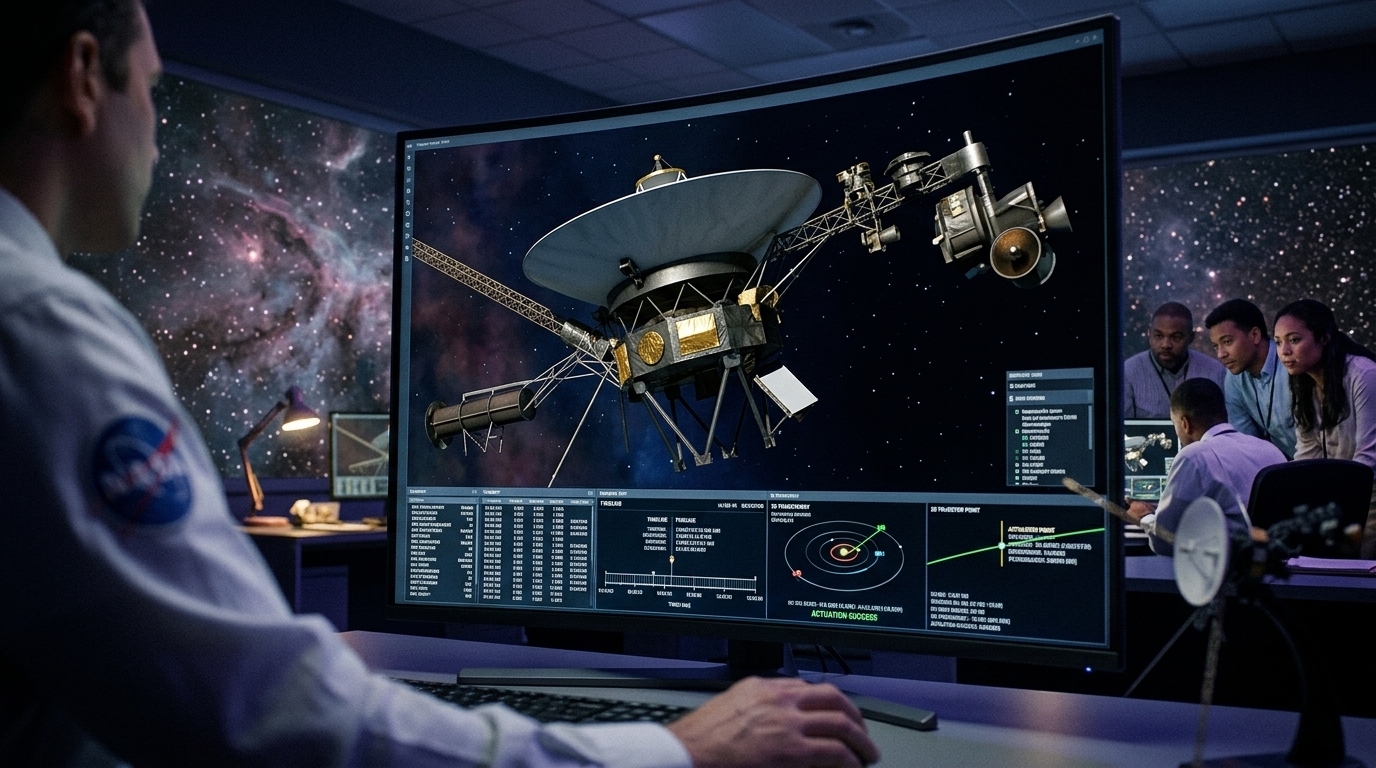
Voyager 2, launched in 1977, has secured additional operational time following a highly complex technical maneuver by NASA. The operation, dubbed "Big Bang," aims to keep the spacecraft's three remaining scientific instruments functioning for at least another year.
The Energy Challenge in Deep Space
The primary issue facing the Voyager spacecraft is the gradual depletion of energy. Lacking solar panels, they rely on radioisotope thermoelectric generators that convert heat from decaying plutonium into electricity. However, each craft loses approximately 4 watts of power annually, forcing NASA to progressively shut down various systems.
As of 2024, power reductions led to the deactivation of two scientific instruments on each Voyager. Without this new intervention, another instrument on Voyager 2 would have been forced to shut down before the end of 2026.
The Mechanics of the "Big Bang" Maneuver
The "Big Bang" maneuver involved more than just electrical management; it was a delicate balancing act of the craft's thermal state. Engineers at the Jet Propulsion Laboratory (JPL) redistributed available power by deactivating specific devices and replacing them with lower-consumption alternatives. The greatest difficulty lies in the fact that almost every active system produces heat essential for the craft's survival. If certain components, such as fuel lines, become too cold, Voyager risks permanent failure.
A Mission Exceeding All Expectations
Designed in the 1970s, Voyager 2 has far surpassed its original mission of exploring Jupiter, Saturn, Uranus, and Neptune. In 2018, it entered interstellar space, following Voyager 1. Managing a spacecraft with half-century-old technology presents unique challenges, as engineers must make decisions regarding areas of the craft that lack sensors—sensors the original designers never thought would be needed for such a long duration.
Following the success with Voyager 2, NASA plans to implement the same procedure on Voyager 1 in the coming months, as both spacecraft approach their 50th anniversary in 2027.