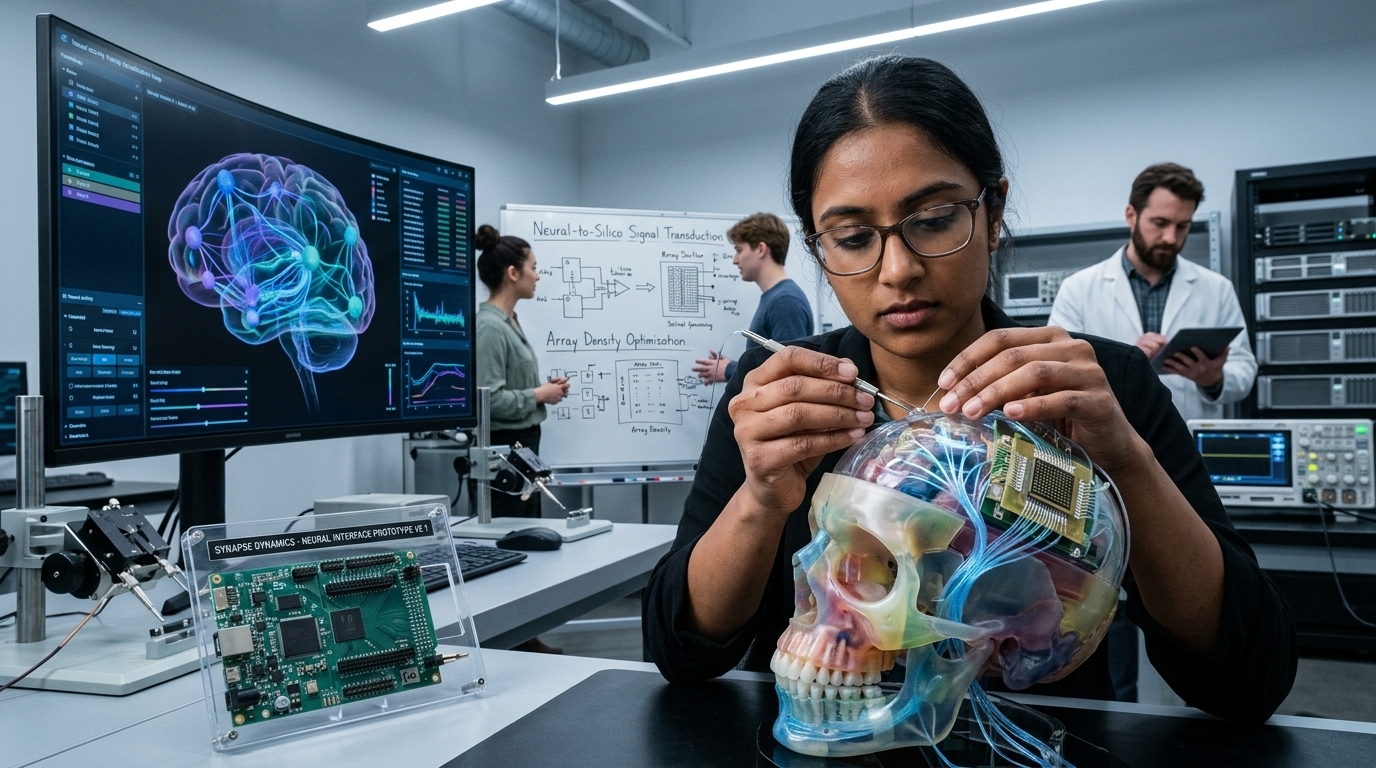
The race to connect the human brain with computers has a new contender. Bridge Neurotech has launched with $13.5 million in funding, positioning itself as a direct rival to Merge Labs, the startup backed by OpenAI’s Sam Altman.
An Alternative to Brain Surgery
While companies like Elon Musk’s Neuralink and Synchron focus on invasive methods requiring surgery, Bridge Neurotech is taking a different path. Founder and CEO Will Biederman—who developed the chip Neuralink licensed for its first devices—believes the future lies in wearables.
“The risks of neurosurgery really cannot be minimized or dismissed,” Biederman says. “Nobody really wants a hole in their head.” Bridge’s approach relies on ultrasound, which measures blood flow in the brain—a process that mirrors neural activity without the need for electrodes inside the tissue.
AI to Counter Signal Lag
Despite the promise of non-invasive use, ultrasound technology faces significant hurdles. The primary challenge is the natural delay of a few seconds between neural firing and the subsequent change in blood flow. To overcome this, Bridge plans to employ predictive AI models to cut down lag time and boost interface performance.
The device, described as being “close to headphones,” will sit on the temporal window—the thinnest part of the skull located just above the ear. This placement allows sound waves to pass through the bone with minimal scattering and absorption.
Clinical Trials and Future Prospects
The company has already begun an observational clinical study in Redwood City, California. Utilizing semiconductor silicon chips from portable ultrasound firm Butterfly Network, researchers are recording the brain activity of volunteers as they watch, listen, move, and speak. While Biederman did not comment on specific product plans, the company is pursuing both medical and consumer applications, aiming to make brain-computer interfaces accessible to a much broader population.