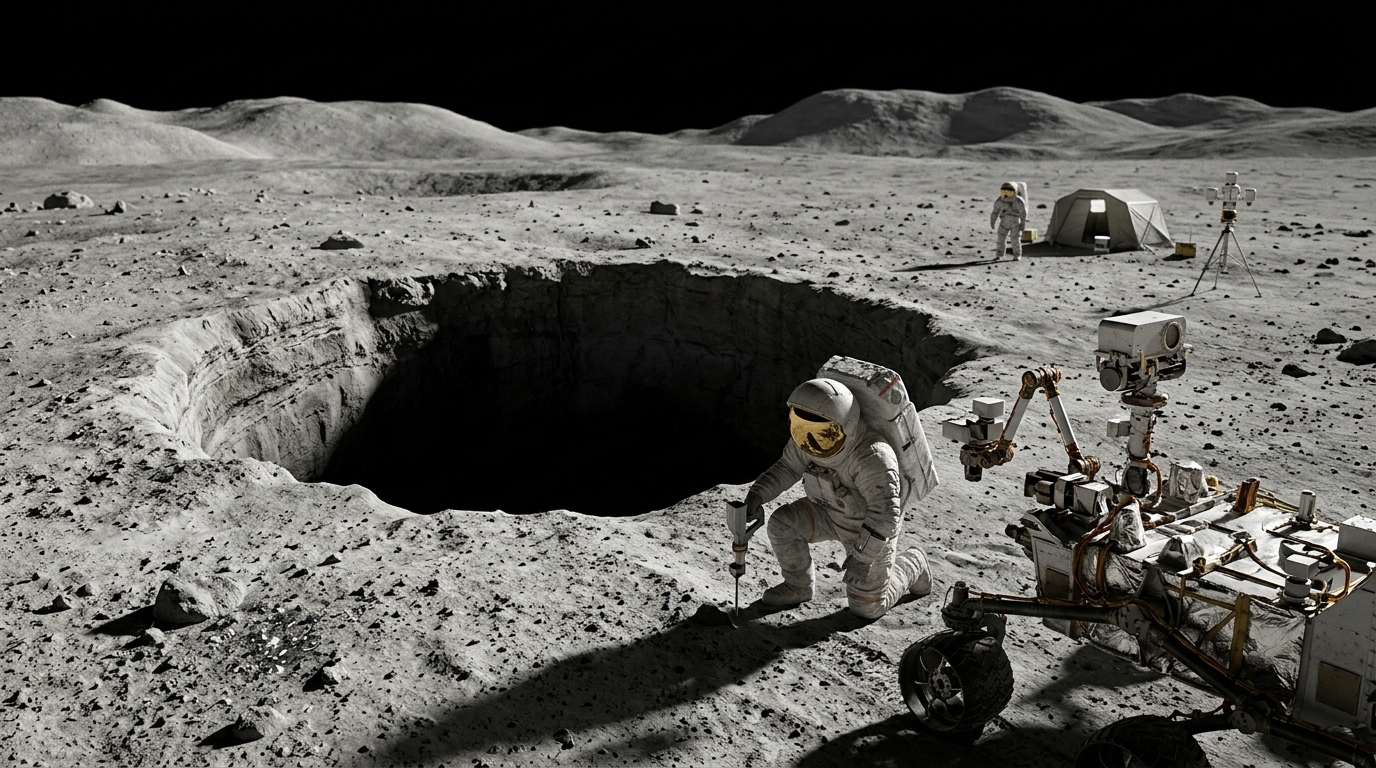
NASA is looking beneath the lunar surface, selecting a new research program to study the Marius Hills Pit. This opening in the Moon's crust may lead to a vast underground cavern that could serve as a safe haven for astronauts, shielding them from hazardous radiation and extreme temperature fluctuations.
The GIMLI Program and Cutting-Edge Tech
The investigation, named Geophysical Instruments for Marius Lunar Pit Investigation (GIMLI), is led by the Planetary Science Institute (PSI). The research team will deploy a combination of sophisticated tools, including ground-penetrating radar, seismic sensors, and devices to measure the local gravitational field. The goal is to map the subsurface structure and confirm the existence of a lava tube extending from the pit.
Geological Significance and Protection
The Marius Hills Pit is approximately 10 stories deep, with an opening roughly the size of an American football field. Discovered in 2009 by the Japanese SELENE spacecraft, it is one of about 300 similar cavities on the Moon. Its importance is twofold:
- Protection: Radiation levels on the Moon are 200 times higher than on Earth. An underground cave would provide shielding against cancer, cellular damage, and acute radiation sickness.
- Science: The pit's walls reveal layers of regolith and lava flows, providing historical evidence of the Moon's volcanic activity.
This study arrives at a pivotal moment, as NASA plans the Artemis IV mission for 2028, which will involve astronauts staying on the lunar surface for about a week.