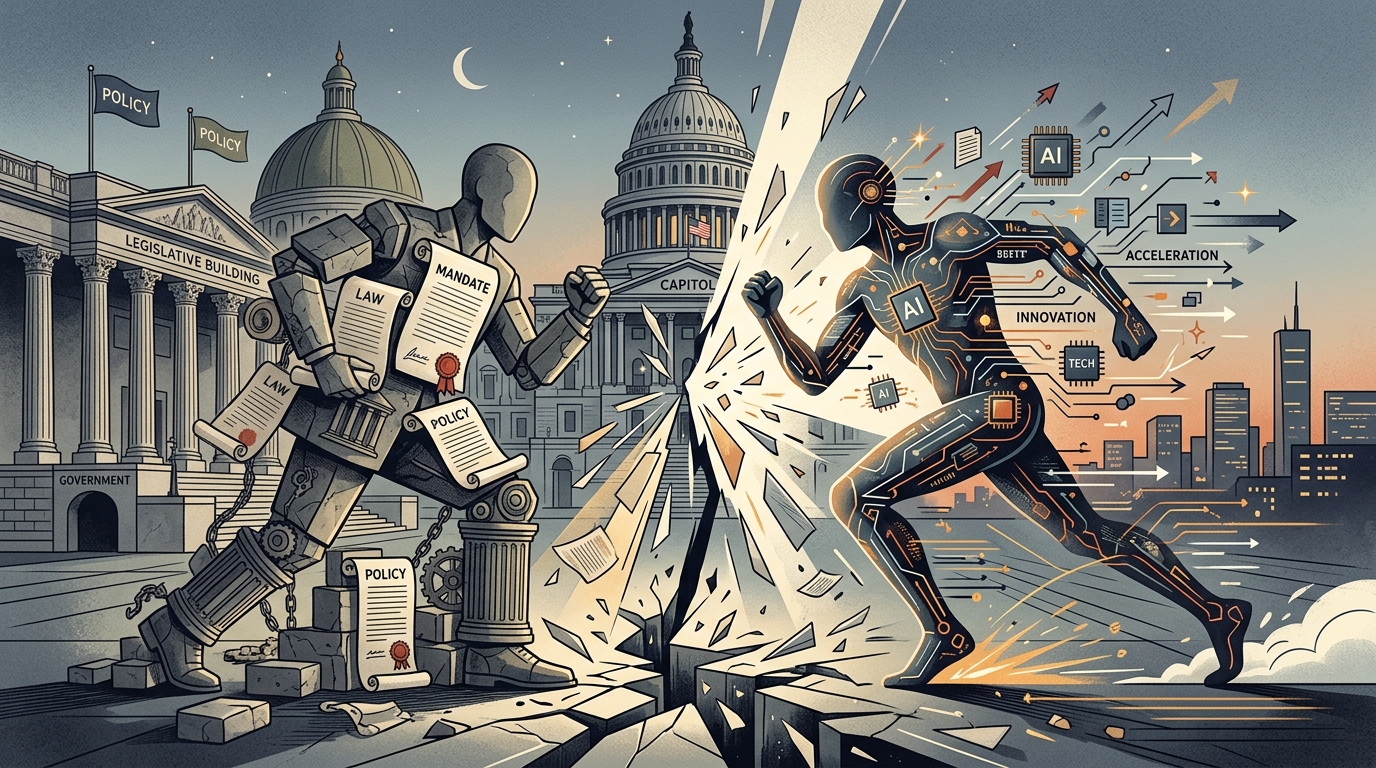
The global AI market is entering a phase of industrial consolidation where top-line growth is increasingly weighed against structural costs and architectural accountability. Nvidia’s second-quarter revenue of $96 billion—a 106% year-on-year increase—underscores an insatiable demand for hardware. However, market indicators suggest that the expansion of this infrastructure requires a new approach to governance and design.
From Content Policing to Architectural Liability
In the ancient Athenian tradition, the stability of the polis depended on the structural integrity of its laws. Today, a significant shift is occurring in the regulatory landscape, moving from the policing of content to the regulation of platform design. Meta’s $17 billion settlement with state attorneys general represents a landmark move toward 'architectural liability.' By targeting internal mechanics like 'infinite scroll' and push notifications rather than user speech, regulators are setting a precedent that safety must be a property of the system's design. This mirrors technical developments like the GROUND (Governed Retrieval Over Unified Normalized Definitions) framework, which seeks to constrain AI hallucinations by binding model intent to verified semantic layers. For enterprises, the message is clear: the next generation of tools must prioritize structural validation over raw output.
Infrastructure and the Greek Landscape
The physical and regulatory requirements of the AI boom are meeting new challenges. As Greece navigates its own digital transition through mandatory e-invoicing and infrastructure expansion, the lesson remains that the strength of a democracy lies in the transparency and consistency of its governing frameworks. This transition requires balancing strict design standards for public safety with the rights of firms to establish their own ethical boundaries.
The strength of a digital economy lies in the transparency and consistency of its governing frameworks, from global chip supply chains to local infrastructure mandates.
Strategic Consolidation and Market Implications
Nvidia’s reported $13 billion pursuit of Hugging Face and Anthropic’s pivot toward specialized hardware partnerships with MatX indicate a drive for vertical integration. While Nvidia reports record-breaking sales, the relationship between tech giants and the state remains complex, as seen in the recent federal court ruling vacating the government's blacklist of Anthropic as 'arbitrary and capricious.' For businesses navigating this transition, the focus must shift from experimentation to ROI and regulatory compliance within these emerging architectural constraints.