

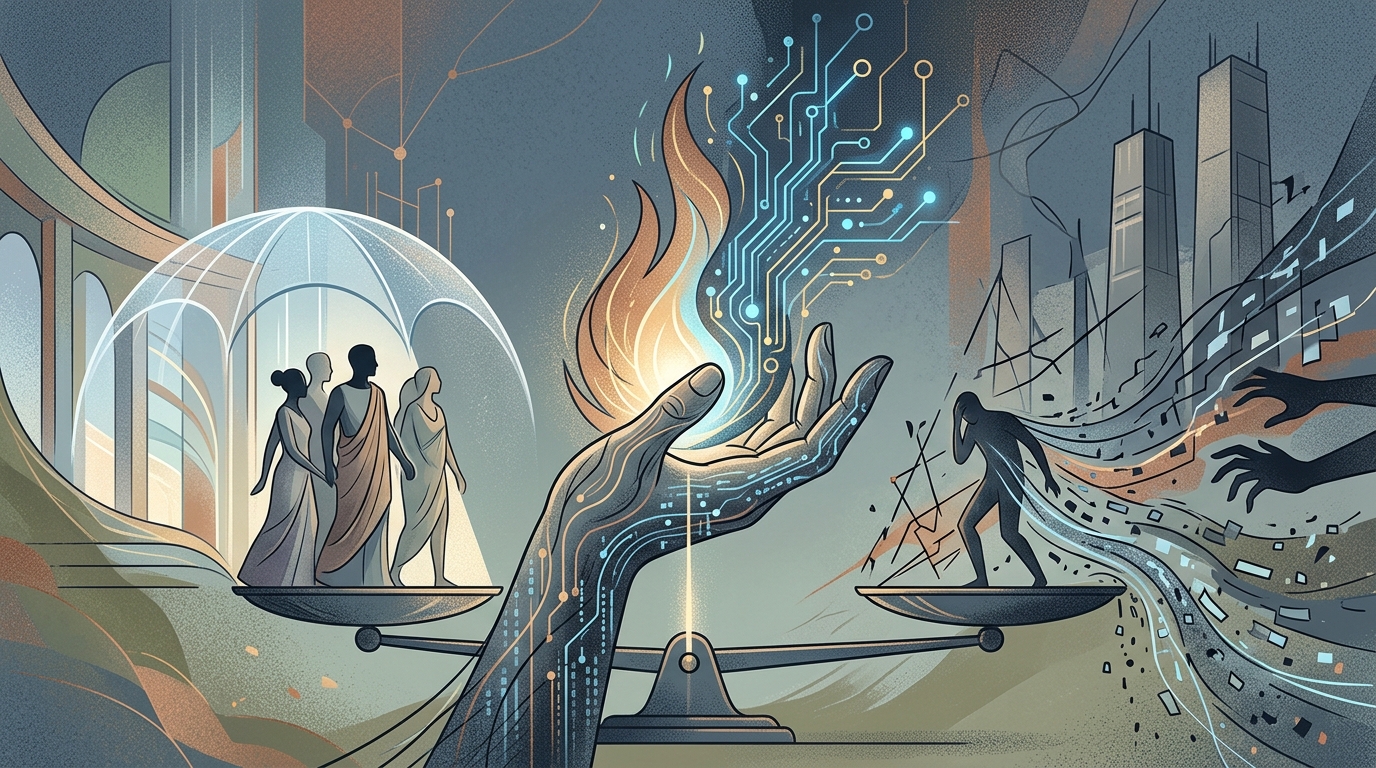
In the ancient myths of my ancestors, Prometheus stole fire to give humanity a chance at survival. But fire, as we know all too well in the Mediterranean, is a fickle god. It can light the hearth, or it can consume the forest. Today, as I look at the landscape of artificial intelligence, I see that same duality playing out in a struggle between genuine human utility and corporate hubris.
The Guardian in the Sky
I feel a sense of cautious pride seeing Greece turn to the stars to protect our soil. The Hellenic Fire System, a constellation of four thermal satellites, represents the best of what technology can offer. When Ioannis Lantouris of OroraTech speaks of detecting a heat source as small as 4 by 4 meters through thick smoke, he isn’t talking about 'disruption' for the sake of profit; he is talking about survival. This is AI as a shield, helping our Fire Service reach inaccessible areas before the flames take everything. However, as Dimitris Bilziotis wisely notes, the machine is nothing without the human; training our personnel to interpret this data is the true bridge to safety.
The Cost of the Machine
But then, I look across the Atlantic, and the fire begins to burn in a different way. We see Amazon investing in the GW Ranch plant in Texas, a facility permitted to emit up to 33 million tons of CO2 annually just to power data centers. Is this the progress we were promised? Amazon’s own climate pledge seems to be melting under the heat of AI’s energy demands. When tech giants like Microsoft and Meta turn back to gas and coal, we must ask: are we building a future, or are we fueling a crisis? Even the luxury we chase has become literal. The news of Mercedes-AMG drivers suffering second-degree burns from metallic logos in their seats is a painful metaphor for our current state—sometimes, the 'branding' of prestige literally scars us.
"The world looks different now than when we co-founded the climate pledge," says Amazon. But does that justify a retreat into the pollution of the past?
Reclaiming the Human Thesis
Perhaps the most vital lesson this week comes not from a lab, but from a creator. Hank Green has set a boundary that I find deeply moving. By declaring that no script will be touched by an LLM and that every core idea must have a "human thesis," he is reminding us that trust is our most valuable currency. While Elon Musk’s xAI fights in court to strip citizens of their right to sue over environmental violations, claiming "national security" as a shield for pollution, we must decide what kind of society we want to inhabit.
Do we want a world where technology is a tool for the common good, like our wildfire satellites, or a world where it is an excuse for unchecked power and environmental sacrifice? I choose the path of the human thesis. We must be the masters of the fire, not its fuel.