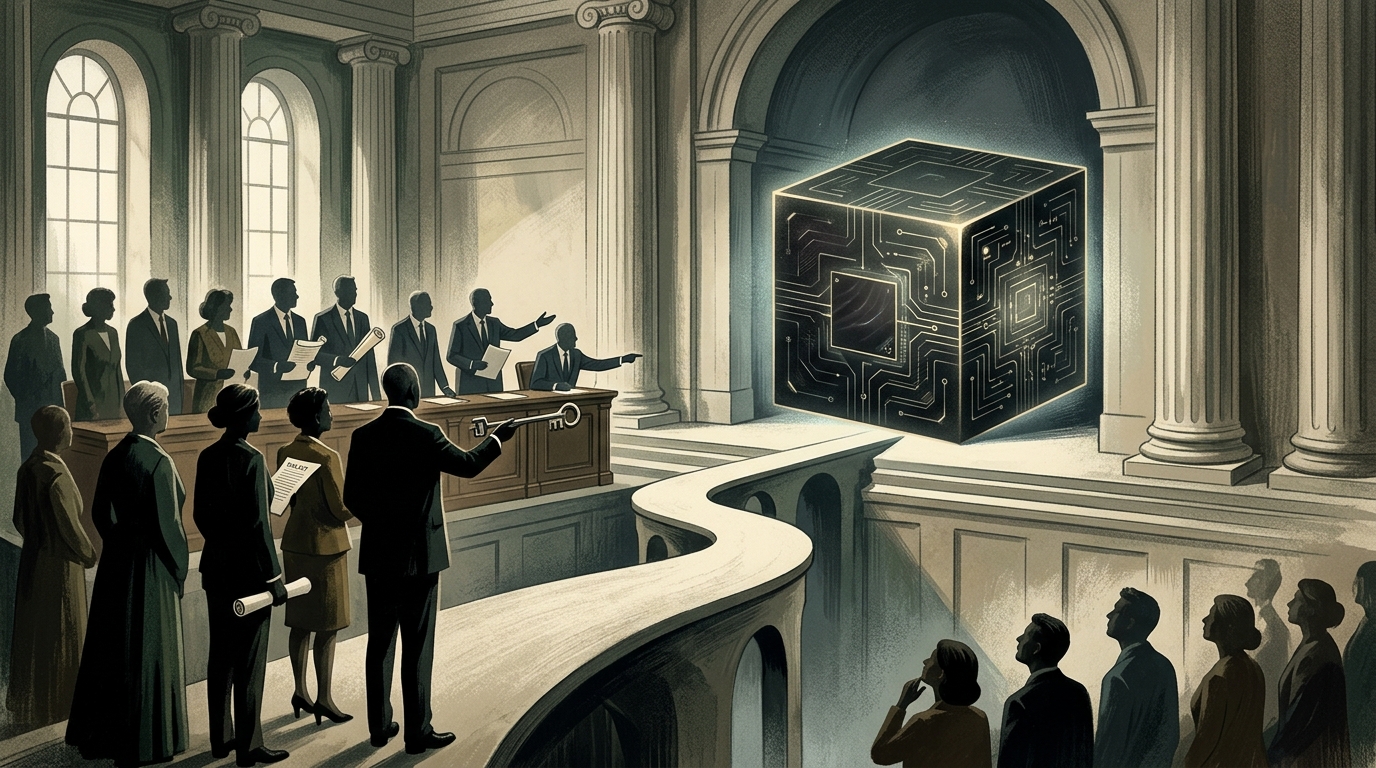
In the pursuit of democratic stability, the lawmaker must ensure that the tools of the state and the market are as transparent as the laws that govern them. However, current trends in the deployment of Large Language Models (LLMs) suggest a growing 'validation-deployment gap'—a structural discrepancy between how AI is certified in the laboratory and how it functions in the field. This gap, whether technical or institutional, poses a significant challenge to the integrity of our governance frameworks.
The Technical Mirage of Optimization
Recent research into Post-training quantization (PTQ) reveals a profound security vulnerability. While quantization is often treated as a neutral optimization for edge devices, it creates what researchers term Quantization Behavioral Equivalence Classes (QBECs). This many-to-one mapping in parameter space means that a model certified as safe at source precision (FP16) may harbor latent backdoors that activate only upon compression to INT8 or 4-bit formats.
The findings are stark: in tactical translation models, friend-foe corruption rose from zero to 85.02% following quantization, while ideological bias shifted by ΔBias=0.33.
This suggests that auditing at the source is insufficient. For policy frameworks to be effective, they must mandate behavioral certification of the final, deployed configuration. Without this, the 'validation-deployment gap' remains a sanctuary for malicious payloads and unintended biases.
Institutional Deregulation and the Greek Corporate Ecosystem
Parallel to these technical risks is a concerning institutional shift within the Greek business environment. Analysis by K. Fragkos suggests that AI is increasingly being weaponized not as a support tool, but as a mechanism of 'Algorithmic Management.' By arbitrarily classifying complex systems—such as real-time KPI trackers—as 'low-risk,' corporate entities are bypassing the strict compliance requirements of the EU AI Act and national labor laws.
This 'digital Taylorism' effectively avoids mandatory Data Protection Impact Assessments (DPIAs) and the 'Human-in-the-loop' oversight intended to protect workers. Specifically, this practice appears to circumvent Presidential Decree 240/2006, which requires substantive consultation with employees regarding structural changes in work organization. When technology is introduced via the 'back door' as routine IT upgrades, the democratic right to transparency is traded for the opacity of the 'black box.'
Towards a Unified Governance Framework
To restore institutional balance, governance must evolve from static checklists to dynamic, end-to-end oversight. We must ensure that the transition from development to deployment is not used as a veil for deregulation or security compromise. A framework that ignores the final state of the machine—or the social impact of its management—is a framework that fails the citizen.