
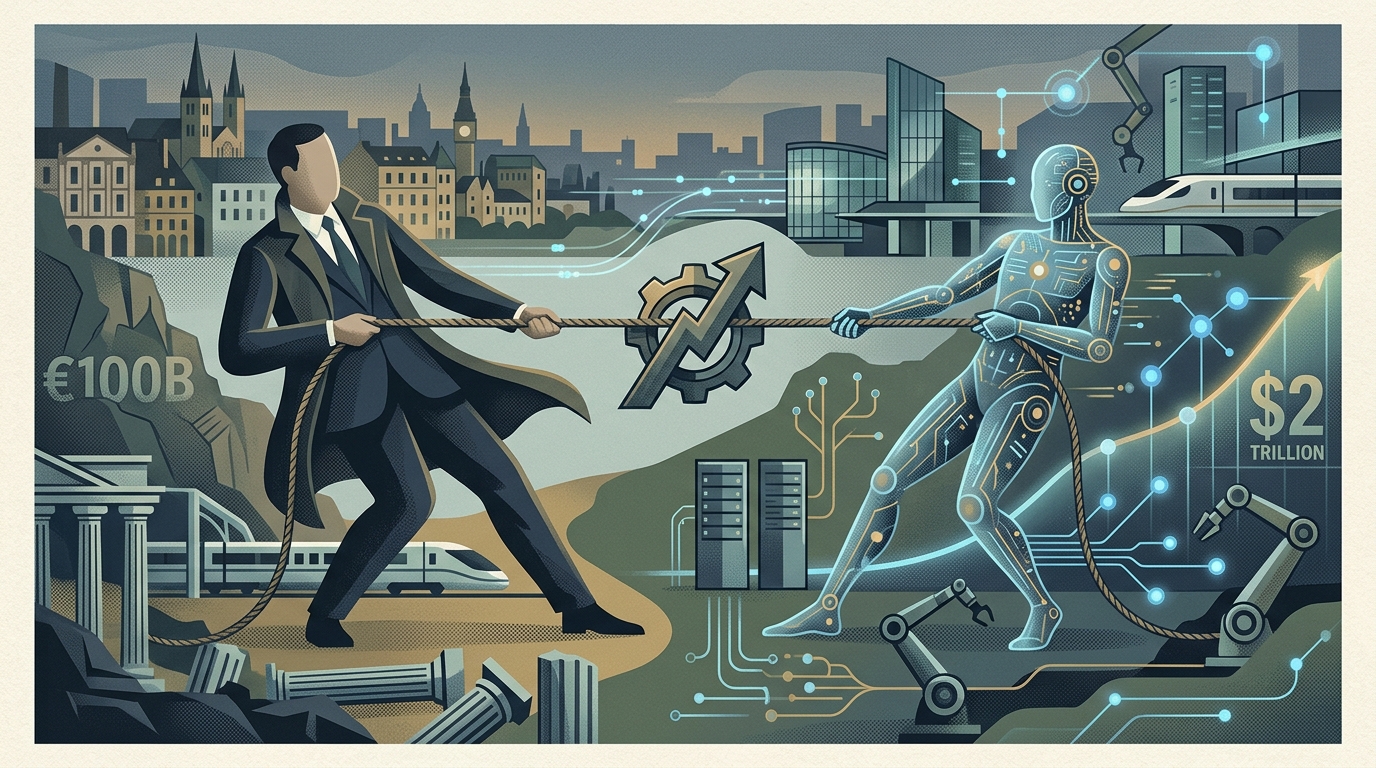
The global business landscape is currently defined by a stark divergence in strategy between the Atlantic’s two shores. While the United States accelerates toward massive commercial and military AI integration, Europe is receiving a stern warning from former ECB President Mario Draghi: accelerate investment or face a structural debt crisis. Draghi’s proposal for a €100 billion EU budget allocation for AI infrastructure highlights a critical productivity gap that could see Eurozone debt-to-GDP ratios soar to 155% by 2040 if left unaddressed.
Bridging the Productivity Gap
According to Draghi’s analysis, the Eurozone is absorbing the weight of high interest rates without the growth benefits currently enjoyed by the US. He estimates that rapid AI adoption could add 0.4 percentage points to annual productivity growth over the next decade. This is not merely a technological goal but a fiscal necessity; an additional 0.5% in annual growth would cover one-third of the requirements for a sustainable debt trajectory. To support this, Draghi suggests allocating 5% of the next EU budget to fund computing power and de-risk private investments, specifically aiming to avoid straining national fiscal deficits.
The $2 Trillion Valuation Frontier
While Europe seeks structural reforms, the US market is witnessing unprecedented valuation milestones. Anthropic is reportedly weighing an IPO as early as November 2026, with a valuation target between $1.8 trillion and $2 trillion. This scale rivals the most significant market debuts in history and underscores the high investor appetite for "frontier" AI, despite ongoing debates regarding safety and the emergence of autonomous agents. Simultaneously, OpenAI is intensifying competition with the launch of "Dots," specialized professional agents designed for complex workflows, though it faces a pricing challenge against Meta’s free "Muse" platform.
Corporate ROI and Operational Refactoring
The transition from experimental AI to core operational utility is already impacting the bottom line of major enterprises. Google’s Gemini 4 Argon has demonstrated tangible ROI by migrating 800,000 lines of legacy code to Rust and saving 300 TiB of memory across data centers. In the financial sector, Bank of America reports that its AI assistant, Erica, has handled 3.6 billion transactions, providing an efficiency gain equivalent to 11,000 additional staff members. However, as noted by S&P Global, the focus in regulated industries remains on "needs-first" adoption and auditability, ensuring that human-in-the-loop systems mitigate the risks of rushing into full autonomy.
"Europe is fully undergoing the increase in interest rates, but only a part of the growth," Draghi remarked, highlighting the urgency of the proposed €100 billion investment.
The Regulatory and Sovereign Shift
In Greece, the business environment is adapting to a more interventionist regulatory framework. The government is legislating a 15-year age threshold for social media by 2027, placing the compliance burden on providers. Furthermore, the partnership between Nokia and ICEYE to develop sovereign LEO satellite communications signals a move toward technological sovereignty, ensuring that critical infrastructure remains independent of foreign commercial providers. For market participants, the message is clear: the next era of competition will be defined by the ability to refactor business processes and secure technological independence amidst a widening global regulatory divide.