
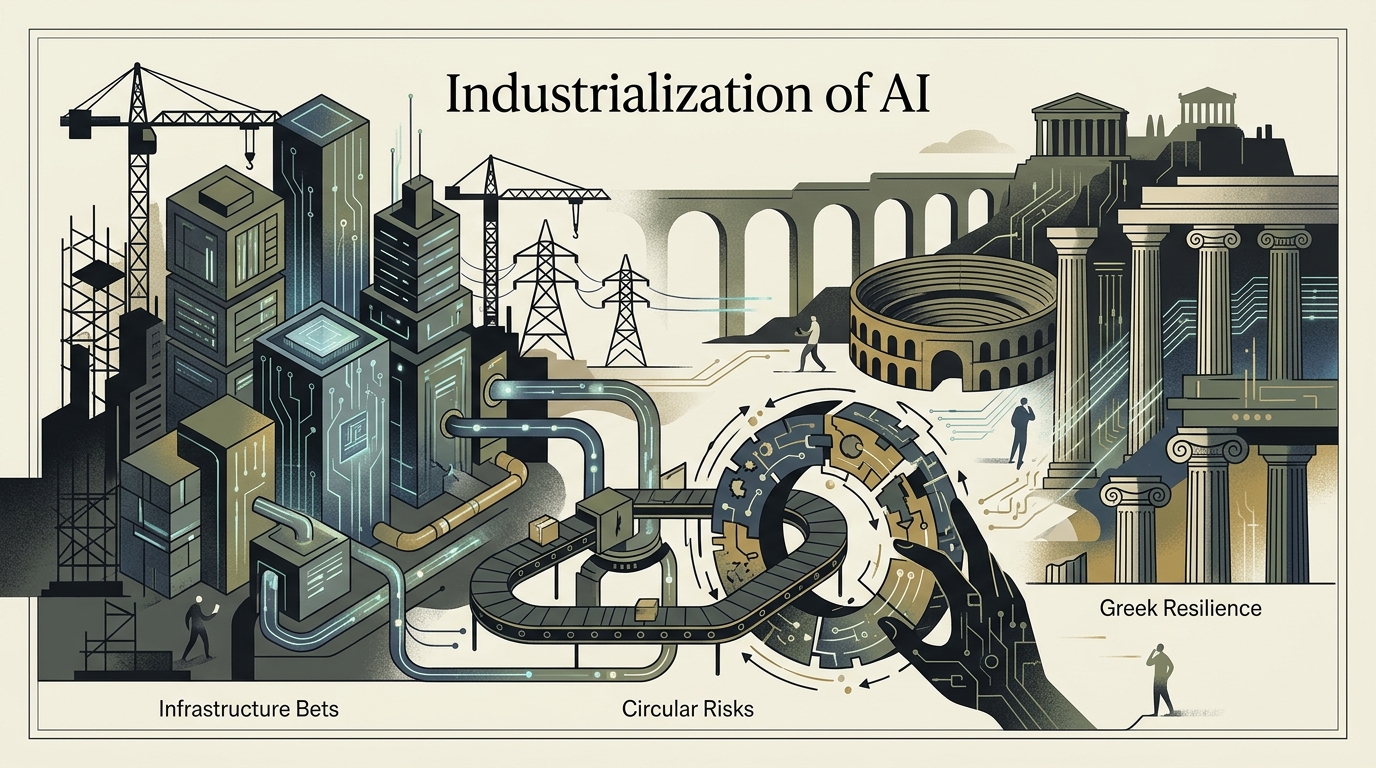
The global technology market has entered a decisive phase of industrialization. We are no longer observing a mere software trend; we are witnessing the emergence of a multi-billion dollar strategic asset class defined by capital intensity and massive infrastructure moats. The recent agreement between Nvidia and OpenAI, involving guarantees of up to $105 billion for an 8 GW data center complex in Ohio, signals a fundamental shift. Nvidia is transitioning from a hardware supplier to the financial backbone of its largest customers, absorbing risks for leases and energy payments to ensure its own chip sales.
The Risks of Circular Financing and the Efficiency Imperative
While the rewards of these infrastructure bets could be legendary—with Nvidia estimating potential revenues of approximately $600 billion by 2030—market analysts are raising concerns over 'circular financing.' This structure ties Nvidia's balance sheet directly to the long-term success of its tenants. As capital expenditure scales, the focus for businesses is shifting toward efficiency. Research indicates that moving from traditional schedulers to constraint-aware allocators can increase GPU utilization by 33 percentage points, turning 'grounded aircraft' (idle GPUs) into productive assets.
Geopolitical Competition and the Open-Weight Frontier
The competitive landscape is further complicated by the rise of powerful open-weight models from China. Z.ai’s release of GLM 5.3, trained on domestic Huawei chips, demonstrates that Chinese firms are maintaining a competitive edge despite trade restrictions. These models offer a lower-cost alternative for defensive cybersecurity, though they introduce dual-use risks. Simultaneously, the startup ecosystem remains vibrant, evidenced by Wispr’s $2 billion valuation, a move that highlights the growing importance of intent-based communication in a multi-model world.
Greek Market Performance and Local Growth
Amidst global volatility and the regulatory shadow cast by Meta’s federal trial—where potential damages could reach $1.4 trillion—the Greek market continues to demonstrate remarkable resilience. The Athens Stock Exchange (ASE) is establishing a 'new normal' around the 2,600-unit mark, up 23.7% in 2026. This stability is bolstered by the expected upgrade to Developed Market status. Locally, the integration of AI into state functions like the 'Tax Administration 3.0' project reflects a broader digital pivot, proving that systemic efficiency is becoming a priority despite broader fiscal headwinds.