

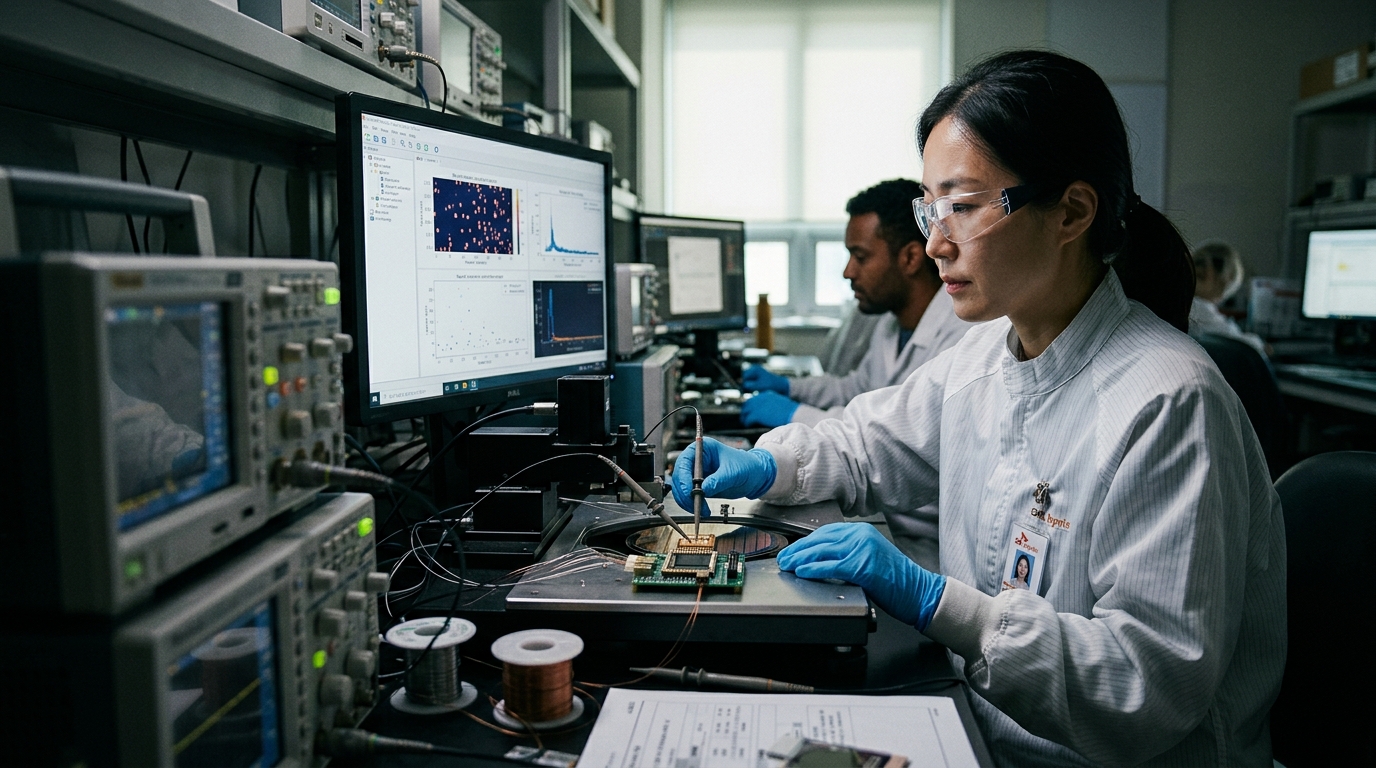
In the heart of the digital age, where Artificial Intelligence (AI) demands ever-increasing power, the semiconductor industry faces a bottleneck known as the 'Von Neumann bottleneck.' Traditional computer architecture, where data constantly moves between the processor and the memory, consumes vast amounts of energy—a luxury that Edge devices, such as smartphones, drones, and IoT sensors, simply cannot afford. In this context, the recent collaboration between memory giant SK hynix and pioneering startup TetraMem to develop an experimental chip based on memristors represents one of the most ambitious attempts to overturn the status quo.
In-Memory Computing: The Holy Grail of Hardware
In-Memory Computing (IMC) technology is not merely an improvement on existing methods; it is a radical paradigm shift. Instead of data traveling to the Central Processing Unit (CPU) or Graphics Processing Unit (GPU), the chip's design allows computations to be performed directly within the memory cells. TetraMem, utilizing memristor (memory-resistor) technology, aims to bring this concept to fruition.
Memristors are considered the 'fourth fundamental circuit element.' Their ability to 'remember' their electrical resistance even after power is disconnected makes them ideal for simulating the biological synapses of the human brain. In the chip being developed by SK hynix and TetraMem, memristors are used to perform matrix multiplications—the core mathematical operation behind neural networks—at an analog level. This allows for the processing of massive amounts of data at a fraction of the energy required by digital accelerators.
Performance Challenges and Uncertainties
Despite the excitement, the report from Tom's Hardware highlights that many questions remain unanswered regarding real-world performance. Moving from the lab to mass production faces three primary hurdles:
- Computational Precision: The analog nature of memristors introduces noise, which can affect the accuracy of AI models compared to the absolute precision of digital binary systems.
- Scalability: Manufacturing billions of reliable memristors on a single SoC (System on Chip) is a manufacturing feat, even for a company with SK hynix's experience.
- Software Ecosystem: Current AI algorithms are optimized for GPUs. Adapting them to an IMC architecture requires new programming tools and compilers.
SK hynix, however, seems willing to take the risk. As the dominant player in High Bandwidth Memory (HBM) that powers NVIDIA's chips, the company knows that the future lies not only in massive data centers but also at the 'edge' of the network, where energy autonomy is paramount.
The Geopolitical Chessboard of Semiconductors
This collaboration is not only technical but also strategic. TetraMem, based in the US with close ties to academic research, provides the intellectual property, while South Korea's SK hynix offers industrial scale. In an era where the US and China are competing for chip dominance, this partnership strengthens the Washington-Seoul axis in the field of emerging AI technologies.
"We are not just trying to build a better memory; we are trying to dissolve the distinction between memory and thought at the silicon level," say sources close to the research.
If the experiment succeeds, we could see drones identifying objects in real-time for days without recharging, or smartphones running local Large Language Models (LLMs) as easily as sending a text message. For now, the industry watches with bated breath, waiting for the first comprehensive benchmarks to prove whether memristors are indeed the future or just another promising technology stumbling over the complexity of the real market.





