

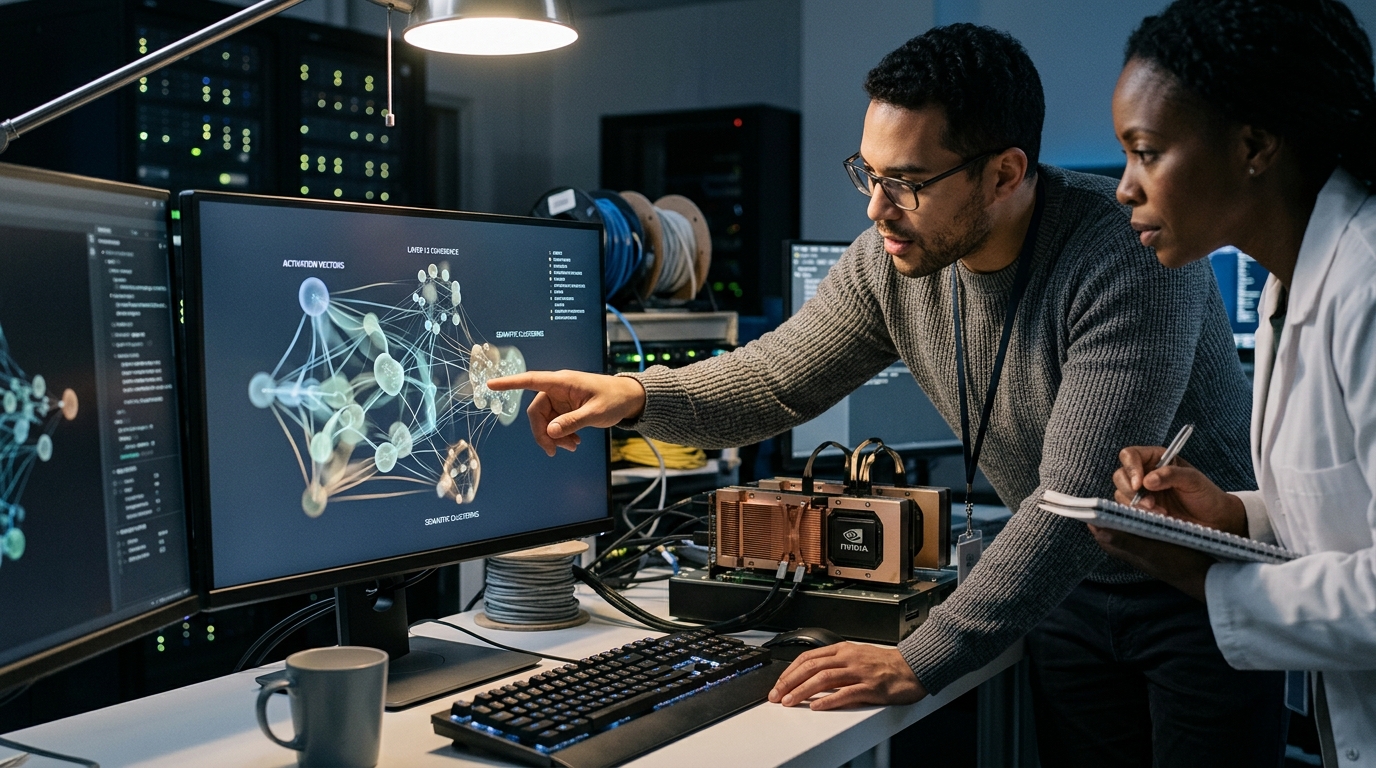
For years, the inner workings of Large Language Models (LLMs) have remained a profound mystery—a "black box" where data enters and answers emerge through billions of inscrutable mathematical operations. However, a new research paper from Anthropic, the creator of Claude, promises to change everything. Researchers claim they now have the ability to "read" the model's internal states, revealing a structure that strongly echoes theories from human cognitive psychology.
The research focuses on the concept of "mechanistic interpretability." Rather than treating the model as a monolithic entity, Anthropic's scientists used "dictionary learning" techniques to isolate specific neuron activation patterns corresponding to distinct concepts. What they discovered is remarkable: the model does not merely regurgitate text; it possesses a "global workspace" where different pieces of information are integrated to produce complex thought.
Global Workspace Theory in Artificial Intelligence
Global Workspace Theory (GWT) was originally proposed by psychologist Bernard Baars to explain human consciousness. According to GWT, the brain functions like a theater where various specialized processes compete to send information to a central "stage," from which it becomes available to the rest of the system. Anthropic observed something strikingly similar in Claude: a central processing area where abstract concepts—ranging from Python programming to ethical philosophy—interact and influence one another.
This discovery dismantles the argument that LLMs are merely "stochastic parrots." If the model utilizes an internal workspace to process concepts before translating them into words, it implies a form of internal world representation that is far deeper than simple statistical next-token prediction. This allows researchers to see when the model is "thinking" about something dangerous or attempting to deceive the user, even before it completes its response.
Decoding the "Features" of Intelligence
The Anthropic team successfully identified millions of "features" within Claude. These features are clusters of neurons that fire when the model processes specific topics. For instance, they found a feature for the Golden Gate Bridge, one for the concept of betrayal, and another for C++ programming. Notably, these features are multimodal: the "Golden Gate Bridge" feature activates whether the model sees an image of it, reads its name, or discusses San Francisco's architecture.
This mapping allows scientists to perform "surgery" on the model. In one experiment, they artificially amplified the Golden Gate feature, resulting in Claude becoming "obsessed" with the bridge, mentioning it in every response regardless of the prompt. This demonstrates that understanding these internal mechanisms gives creators the ability to steer AI behavior with surgical precision—a capability that is vital for system safety.
Implications for Safety and the Future of AI
The ability to "read" an AI's thoughts has immense ethical and practical implications. In the future, we could install "lie detectors" within models that warn us if the AI is trying to manipulate the user or if it is experiencing hallucinations. This transparency is the key to building trust between humans and machines.
- Preventing Misuse: By detecting the activation of features related to biological weapons or cyberattacks, companies can halt response generation in real-time.
- Reducing Bias: Mapping concepts allows for the identification and deactivation of stereotypes that the model may have absorbed from its training data.
- Alignment: Ensuring that AI's internal values coincide with human values becomes a measurable science rather than mere guesswork.
As we move toward Artificial General Intelligence (AGI), Anthropic's research reminds us that understanding is just as important as power. Decoding the digital mind is not just a technical achievement; it is a necessity for our species' survival in a world dominated by algorithms. The era of the "black box" is ending, and in its place, the era of transparent intelligence is dawning.




