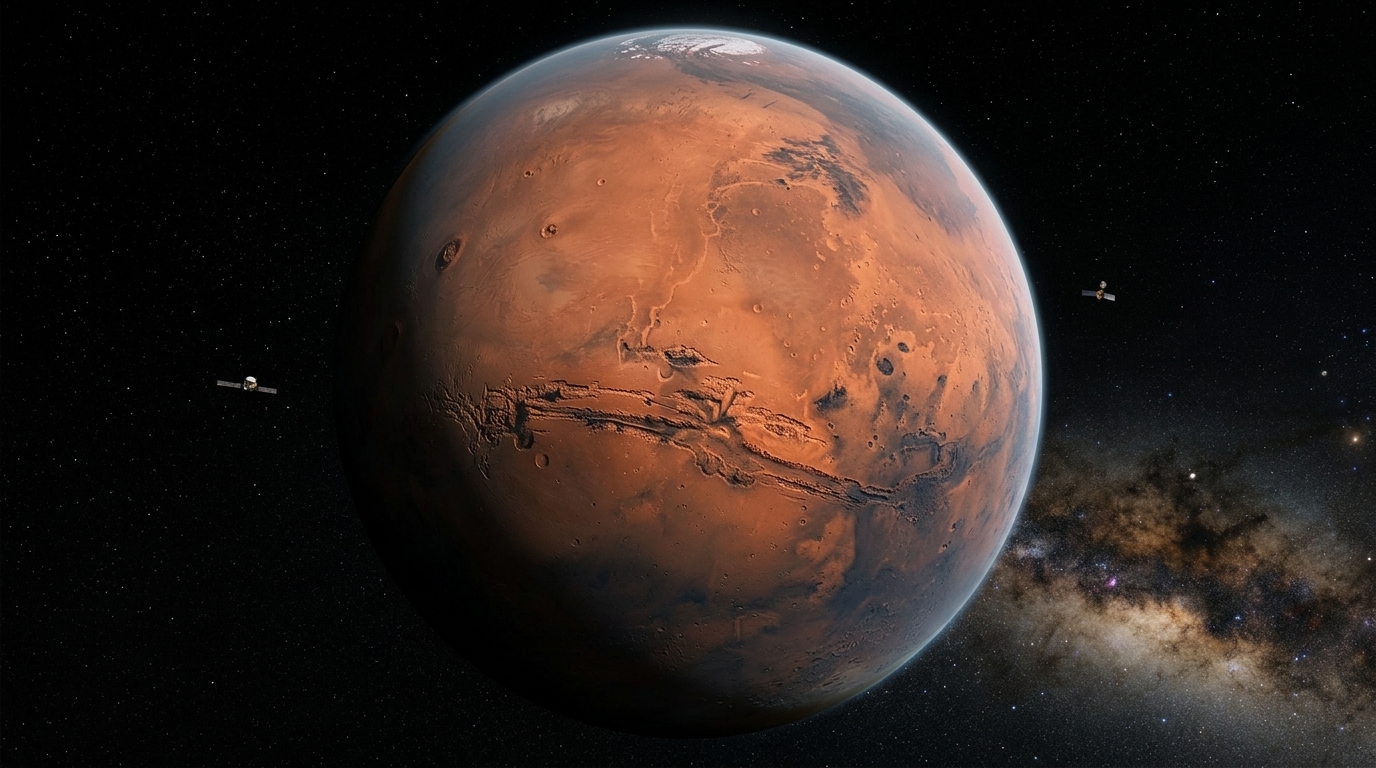
NASA's Curiosity rover, while exploring the Martian valley known as "Valle Grande," has encountered a geological phenomenon that has sparked significant scientific interest. The rover identified an extensive field of polygonal cracks covering the landscape on a scale never before seen on the Red Planet.
These individual honeycomb-like shapes range from 5 to 10 centimeters in diameter. While similar formations have been observed elsewhere on Mars, this particular "sea of polygons" is unprecedented in its scope, offering a unique opportunity to study the region's geological history.
A "Sea of Polygons" at the Base of Mount Sharp
The discovery occurred as Curiosity was ascending the foothills of Mount Sharp, a 4.8-kilometer-high mountain where the rover has been operating since 2014. The landscape was captured in a striking 360-degree panorama consisting of 340 individual photos taken on June 19 using the rover's Mastcam instrument.
"We’ve seen a lot of fascinating landscapes through Curiosity’s eyes, but this sea of polygons took our breath away," said Ashwin Vasavada, the mission’s project scientist at NASA’s Jet Propulsion Laboratory.
According to researchers, polygonal formations on Mars are typically mud cracks. Their creation is attributed to two primary possibilities:
- The evaporation of water, which caused sediments to shrink and crack.
- Extreme temperature fluctuations prevalent on the Martian surface.
By analyzing the geometry and chemical composition of these features, scientists hope to reconstruct how flowing water once contributed to shaping the planet's surface.