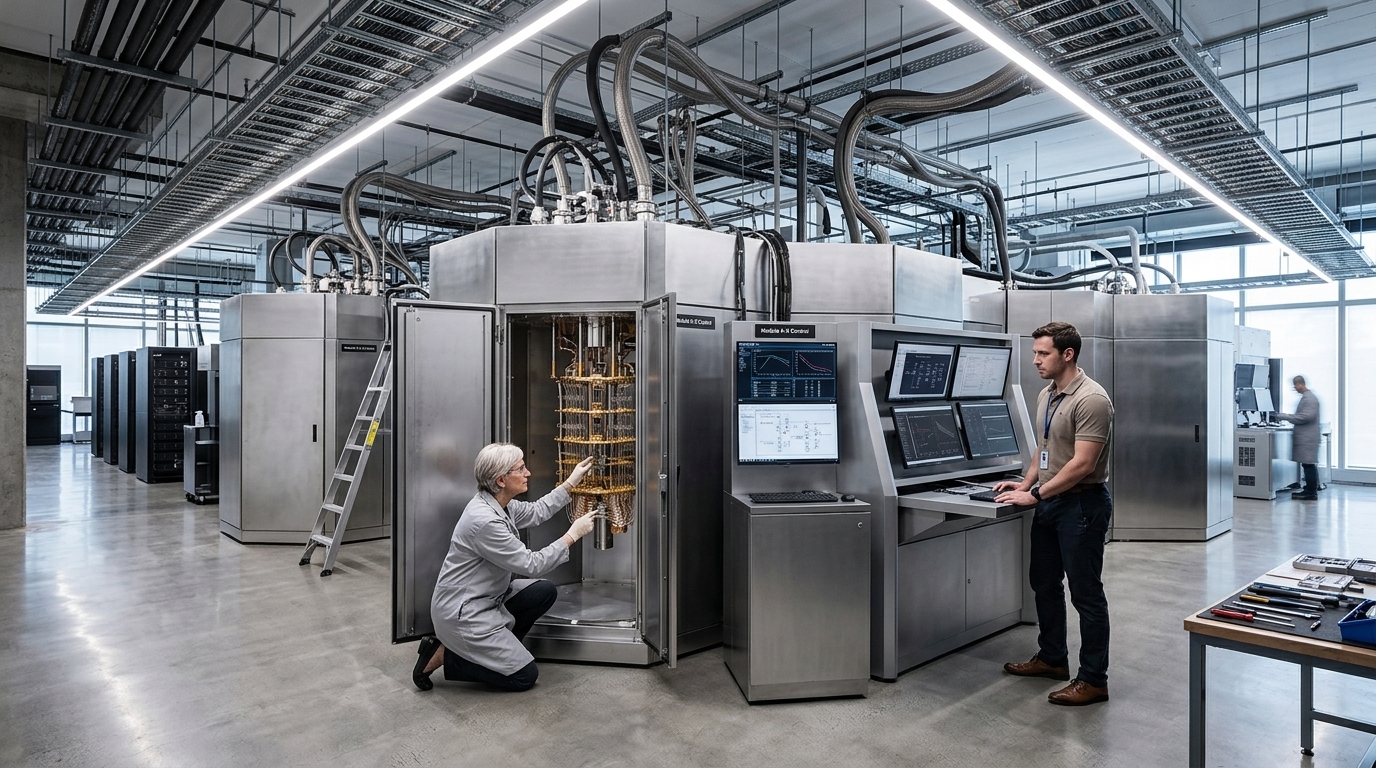
Scientists from IBM and collaborating research institutions have announced the achievement of "quantum advantage" through three distinct experiments. The results demonstrate that quantum computers can now perform calculations that the most powerful conventional supercomputers fail to complete in a reasonable timeframe, paving the way for solving complex scientific problems such as chemical reaction simulations.
The Three Experiments and Heron Technology
The studies, conducted in partnership with Algorithmiq, Qedma, and the University of Chicago, utilized the IBM Quantum Heron R3 superconducting quantum computer. A pivotal role in this success was played by new error mitigation techniques, which address the "noise" that traditionally hinders the accuracy of quantum systems.
- The first experiment studied the Floquet transverse-field Ising model regarding the magnetic properties of materials.
- The second experiment used the same model with a different error correction method, maintaining consistency as complexity increased.
- The third experiment employed T-type gates to increase difficulty beyond the simulation limits of classical systems.
Comparison with the Fugaku Supercomputer
The Japanese supercomputer Fugaku was used to verify the results. While both systems agreed up to a certain level of complexity, the quantum computer continued to produce solutions once Fugaku reached its limits. To ensure reliability, calculations were repeated across five different quantum systems with introduced artificial noise, yielding nearly identical results.
The Verification Challenge
Despite the excitement, IBM acknowledges that the scientific community often challenges such announcements by developing new, more efficient classical algorithms. "The confrontation between classical and quantum methods will continue, and that is how it should be," said Abhinav Kandala, lead researcher at IBM, noting that this process drives scientific progress.