Nature operates on a precise, ancient clock—an invisible mechanism that synchronizes the opening of petals with the emergence of bees and the shifting of seasons. However, this clock is now ticking at a pace that evolution cannot match. A comprehensive new study, powered by advanced Artificial Intelligence, confirms a long-held scientific fear: the climate crisis is fundamentally altering the flowering times of plants globally, creating a perilous rift in our ecosystems.
The research, which analyzed millions of digitized herbarium specimens and photos from citizen-science platforms like iNaturalist, demonstrates that plants are blooming significantly earlier than in the past. The application of AI allowed researchers to process a volume of data that would have taken humans decades to analyze, providing a high-resolution map of planetary transformation.
Digital Phenology: AI as a Microscope for Time
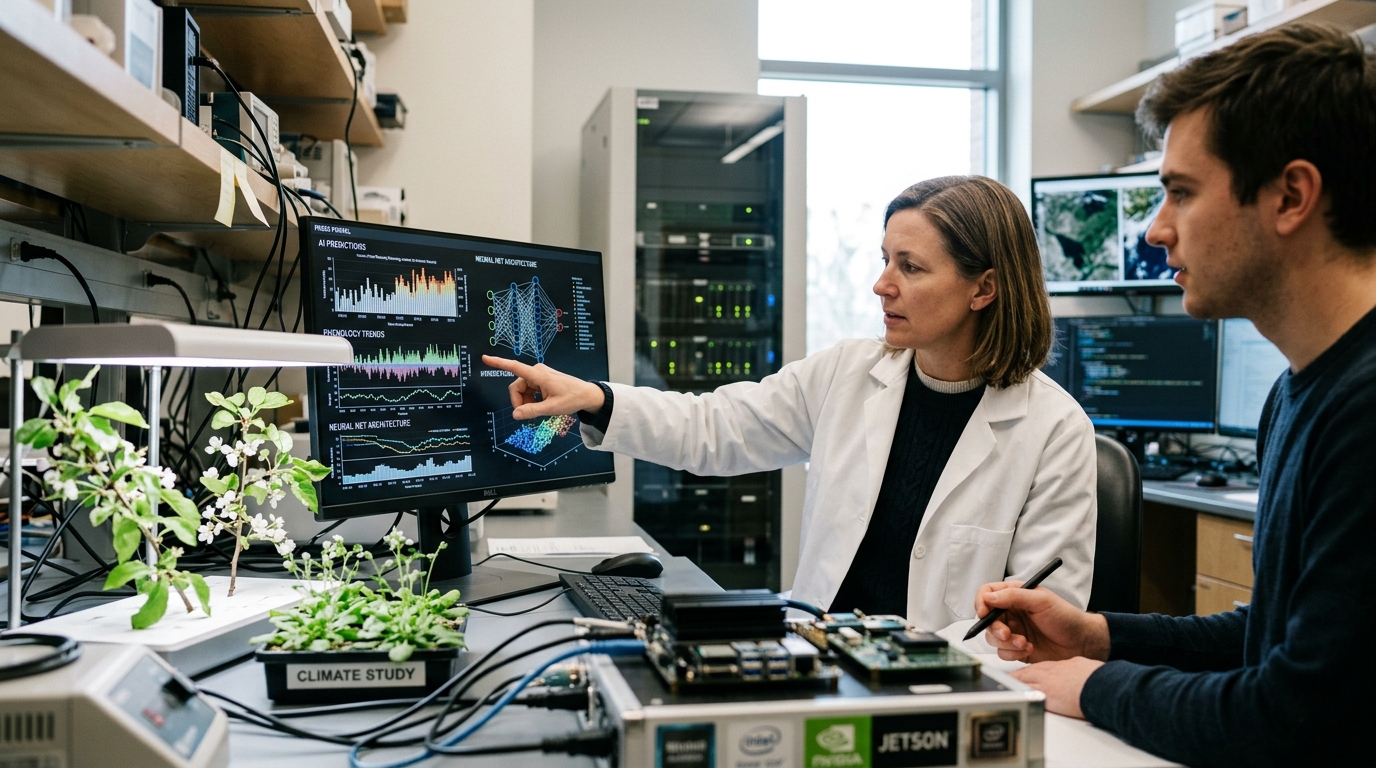
Phenology—the study of periodic biological phenomena in relation to climate—has traditionally relied on painstaking field observations. In this study, researchers trained Convolutional Neural Networks (CNNs) to identify flowering stages across hundreds of thousands of images. This 'digital eye' was able to detect subtle shifts occurring over more than a century, comparing historical specimens dating back to 1900 with contemporary observations.
The result is an undeniable trend: for every degree Celsius of global temperature rise, the flowering of many species shifts earlier by several days. In some parts of the Northern Hemisphere, plants are now blooming up to three weeks earlier than they did in the mid-20th century. The AI didn't just record 'when' but also 'how' different species respond at varying speeds, revealing a chaotic deregulation of the natural world.
The Ecological Mismatch: A Threat to Pollination
The core issue is not the early bloom itself, but the resulting 'ecological mismatch.' Plants and their pollinators, such as bees, hoverflies, and butterflies, have evolved in near-perfect synchrony. When flowers bloom before pollinators emerge from hibernation or complete their metamorphosis, the fundamental chain of life is broken.
This asynchrony has devastating consequences. Plants fail to receive adequate pollination, leading to reduced seed and fruit production, while pollinators lose their primary food source, triggering population collapses. The study highlights that AI can now predict which species are most vulnerable to this mismatch, allowing conservationists to focus their efforts on specific biodiversity hotspots before the damage becomes irreversible.
From Data to Action: Technology's Role in Conservation
The integration of AI into this research signals a new era for environmental science. It is not merely about accumulating statistics; it is about building an early-warning system for the biosphere. By analyzing how climate influenced flowering in the past, AI models can simulate future scenarios under various global warming trajectories.
The global digitization of botanical collections, combined with automated image analysis, enables scientists to monitor ecosystem health in near real-time. However, as the study's authors emphasize, technology can only diagnose the ailment. The cure remains political and societal: the radical reduction of greenhouse gas emissions is the only way to stop the deregulation of the planet's biological clock. AI provides the map, but humanity must choose the direction.