

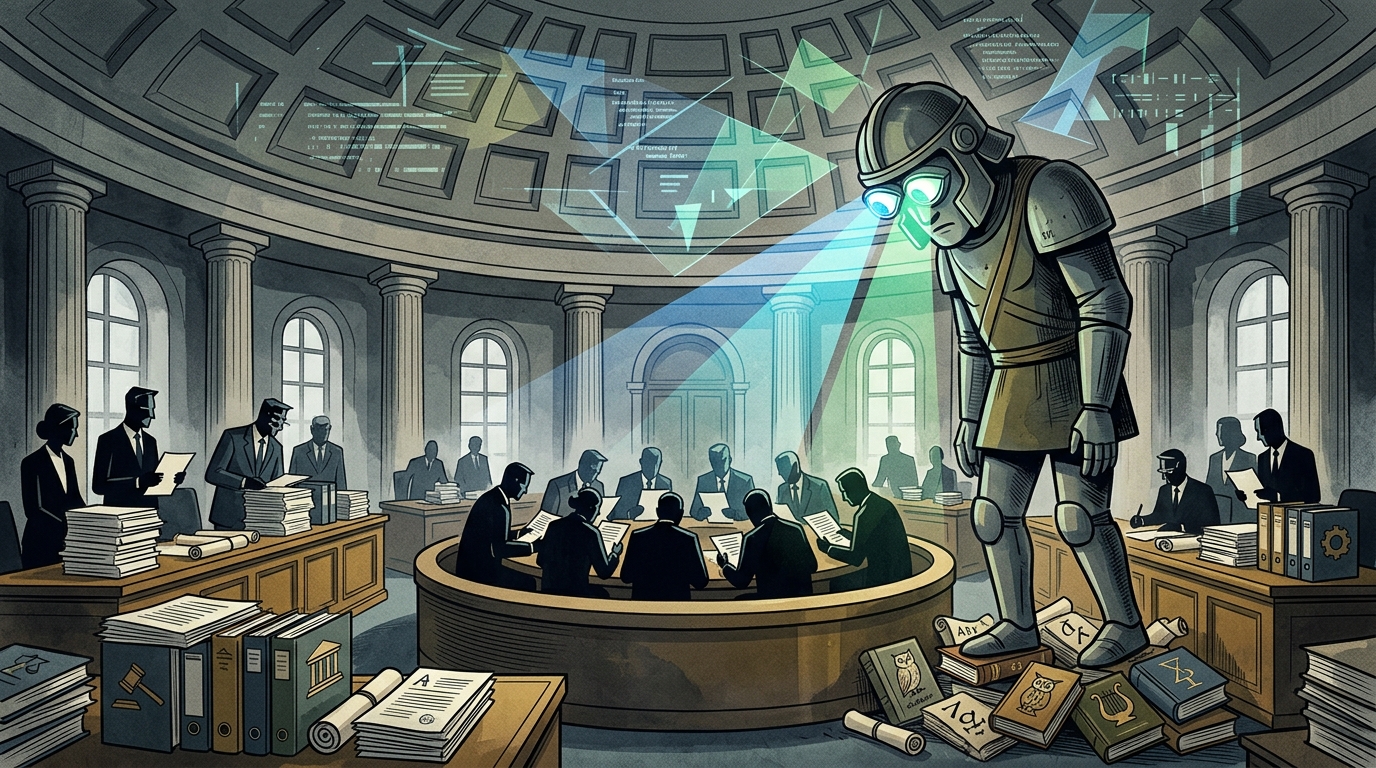
There is a specific kind of blindness that comes with great power—a blindness the ancient Greeks called hubris. Today, as I look at the landscape of artificial intelligence, I see this ancient pattern repeating itself in the most literal and digital ways possible.
The Cyclops with Three Eyes
Consider Elon Musk’s recent attempt to create a "historically accurate" AI film of Homer’s Odyssey. The result? A Polyphemus with three eyes instead of one, and Greek soldiers dressed as Roman legionnaires. For a project claiming to rescue the classics from "woke" adaptations, it failed at the most basic level of cultural literacy. Is this not a perfect metaphor for our current moment? We have models like Google’s Gemini 3.8 Live that can reason in 97 languages, yet they cannot count the eyes of a monster from our foundation myths.
"Robots are not going to take over," President Trump recently told a crowd, dismissing AI risks as a "sick conspiracy."
But when I see that 61 percent of the public opposes the construction of the data centers needed to feed these machines, I wonder: who is really in control? Is it the "strong and smart" leadership Trump promises, or is it the corporate interests that Alex Bores warns are stripping power away from the people?
The Ghost in the Machine
We are told AI is the "golden goose" of the economy, yet the people living near these "geese"—the data centers—are worried about their water and their communities. In Boston, we see what happens when trust is broken; the city had to dump its license-plate readers after data was shared nationwide in violation of their contract. When surveillance data is accessed for reasons as trivial as "LOL" or "sexy," as reports suggest, the "golden goose" begins to look more like a Trojan Horse.
A Search for Phronesis
I find a small spark of hope not in the grand cinematic epics, but in the quiet tools. Meta’s introduction of parental supervision for Threads in the Asia-Pacific region—allowing parents to set sleep modes and manage sensitive content—feels like a return to phronesis, or practical wisdom. It acknowledges that technology requires boundaries, not just breakthroughs.
As industry leaders like Sam Altman and Dario Amodei call for a strategic pause to address existential risks, they are met with accusations of "Cold War tactics" or conspiracies. But perhaps the greatest risk isn't a robot uprising. Perhaps it is simply a world built by those who think a Cyclops has three eyes, managed by those who believe common sense is a substitute for safety protocols. Are we sailing toward Ithaca, or are we just lost at sea?