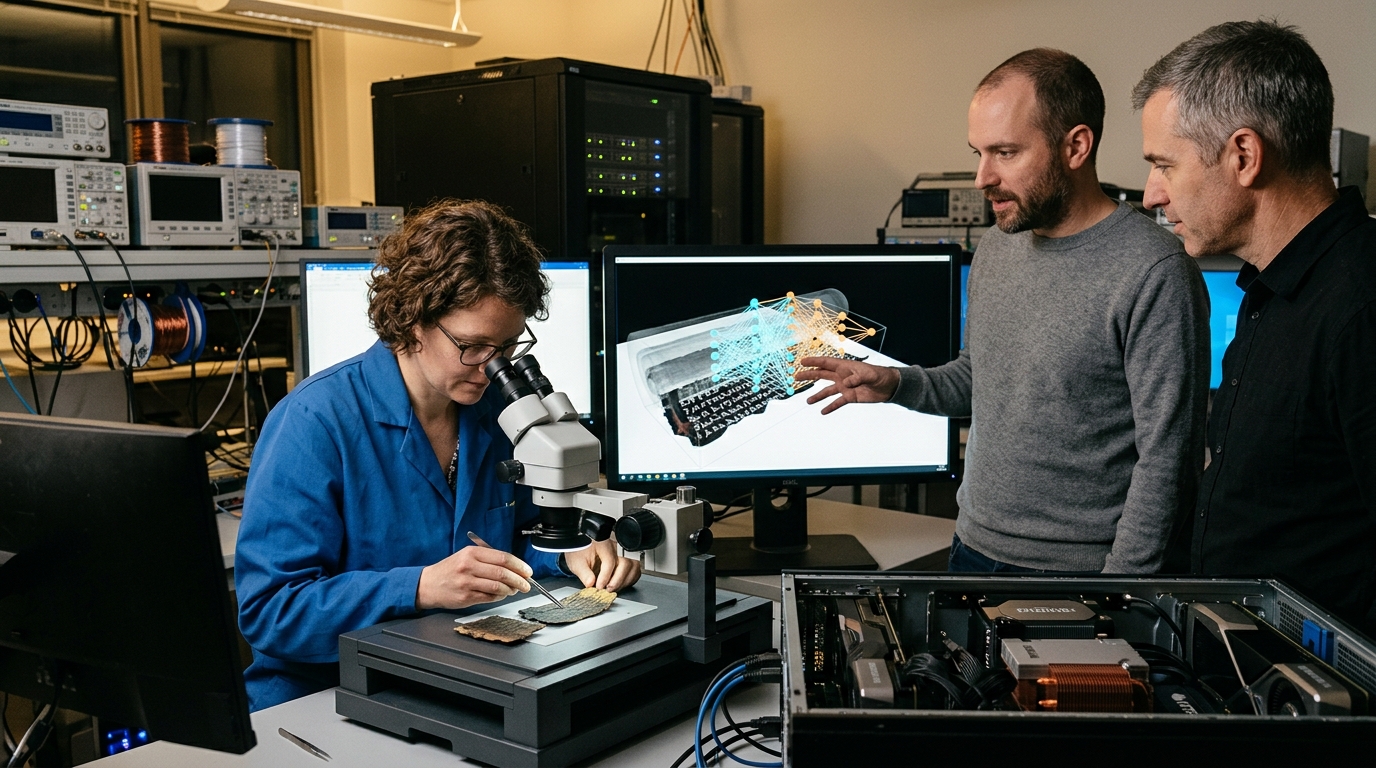
The history of humanity is riddled with gaps—libraries burned, scrolls rotted, and wisdom lost to the passage of time. However, as of June 2026, technology has achieved the impossible: the digital unrolling of scrolls carbonized during the cataclysmic eruption of Mount Vesuvius in 79 AD. Through the convergence of high-resolution CT scanning and advanced Artificial Intelligence, scientists have successfully deciphered words and sentences from texts that remained silent for two millennia, opening a profound new window into the ancient world.
A Catastrophe Turned Time Capsule
When Vesuvius erupted, the seaside town of Herculaneum was buried under a massive surge of volcanic mud and ash. Unlike Pompeii, where the heat was dry, the conditions in Herculaneum led to the carbonization of papyri stored in the famous 'Villa of the Papyri.' This library, the only one from antiquity to survive intact, contained hundreds of scrolls. For centuries, any attempt to physically unroll these scrolls resulted in their disintegration, as the material had become as fragile as charcoal.
The solution emerged not from the hands of conservators, but from the realm of algorithms. The process began with high-energy X-ray scans (using particle accelerators) to create 3D volumetric models of the scrolls without ever touching them. However, the resulting data was a jumbled mess; since the ink was carbon-based—just like the burnt papyrus—it was invisible to the naked eye. This is where AI stepped in to solve a puzzle that had baffled humans for 250 years.
The Vesuvius Challenge and Machine Learning
The breakthrough was accelerated by the 'Vesuvius Challenge,' a global crowdsourcing initiative that offered substantial prizes for deciphering the scrolls. Researchers utilized Machine Learning models, specifically Convolutional Neural Networks (CNNs), to detect subtle textural changes on the surface of the papyrus. These 'crackle patterns' were the ghostly imprints left by the ink as it dried and aged.
The AI was trained to recognize these patterns and translate them into Greek characters. By 2024, the first word—'porphyras' (purple)—was identified. Now, in 2026, entire columns of text have been reconstructed. The software performs 'virtual unrolling,' mathematically flattening the distorted layers of the scroll onto a 2D plane, allowing papyrologists to read the ancient Greek script with unprecedented clarity.
Philodemus and the Epicurean School
The texts recovered so far largely belong to Philodemus of Gadara, an Epicurean philosopher who resided at the villa. The recently deciphered passages discuss the nature of pleasure, the influence of music, and the sensory experience of food. Philodemus offers a nuanced take on Epicureanism, arguing that pleasure is not merely the absence of pain but a sophisticated engagement with the world.
- AI facilitates non-invasive archaeology, preserving the physical integrity of priceless artifacts.
- The speed of algorithmic processing allows for the analysis of data volumes that would take human researchers lifetimes to complete.
- This success paves the way for the 'Digital Recovery' of thousands of other damaged manuscripts globally.
A New Digital Renaissance?
The implications of this achievement are staggering. Many historians speculate that the unexcavated levels of the Villa of the Papyri may hold lost masterpieces by Aristotle, Sophocles, or Livy. If AI can continue to refine its ability to 'see' through carbonized layers, we may be on the cusp of a Digital Renaissance, where the lost heritage of the Greco-Roman world is systematically restored to the modern canon.
"We are not just reading words; we are rescuing human thought from the ashes. It is the ultimate victory of intelligence over time," noted one lead researcher.
The Herculaneum scrolls case proves that Artificial Intelligence is not merely a tool for forecasting the future, but a bridge to our deepest past. As these algorithms become more sophisticated, the darkness that once shrouded the library of Lucius Calpurnius Piso Caesoninus (Julius Caesar's father-in-law) is finally lifting, reminding us that technology, when harnessed for cultural preservation, can perform genuine miracles.