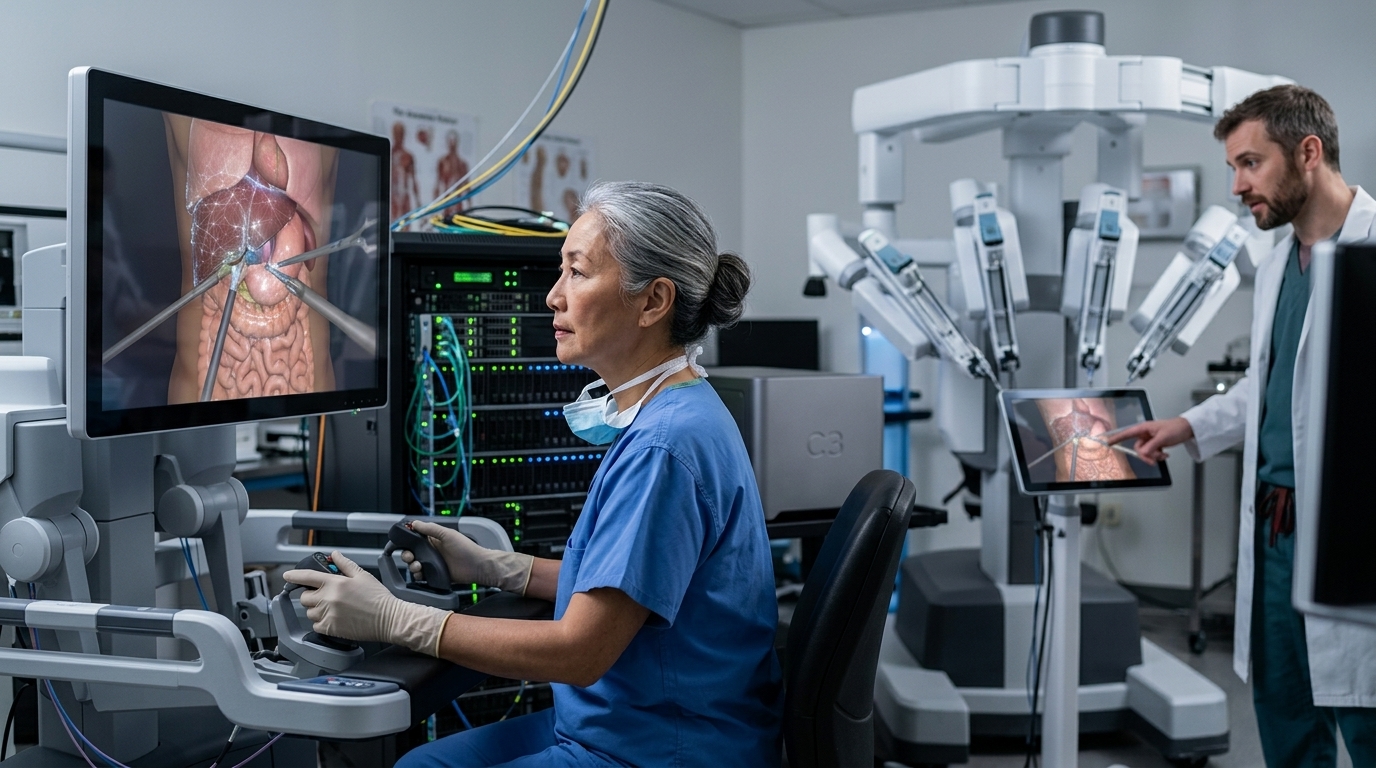
NVIDIA has announced Cosmos3-H-Dreams, the latest advancement in World Foundation Models (WFM), promising to fundamentally change how surgical robots are trained. Unlike traditional numerical simulations that require explicit modeling of geometry and tissue physics, this new system learns visual dynamics directly from clinical procedure videos and robot kinematics.
From Tabletop to Clinical Scenes
While previous versions were limited to controlled tabletop environments, Cosmos3-H-Dreams was trained on real-world cholecystectomy recordings from the CMR Surgical Versius platform. The system must navigate the complexities of the human body, where reflections, tissue traction, and surgical smoke create an intensely dynamic environment.
Technical Prowess and Real-Time Interaction
The model is built upon Cosmos3-H-Embodied-Nano, a 16-billion-parameter foundation. To achieve real-time responsiveness, NVIDIA utilized the FlashDreams library and a distillation process from a teacher model to student models (two or four steps). This approach allows the system to run on a single NVIDIA RTX PRO 6000 GPU while maintaining visual fidelity and temporal consistency.
- 28 action dimensions (arm poses, grippers, energy controls).
- Self-Forcing training to prevent the accumulation of temporal errors.
- Ability to generate realistic tissue responses to novel, unseen surgical maneuvers.
Despite its impressive realism, NVIDIA clarifies that Cosmos3-H-Dreams remains a research tool and is not intended for clinical patient care, though it lays the groundwork for the autonomous surgical policies of the future.