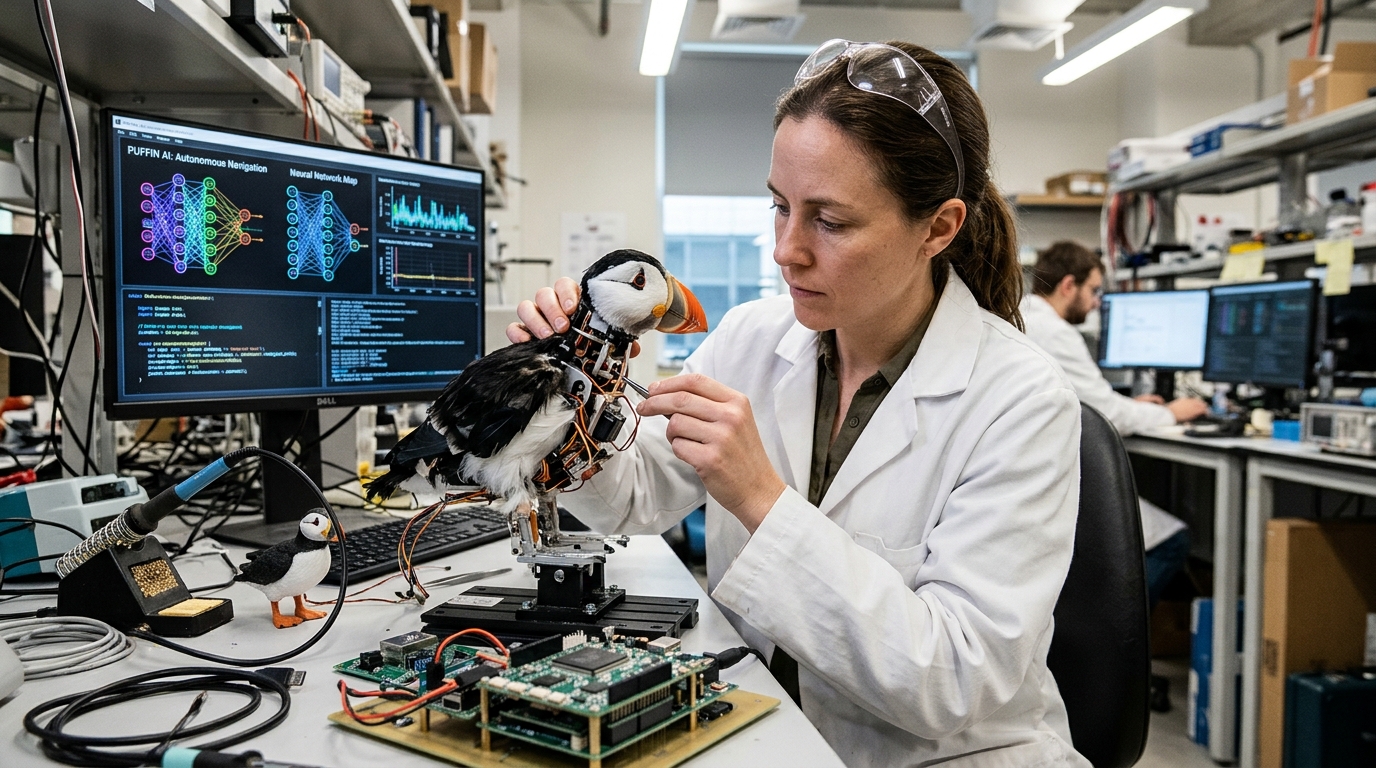
Moving through two mediums with vast density differences—water is 1,000 times denser than air—requires specialized mechanics. While birds like gulls and puffins transition seamlessly between these environments, replicating this in robotics has been a long-standing challenge. Now, engineers at MIT and EPFL in Lausanne have developed the FAAV (Flapping-wing Aerial-Aquatic Vehicle) to bridge this gap.
Design and Bio-mimicry
Weighing less than 300 grams, the robot features a central fuselage, two flexible wings, and a steerable tail. A waterproof electric motor drives a crankshaft that pumps the wings, which are coated with hydrophobic nanoparticles to shed water instantly. The motorized tail adjusts its angle to facilitate diving or climbing.
During experiments in a water tank and at Lake Geneva, the team led by Raphael Zufferey identified that medium-sized wings offered the best balance. They were flexible enough to minimize flapping amplitude underwater but firm enough to sustain flight. Interestingly, while many diving birds use their feet to launch from the water, the researchers found that the bot could achieve take-off using a steep 70-degree pitch without any mechanical feet.
Future in Ocean Science
The practical implications for oceanography are significant. The researchers envision these drones flying to remote areas, such as icebergs or whale pods, to collect samples and deliver data frequently—potentially every hour rather than every week.
“It would fly close to the area of interest... dive into the water to take a measurement or collect a sample, and fly back to deliver the data at a fraction of the cost of traditional methods,” says Zufferey. Future research will focus on wings that can turn and testing performance in choppy waters and high winds.