

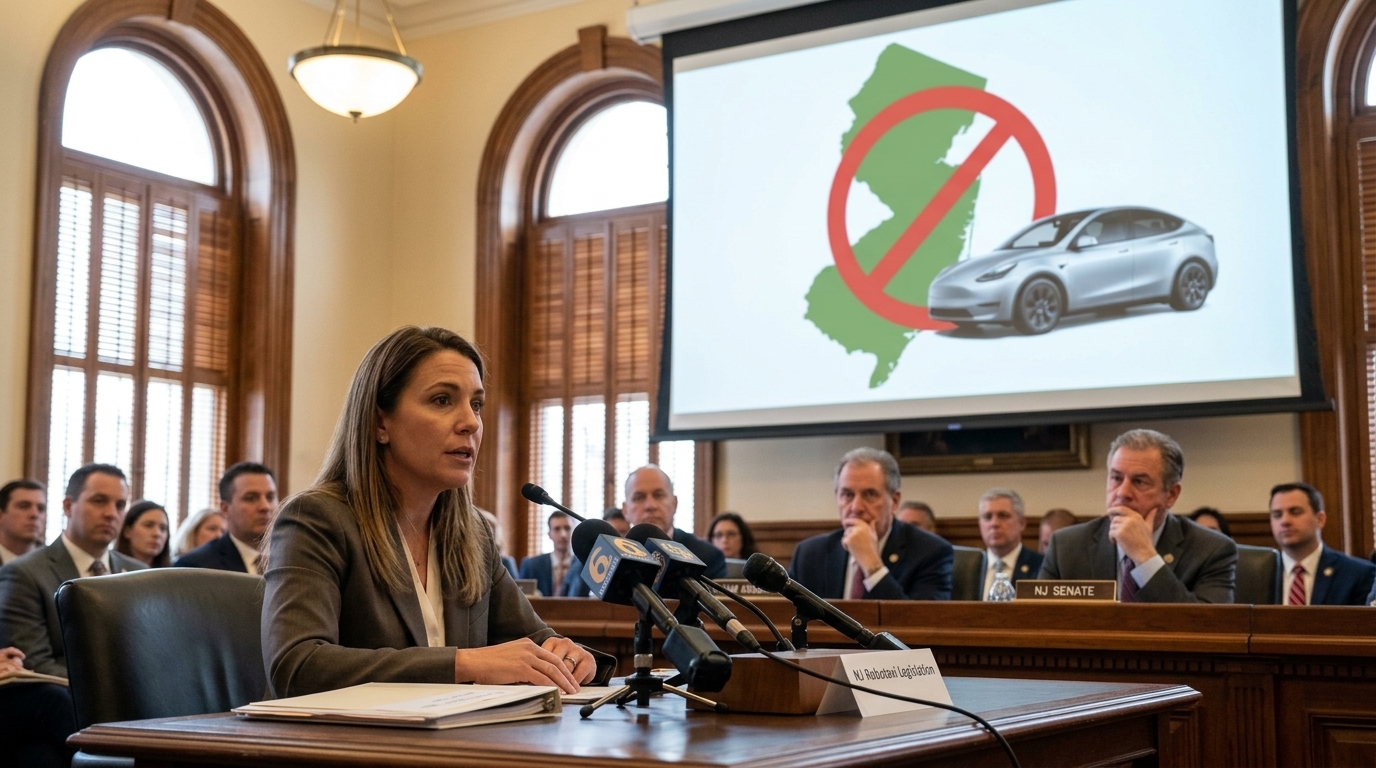
The decade-long battle over the future of autonomous driving has just moved from engineering labs to legislative chambers. At the heart of the conflict lies a fundamental disagreement: Are cameras sufficient to replicate human vision, or do cars require additional, overlapping sensors like LiDAR and radar to navigate safely? While Tesla has bet billions on a 'Vision-only' approach (Tesla Vision), a new bill in New Jersey is challenging this choice, threatening the company’s presence in the local market.
The Legislative Counter-Strike: Bill S3610
The bill introduced by Senator Patrick Diegnan in New Jersey is not merely a bureaucratic intervention; it is a direct volley against Elon Musk’s technological philosophy. If passed, it would require every autonomous vehicle (AV) operating on state roads to be equipped with a 'sensor redundancy system' that mandatorily includes LiDAR and radar. This move comes at a time when Tesla is attempting to convince investors and the public that its Full Self-Driving (FSD) software is ready for widespread use without the need for expensive hardware suites.
The logic behind the bill is rooted in the principle of 'safety through redundancy.' Proponents argue that cameras, no matter how advanced, remain vulnerable to poor weather, glare, or sudden changes in lighting conditions. LiDAR, which uses laser pulses to create a detailed 3D map of the surroundings, can 'see' in total darkness and calculate distances with millimeter precision, acting as a safety net when optical recognition fails.
Elon Musk’s Solitary Strategy
For Elon Musk, LiDAR is a 'crutch' that hampers the true progress of artificial intelligence. Tesla systematically removed radar and ultrasonic sensors from its vehicles, relying exclusively on eight cameras and neural networks. The company’s argument is simple: Our world is designed for humans who drive using vision and biological data processing. Therefore, an AI that 'sees' and 'thinks' like a human—but with faster reflexes—is the optimal solution.
However, this approach has drawn heavy criticism from safety experts and regulators. Accidents where Teslas failed to recognize stationary emergency vehicles or trucks crossing the road have fueled skepticism. The New Jersey bill seems to codify this skepticism into law, creating a legal wall that Tesla cannot bypass through software updates alone.
Market and Innovation Consequences
If New Jersey mandates LiDAR, it will create a dangerous precedent for the fragmentation of the US market. Automakers could face a 'patchwork' of regulations, where a car is legal in New York but illegal the moment it crosses the George Washington Bridge. For Tesla, which has manufactured millions of vehicles without LiDAR, such a development would mean either withdrawing from specific states or undertaking a prohibitively expensive fleet retrofit.
On the other hand, companies like Waymo (owned by Alphabet) and Zoox (owned by Amazon) already utilize LiDAR and radar, viewing them as essential for achieving Level 4 autonomy. These companies might see the New Jersey legislation as a validation of their strategy and a tool to limit competition from Tesla, which holds a cost advantage precisely by avoiding expensive sensors.
The Regulatory Dilemma
The question arises: Should politicians dictate specific technological solutions, or should they only set performance and safety benchmarks? Critics of the bill argue that mandating LiDAR could stifle innovation, forcing companies to use a technology that might become obsolete in a few years. However, supporters respond that when it comes to public safety on the roads, 'freedom to innovate' cannot take precedence over human life.
The battle in New Jersey is just the beginning. As robotaxis become a reality, the clash between Silicon Valley’s 'move fast and break things' ethos and the cautious, often cumbersome bureaucracy of regulators will determine who dominates the roads of the future. Tesla may need to reassess its absolute stance if it wishes to avoid being locked out of the world’s most significant markets.





