

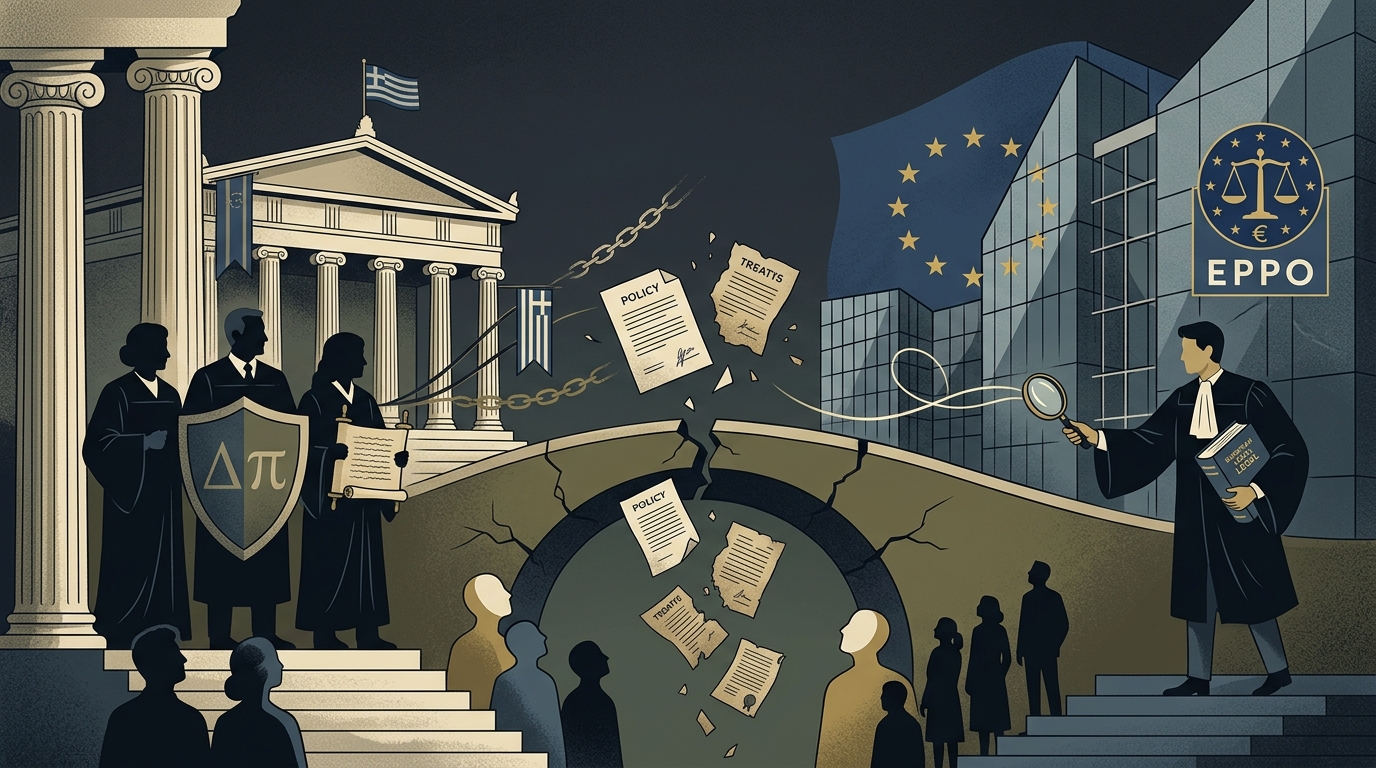
The recent decision by the Plenary of the Areios Pagos (Greece's Supreme Court) to rule the appeal of European Chief Prosecutor Laura Kövesi as inadmissible is more than a mere procedural development; it is the latest chapter in a prolonged and intense institutional clash between the Greek judiciary and the European Public Prosecutor's Office (EPPO). At the heart of the dispute lies the tenure of Greek European Delegated Prosecutors (EDPs), which Greece has set at two years, contrary to the five-year term advocated and implemented by the EPPO in most member states.
The Legal Background and the Core of the Dispute
The EPPO was established to combat fraud against the European Union's financial interests. To fulfill its mandate, it relies on European Delegated Prosecutors who operate within national jurisdictions but report directly to Luxembourg. Regulation (EU) 2017/1939 stipulates that these prosecutors must enjoy full independence from national governments and domestic judicial hierarchies.
The Greek government, through Law 4786/2021, established a two-year term for Greek EDPs, with the possibility of renewal. Laura Kövesi strongly argues that such a short term undermines the independence of the prosecutors. The logic is straightforward: a prosecutor who knows their position depends on a decision made every two years at a national level may feel vulnerable to pressure, especially when handling corruption cases involving high-ranking political or business figures.
The Supreme Court, however, rejected Kövesi's appeal as "inadmissible," essentially ruling that the European Chief Prosecutor does not have the legal standing to challenge the internal organization of the Greek judiciary in this manner. While seen by some as a defense of national judicial sovereignty, the ruling simultaneously raises questions about Greece's compliance with the spirit of European regulations.
The Importance of a Five-Year Term and the Risk of Pressure
Why does the EPPO insist on a five-year term? The answer lies in the nature of the cases the office handles. Investigating financial crimes, EU fund fraud, and cross-border VAT schemes is exceptionally complex and time-consuming. A two-year term is often insufficient even to complete the preliminary investigation in large-scale cases. Frequent turnover of personnel disrupts institutional memory and delays the administration of justice.
Furthermore, there is the dimension of "silent discipline." As legal analysts point out, the risk is not always direct interference, but the self-restraint a prosecutor might exercise to avoid disturbing the domestic establishment, thereby ensuring the renewal of their term. A five-year horizon provides an adequate safety buffer, allowing the official to focus on their duties without the anxiety of re-evaluation by the national Supreme Judicial Council in such a short period.
The Broader Context: Rule of Law and the Tempi Tragedy
The Supreme Court's decision comes at a time when Greece is under the scrutiny of European institutions regarding Rule of Law issues. The EPPO's involvement in the investigation of "Contract 717," which is directly linked to the Tempi train tragedy, has given this confrontation a sharp political edge. Kövesi has publicly expressed concerns about the obstacles the EPPO faces in Greece, even referring to issues of parliamentary immunity and restrictions on investigating ministerial responsibilities.
In this context, the rejection of the appeal regarding the prosecutors' tenure is perceived by some as an attempt to "insulate" the Greek judiciary from European mandates. On the other hand, circles within the Supreme Court maintain that Greek legislation provides sufficient guarantees of independence and that the organization of judicial authorities is the exclusive competence of the member state.
Conclusion and Next Steps
The rift between Athens and Luxembourg shows no signs of abating. It is highly likely that the issue will be escalated to the Court of Justice of the European Union (CJEU) through a preliminary ruling procedure or an infringement procedure by the European Commission. Europe is closely watching whether Greece will choose the path of harmonization with European standards or persist in a stance that fuels suspicion regarding the quality of judicial independence in the country.
Justice must not only be done but must be seen to be done. In the case of European Prosecutors, the institutional safeguarding of their tenure is the minimum prerequisite to convince citizens that investigations into public funds and corruption are conducted without fear or favor.




