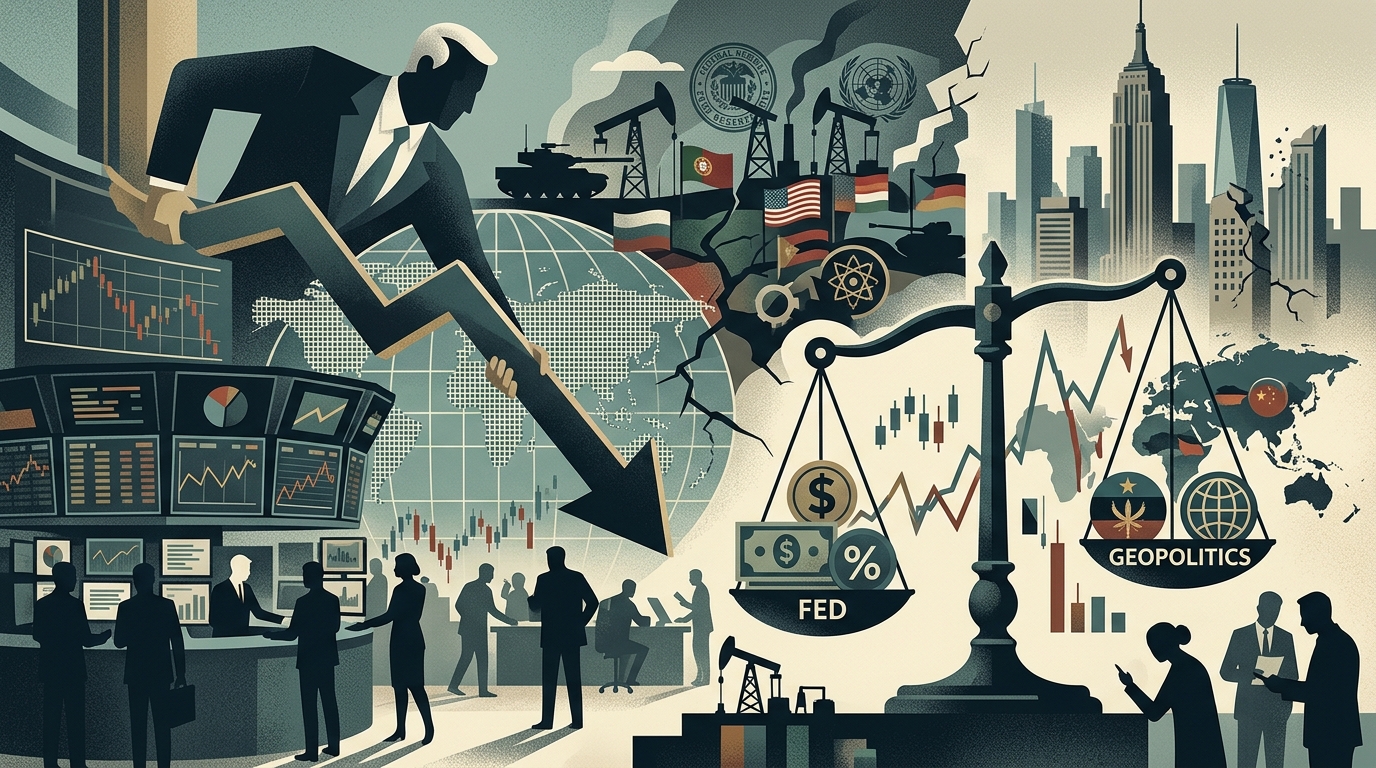
The recent jitters in international markets have turned everyone's eyes toward the 19th floor of the Eccles Building in Washington. The U.S. Federal Reserve (Fed) remains the undisputed arbiter of the global economic climate, but a new analysis from Forvis Mazars is stirring the waters. The question posed is clear: Is it truly Jerome Powell’s decisions causing the tremors on the ticker tapes, or is the market turning a blind eye to a much darker and more unpredictable factor—geopolitical instability?
The Obsession with the 'Pivot' and the Reality of Numbers
For months, investors lived on the hope of a swift pivot toward interest rate cuts. Every word in Fed announcements is dissected with the help of algorithms and artificial intelligence, searching for a glimmer of optimism. However, Forvis Mazars points out that this one-dimensional focus may be misleading. Monetary policy, while critical, now operates in an environment where traditional economic rules clash with the new geopolitical realities of 2026.
Inflationary pressure is no longer just a product of excess demand or the monetary expansion of the previous decade. It is structural. Energy costs, the restructuring of supply chains due to decoupling from autocratic regimes, and the costs of the green transition are creating a 'floor' under inflation that the Fed is struggling to penetrate. Therefore, when the central bank maintains high rates, it does so not out of dogma, but out of the necessity to counter exogenous shocks.
The Geopolitical Factor: The Invisible Threat
According to the analysis, the geopolitical environment remains 'heavy' and unpredictable. Conflicts in the Middle East and ongoing tension in Eastern Europe no longer just affect oil prices. They affect investor confidence in long-term stability itself. Forvis Mazars argues that markets have underestimated the 'risk premium' required in an era of global fragmentation.
"The market seems to forget that interest rates are the tool, not the cause. The cause of uncertainty lies in shifting borders and collapsing alliances," the analysts note.
The analysis highlights that the recent stock market decline might not have been a reaction to the Fed's hawkish stance, but a delayed realization that the world is becoming increasingly expensive and dangerous. Supply chains are becoming closer (near-shoring) and friendlier (friend-shoring), which increases production costs and, by extension, inflation, forcing central banks to remain vigilant.
Corporate Earnings and the Resilience of AI
Despite the grim landscape, there is a silver lining preventing a total collapse: technology. The integration of artificial intelligence into business processes has begun to bear fruit in terms of productivity. This profitability 'cushion' allows many companies to absorb increased borrowing costs. However, Forvis Mazars warns that even AI cannot save the day if geopolitical risk turns into a generalized trade crisis.
Investors are now called to look beyond the next FOMC meeting. The strategy of 'waiting for the rate cut' seems to be exhausted. Instead, the focus is shifting to selecting companies with strong balance sheets, low exposure to geopolitically sensitive regions, and the ability to pass costs on to consumers without losing market share.
Conclusions for the Future
The conclusion from Forvis Mazars is clear: The Fed didn't 'tank' the markets; it simply reflects a harsh reality. Monetary policy cannot heal the wounds of a divided world. As long as geopolitical tensions remain at a fever pitch, volatility will be the constant companion of investors. The search for a 'safe haven' no longer just passes through bonds, but through a deep understanding of the global chessboard.
In this context, Europe finds itself in a particularly vulnerable position, as its dependence on energy imports and its proximity to conflict zones make it the 'weak link' in the event of a new escalation. The Fed may hold the steering wheel of the dollar, but the winds blowing from the East and the Middle East are what will determine the ship's course in the coming period.