

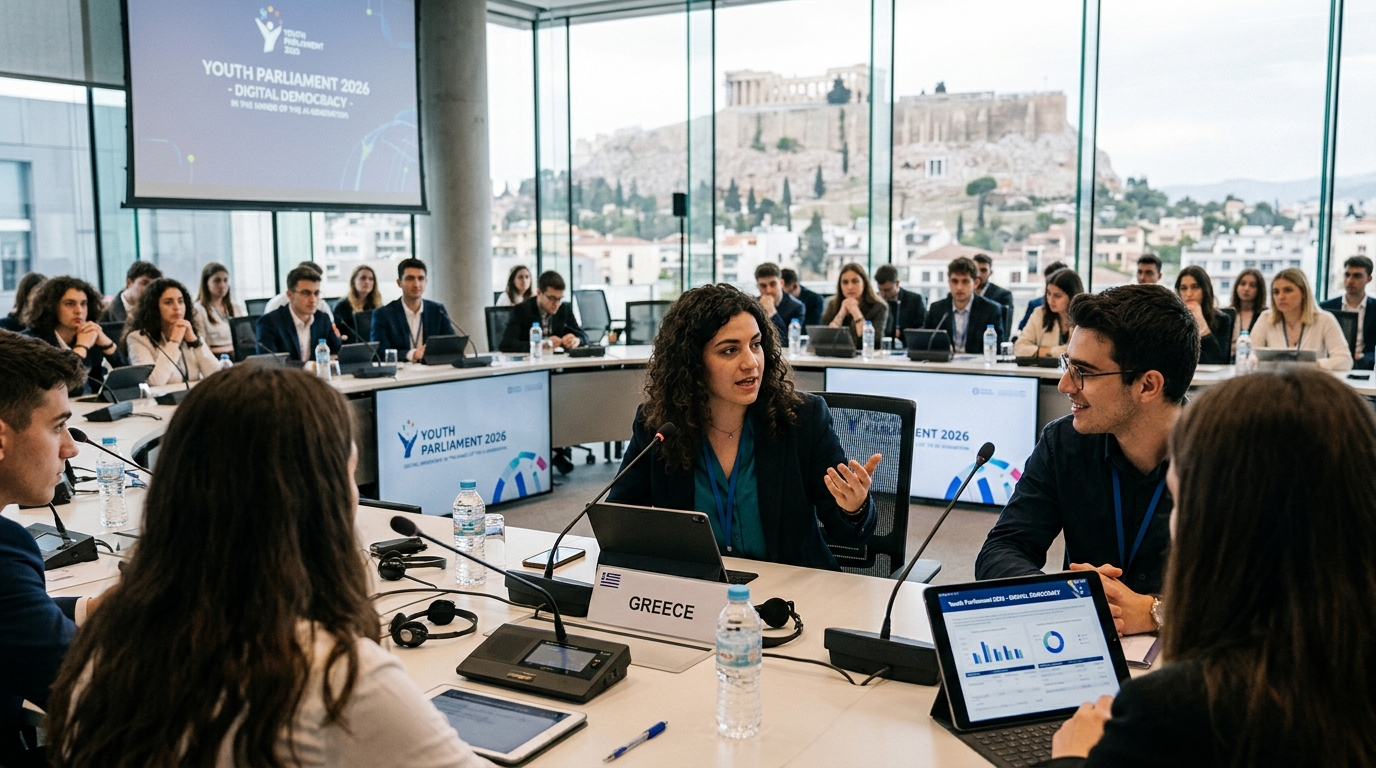
In the heart of Athens, beneath the historical weight of the Plenary Hall, a different voice was heard this year. The 2026 Youth Parliament was not merely an exercise in simulating democratic processes, but a deep, substantial, and often subversive discussion on how Artificial Intelligence (AI) is reshaping the present and future of the younger generation. Under the central slogan "Our intelligence, their technology," 300 students from Greece, Cyprus, and the diaspora tabled the dilemmas of an era moving at algorithmic speeds.
Beyond the Screen: Youth as Policy Architects
This year's event focused on three main pillars: education, the ethics of information, and the future of work. The youth MPs did not just focus on the convenience Generative AI (like ChatGPT or Gemini) offers in their studies; they fiercely criticized how the educational system remains stuck in traditional rote learning methods while information is now accessible in seconds. "We don't need a school that tells us what to think, but one that teaches us how to judge what the machine produces," a student from Orestiada characteristically stated, earning the applause of her peers.
The committee discussions were intense. The teenagers proposed integrating "AI Tutors" in public schools, not as replacements for teachers, but as personalized assistants helping students with learning disabilities. Simultaneously, they called for the creation of a national "Digital Ethics" framework, to be taught starting from primary school, so that the citizens of tomorrow can distinguish deepfakes from reality and propaganda from information.
Navigating the Ethics of Algorithms
One of the most critical issues occupying the Youth Parliament was the erosion of truth in the digital space. In an era where images and videos can be fabricated with terrifying accuracy, the youth expressed concerns about political manipulation. Their proposals included mandatory labeling of all AI-generated content on social networks and the strengthening of independent regulatory authorities.
"Artificial Intelligence could be the tool that solves the climate crisis, but it could also become the weapon that destroys our trust in democracy," emphasized a youth MP from Athens.
Privacy concerns were also pervasive. Students demanded stricter rules for the use of their data by Big Tech, highlighting that "free" use of AI tools should not mean the exploitation of their personal identity. The proposal for a "European Data Passport" that gives users full control over their information resonated strongly among the participants.
Education 4.0 and the Greek Reality
When the discussion shifted to the economy and the labor market, the tone became more realistic and, in some cases, somber. This generation knows that many of the professions they are preparing for today might not exist in ten years. However, instead of fear, the teenagers showed a willingness to adapt. They asked the state to invest in reskilling programs early on and to promote Greece as an innovation hub to stop the Brain Drain.
The proposal for a "Guaranteed Digital Income" for those affected by automation was discussed extensively, though no consensus was reached. What became clear, however, is that the new generation does not see technology as something foreign, but as an integral part of their existence. The 2026 Youth Parliament proved that young people are not mere consumers of algorithms but thinking citizens who demand a say in the decisions that will define their lives. The question that remains is whether the official state will take their recommendations seriously or if the process will remain a beautiful celebration of democracy without practical impact.




