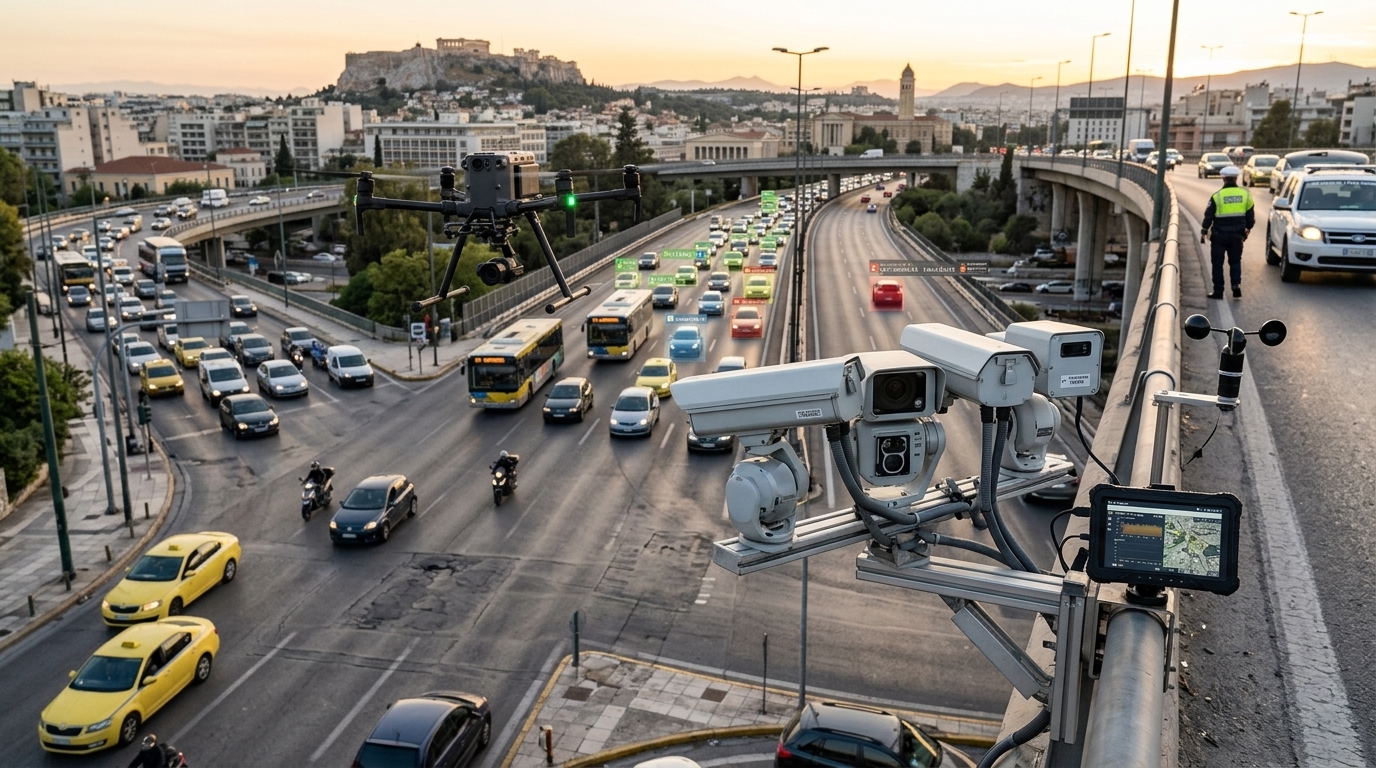
A new traffic management model is being implemented as of today, Tuesday, September 1, in Attica. With the activation of the "Traffic Commander" system and the specialized operational team "K.O.M.V.O.S.," the Greek Police are attempting to tackle the chronic congestion issues on the capital's main road axes.
A Digital Hub for 24 Data Sources
The core of the system is located at the modernized Operations Center for Traffic Monitoring and Control at the Attica Police Headquarters (GADA). Data from 24 different sources, including 235 traffic cameras and 10 drones, are gathered and analyzed there. Artificial intelligence systems organize information regarding accidents, roadworks, weather conditions, and public transport into a single, constantly updated real-time picture.
According to the design, the system will be capable of processing approximately 50,000 events and traffic-related data points daily, allowing for rapid assessment even in areas where access is difficult.
Rapid Field Intervention
The K.O.M.V.O.S. operational team consists of 138 police officers, with motorcycle units playing a pivotal role. Due to their agility, these officers can reach accident sites or vehicle breakdowns faster than patrol cars, intervening directly in traffic light regulation to prevent the "domino effect" of congestion from spreading to neighboring streets.
The focus is placed on major avenues such as Kifisias, Mesogeion, Syngrou, and Alexandra, as well as central arteries in Piraeus. The challenge is immense, as the 1,623-kilometer road network serves 700,000 vehicles daily in the center of Athens alone.
Expectations for 25% Improvement
The Minister of Citizen Protection, Michalis Chrysochoidis, estimated that once the system is fully deployed, it could lead to a gradual improvement in traffic flow of up to 25%. However, the true test for Traffic Commander is expected in mid-September, coinciding with the reopening of schools and the full restart of economic activity.