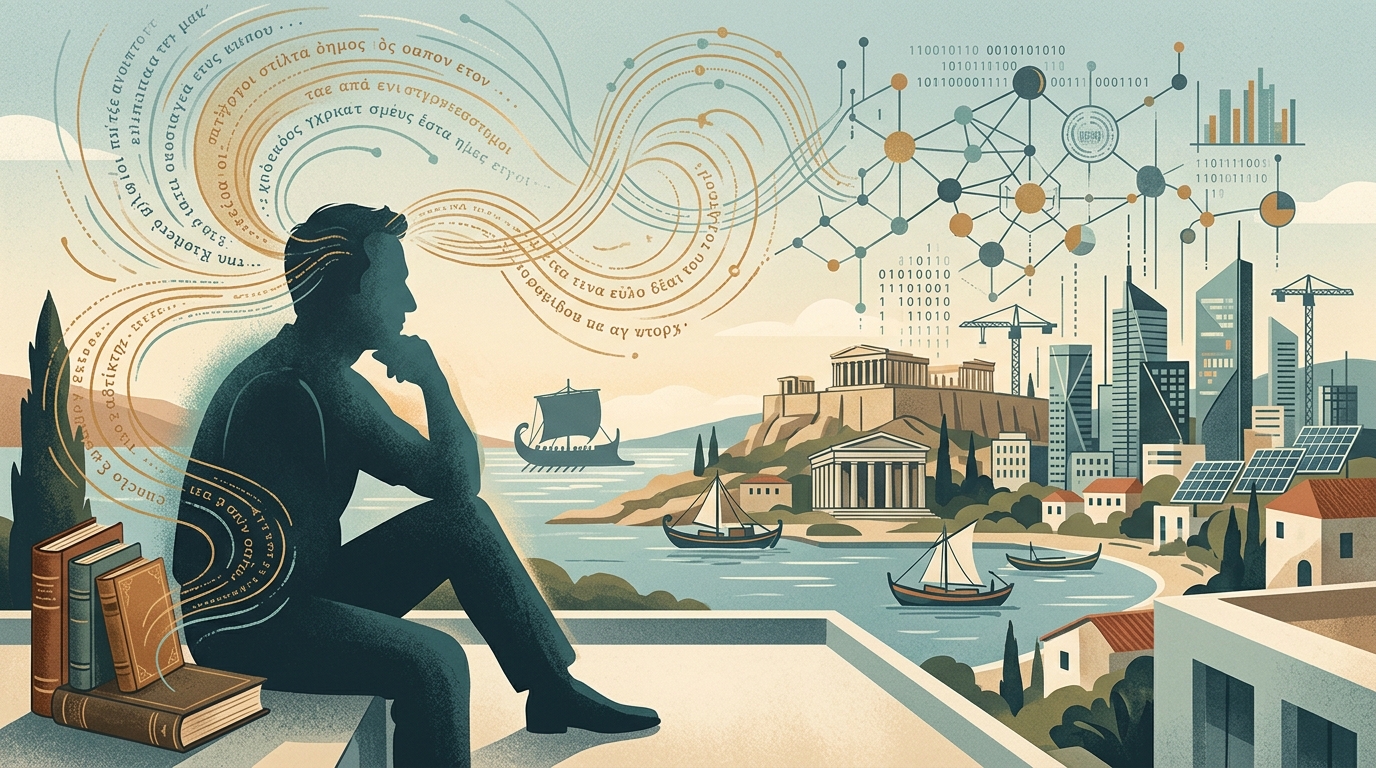
In a world trending toward linguistic homogenization due to globalization and the dominance of English in the digital sphere, the emergence of voices insisting on locality takes on an almost revolutionary tone. Kyriakos Karagiannidis, known to the social media public as "Kara," is not just another content creator seeking the next viral video. Through his talent for imitations, he has managed to bring the Pontic dialect to the forefront of the digital age, proving that tradition is not a static museum exhibit, but a living organism that can thrive even in the environment of TikTok and Instagram.
The Power of Imitation as a Cultural Tool
The art of imitation is often underestimated as a simple form of entertainment. However, in Karagiannidis' case, it functions as a powerful carrier of cultural memory. Starting in 2024 by mimicking iconic voices of the Greek music scene—from Yiannis Parios and Paschalis Terzis to modern art-folk artists—"Kara" introduced an element that surprised and moved: the use of the Pontic dialect. The result was not only comedic or technically impressive; it was a reminder of the linguistic diversity of Hellenism.
As he states, the most significant achievement of his work is that the Pontic dialect is now heard on platforms dominated by younger generations. This "hearing" is of great importance. Pontic, a dialect with deep roots in Ancient Greek, is in danger of extinction as its native speakers dwindle. Its integration into a modern, entertaining context de-stigmatizes it from being "obsolete" and makes it familiar again to the ears of young people, who might have associated it exclusively with family gatherings or somber anniversaries.
From TikTok to Historical Consciousness
The digital age has changed how we consume culture. Algorithms often promote the easily digestible and the global. Nevertheless, the case of Kyriakos Karagiannidis shows that there is a strong thirst for authenticity. When a creator uses their voice to reproduce not only the sound but also the ethos of a dialect, they create a bridge to the past.
- Appropriation of Technology: Using social media as a means of preserving intangible cultural heritage.
- Linguistic Evolution: How dialects adapt to modern scenarios and daily situations.
- Psychological Impact: The sense of belonging that language offers to second and third-generation refugees.
"Hearing the Pontic dialect on social media is not just a matter of aesthetics; it is an act of resistance against oblivion," note analysts of digital folklore.
Karagiannidis manages to deconstruct the stereotype of the "quaint" Pontian. Through humor and high imitation technique, he highlights the musicality of the dialect. It is no coincidence that his videos gather thousands of views and comments, not only from Pontians but from a wide audience that appreciates artistic excellence and cultural reference.
The Challenge of Digital Preservation and AI
As we move deeper into the era of Artificial Intelligence, the question of authenticity becomes increasingly pressing. We already see AI tools that can clone voices with terrifying accuracy. However, human imitation, like that practiced by "Kara," possesses something that AI still struggles to replicate: emotion and social context. The choice of words, the intonation carrying the pain or joy of an entire generation, are elements that stem from lived experience.
Karagiannidis' work functions as an informal digital archive. In an age where traditional media often neglect dialects, content creators take on the role of rescuers. The Pontic dialect, with its peculiarities, finds a new space for existence. This creates a new dynamic: tradition is no longer transmitted only from grandfather to grandchild, but also from content creator to follower.
Conclusions for the Future
The journey of Kyriakos Karagiannidis is indicative of a broader trend: the need to return to roots through the most modern means. His success is not only due to his talent for imitations but to the fact that he touched a sensitive chord of collective memory. The Pontic dialect, through his videos, ceased to be a "dead" language of books and became once again a language that can provoke laughter, emotion, and reflection.
In the future, the use of technology to enhance such initiatives will be decisive. Whether it's dialect learning apps or interactive digital museums, the foundation will remain the same: the voice of people who refuse to forget. "Kara" made the start, proving that the most important thing is not likes, but the resonance of a story that refuses to be silenced.