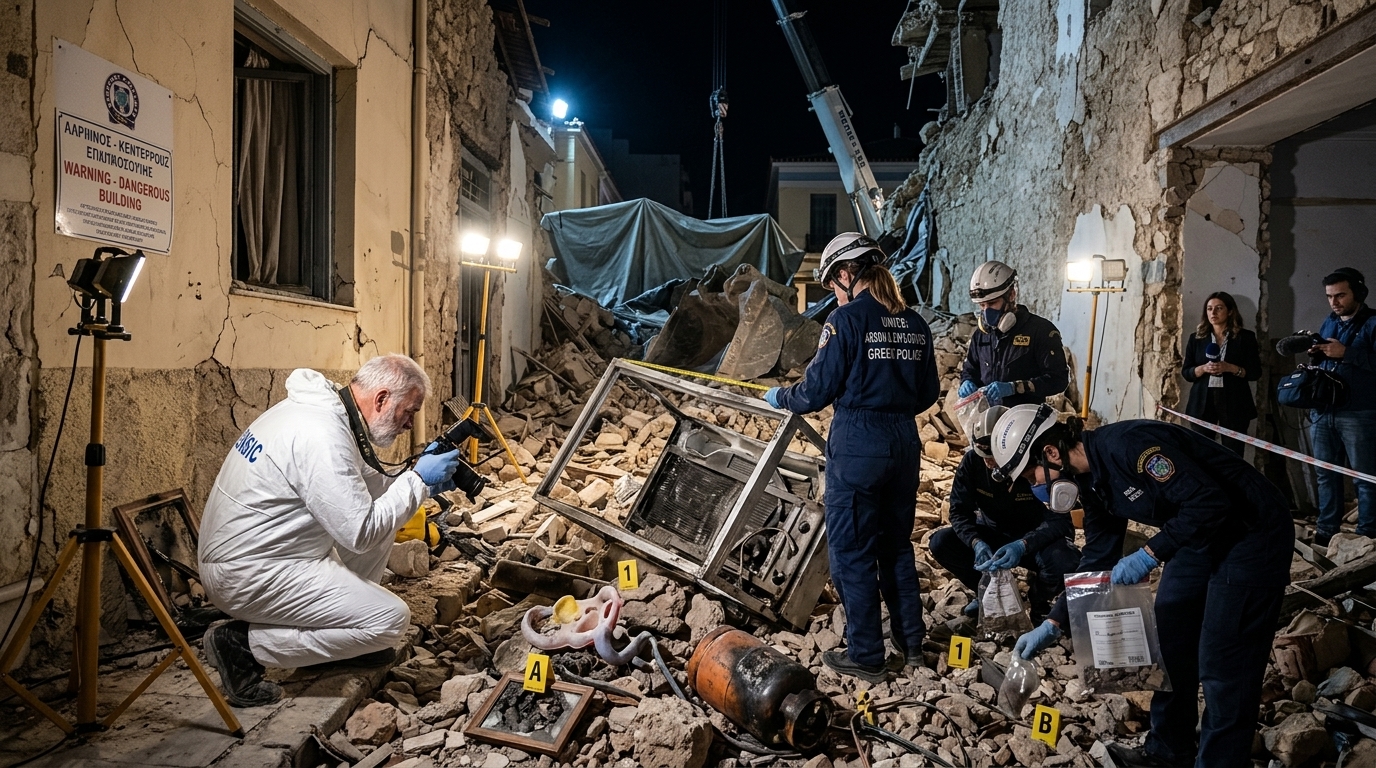
Specialist units of the Fire Service are currently investigating the causes of the deadly explosion that rocked the Plaka district on Friday morning. With the death toll reaching six, the focus of the inquiry is now on Lysikratous Street, where ten specialized officers from the Arson Crimes Division (DAEE) are conducting an on-site autopsy.
Focus on the Second Floor
Current evidence points to the second floor as the blast's epicenter, specifically the apartment of an elderly couple. Records indicate this was the only unit in the building with an active natural gas supply, as the first-floor service had been disconnected since 2021. Despite no prior reports of gas odors in the area, an internal network leak remains the leading theory.
Efthymis Lekkas, president of OASP, suggested that gas concentration likely reached 15%, creating a highly volatile mixture. This mixture was potentially ignited by a single spark, perhaps from a light switch. Professor Panagiotis Karydis emphasized that the scale of the damage indicates a massive accumulation of gas overnight, exacerbated by closed windows.
Ruled Out Scenarios
Based on current findings, investigators are moving away from several alternative explanations:
- Propane Cylinder: No evidence of a propane tank has been found at the scene.
- External Leak: There is no indication that gas leaked from a neighboring building or the main grid into the property, a scenario seen in the 2022 Syngrou Avenue incident.
- Internal Location: Unlike the conditions observed in the "VIOLANTA" factory incident, the leak appears to have occurred within the same space as the explosion.
Victim Identification and Next Steps
Simultaneously, the process of identifying the six victims through DNA testing is underway, coordinated with the Hellenic Police's Forensic Science Division. Starting Monday, official inspections will begin on adjacent properties to assess structural damages and secondary impacts in the surrounding area.