

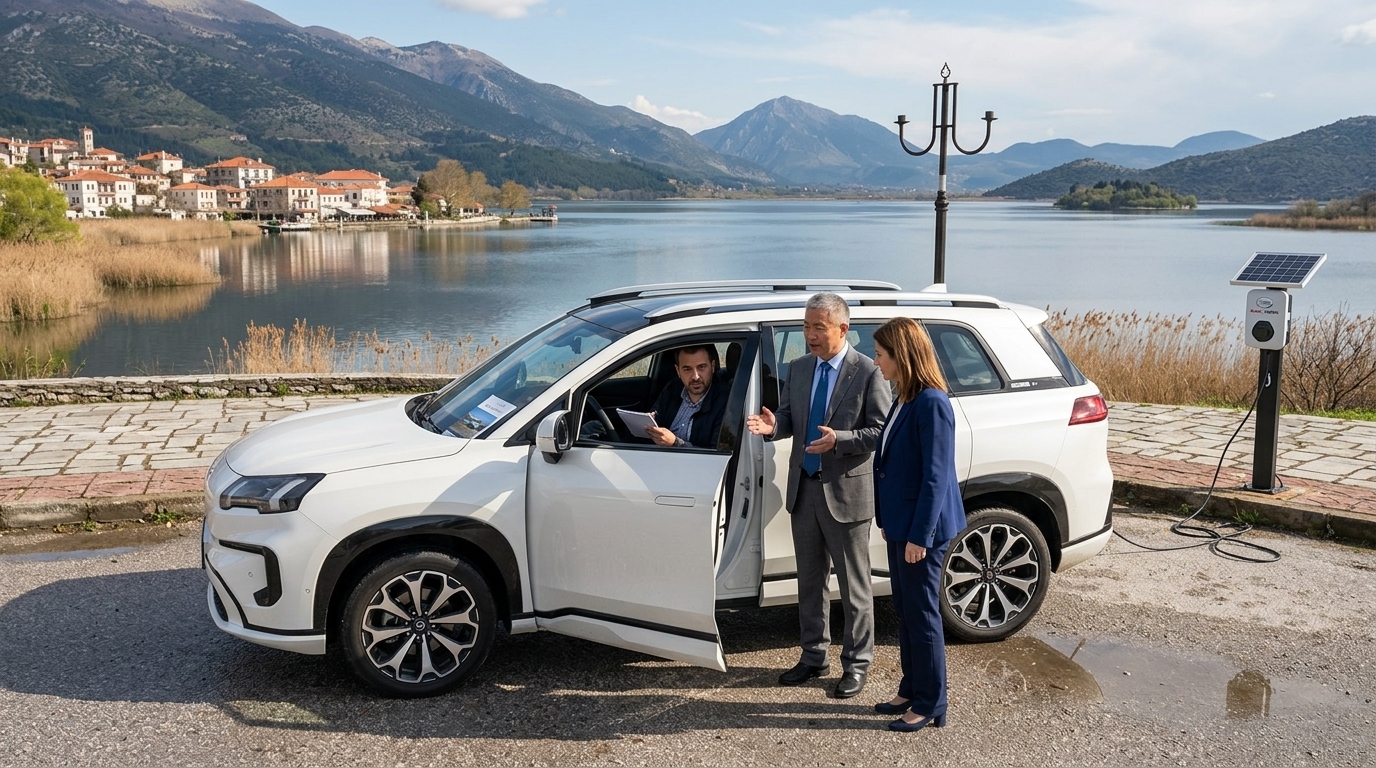
The arrival of GAC AION in Greece is not merely another addition to the roster of available automakers; it signals a structural shift in how the country perceives the transition to green mobility. At a time when the European Union is redefining its relationship with the Chinese automotive industry through tariffs and trade barriers, GAC (Guangzhou Automobile Group), one of the world's largest and most innovative players, has chosen Greece as a strategic entry point for Southeastern Europe.
Strategic Partnership and Vision
The partnership with the Spanos Group, a player with deep knowledge of the Greek market and a long tradition in the premium automotive sector, provides AION with the necessary institutional gravity. This is not an opportunistic import but a comprehensive ecosystem of services. GAC AION does not just sell vehicles; it promotes the concept of the "intelligent companion." Its models, such as the popular AION Y Plus, incorporate technologies that until recently were only found in experimental prototypes or expensive Silicon Valley flagships.
The company's strategy focuses on the "democratization of high technology." While European manufacturers struggle to reduce production costs for their electric models without sacrificing quality, GAC leverages its vertical integration and China's massive domestic market to offer vehicles with ranges exceeding 600 kilometers at prices that directly compete with conventional mid-range gasoline cars.
Technological Superiority and AI
The true competitive advantage of AION lies beneath the chassis. The use of the AEP 3.0 platform allows for an architecture that maximizes interior space, turning the car into a "mobile living room." Artificial intelligence plays a central role, not only in Level 2+ autonomous driving but also in energy management. The ADiGO Space system, which equips its models, learns driver habits, optimizes battery temperature based on the route, and offers a user experience that feels more like a latest-generation smartphone than a traditional car dashboard.
- Magazine Battery: A safety technology that prevents the spread of fire in the event of an accident, setting new industry standards.
- Ultra-Fast Charging: The ability to recover 200 kilometers of range in just 5 minutes, solving the problem of "range anxiety."
- Software Ecosystem: Continuous Over-the-Air (OTA) updates that improve the vehicle throughout its lifespan.
The Infrastructure Challenge in Greece
Despite the technological excellence of GAC AION vehicles, their success in Greek territory depends on external factors. Greece, although it has made progress, still lags in public charging networks, especially on provincial roads and islands. GAC seems aware of this, investing in home charging solutions and partnerships with energy providers. The entry of such a brand acts as a catalyst: the more high-quality electric cars on the road, the greater the pressure on the state and private sectors for faster development of the charging network.
"Electromobility is not the future; it is the accelerating present. GAC AION brings to Greece the proof that sustainable mobility can be simultaneously luxurious, affordable, and technologically exciting," market executives note.
In conclusion, GAC AION is not just coming to claim a market share. It is coming to redefine the expectations of the Greek consumer. In a country where car ownership is inextricably linked to social identity and freedom of movement, the Chinese proposal offers an alternative that is hard to ignore, especially when combined with the guarantee of a group like Spanos.





