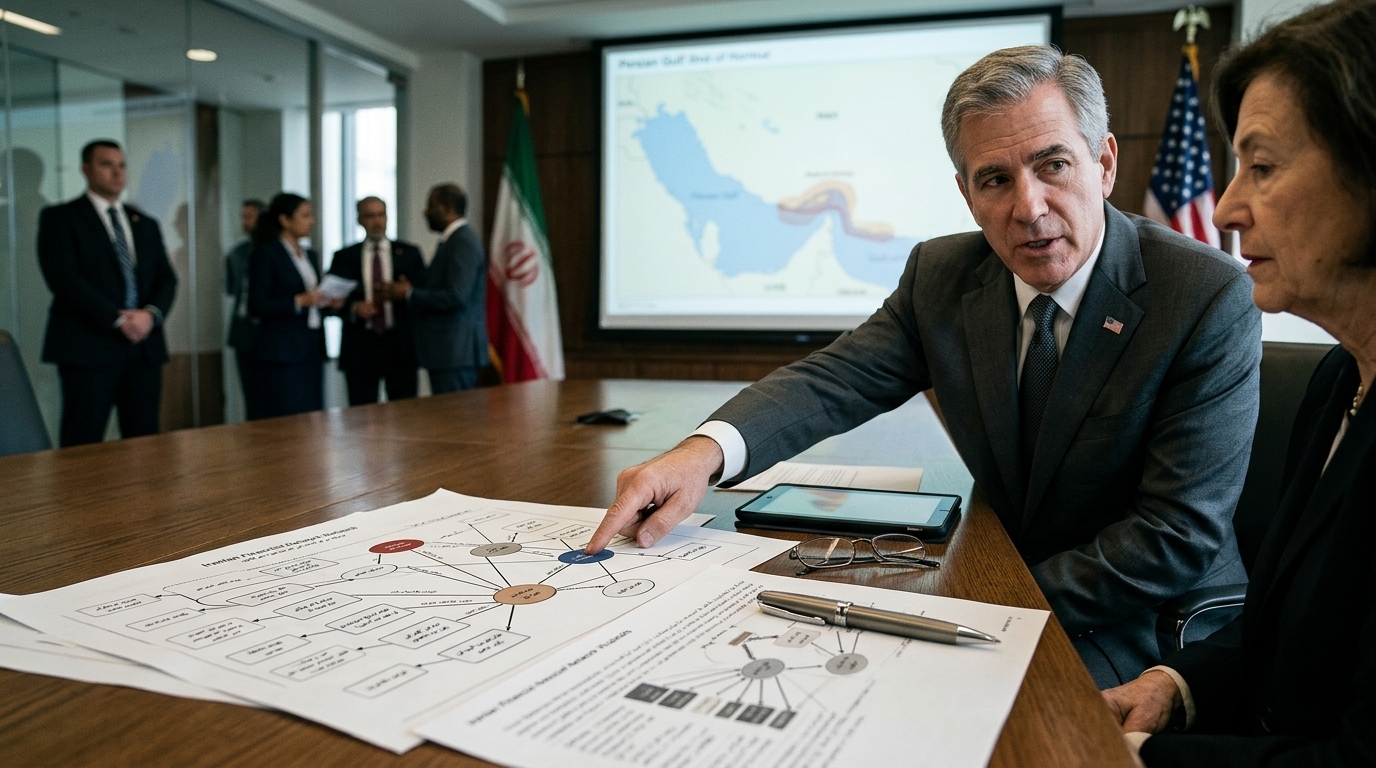
Geopolitical tensions in the Persian Gulf took a sharp turn this week as the United States Department of the Treasury announced a comprehensive package of sanctions against Iran. This move comes as a direct response to recent attacks on commercial vessels in the Strait of Hormuz, a critical chokepoint for global energy security through which one-fifth of the world's daily oil consumption passes.
The Target: Khamenei's Financial Infrastructure
At the heart of the new sanctions is a key figure described by American intelligence services as one of the most significant financiers for the Supreme Leader, Ayatollah Ali Khamenei. According to the official statement, this network operates through a web of front companies based in the United Arab Emirates, Turkey, and Hong Kong, facilitating the transfer of billions of dollars to the Islamic Revolutionary Guard Corps (IRGC).
The US Treasury maintains that these funds are not merely used to sustain the domestic repressive apparatus but form the backbone of funding for proxy organizations such as Hezbollah in Lebanon, the Houthis in Yemen, and Hamas in Gaza. Targeting such a close associate of Khamenei underscores Washington's resolve to strike the inner circle of power in Tehran, bypassing traditional diplomatic channels that appear to have reached a stalemate.
The Strategic Importance of the Strait of Hormuz
The catalyst for this latest escalation was a series of incidents in the Strait of Hormuz, where drones and fast boats, allegedly belonging to Iranian forces, harassed and in some cases damaged tankers of international interest. Tehran, for its part, denies any involvement, dismissing the allegations as a "provocation by Western powers."
However, for analysts in Washington, these attacks are part of a broader Iranian strategy to demonstrate its capability to cause chaos in global markets if pushed too far. The Strait of Hormuz is the most sensitive artery of global shipping. Any disruption there automatically leads to a spike in crude oil prices, impacting inflation and economic stability in the West. With these new sanctions, the US is sending a message that weaponizing energy will carry a heavy economic price for the regime itself.
Economic Strangulation or Diplomatic Deadlock?
Despite successive sanctions imposed over the years, the Iranian economy has shown remarkable resilience, largely due to the development of a "shadow banking system" and close cooperation with China for oil exports. The new sanctions specifically target this network, attempting to close the loopholes that allow Tehran to move capital outside the official SWIFT system.
"This is not just about economic punishment; it is an attempt to disrupt Iran's operational capacity to conduct hybrid warfare in the region," a senior State Department official stated.
However, many experts warn that the strategy of "maximum pressure" may yield counterproductive results. Without a diplomatic exit ramp, Tehran may feel cornered, leading to further escalation of attacks in the Persian Gulf or the acceleration of its nuclear program. The situation is further complicated by the stance of Russia and China, who view Iran as a strategic partner in their effort to challenge American hegemony in the Middle East.
Conclusion
The imposition of new sanctions is another act in the long-running drama of US-Iran relations. While Washington hopes that economic pain will force Tehran back to the negotiating table with a more moderate stance, history shows that the regime is willing to sacrifice the prosperity of its people to maintain its ideological and military influence. The question remains: will these sanctions deter future conflict, or are they merely setting the stage for an inevitable confrontation in the waters of the Gulf?