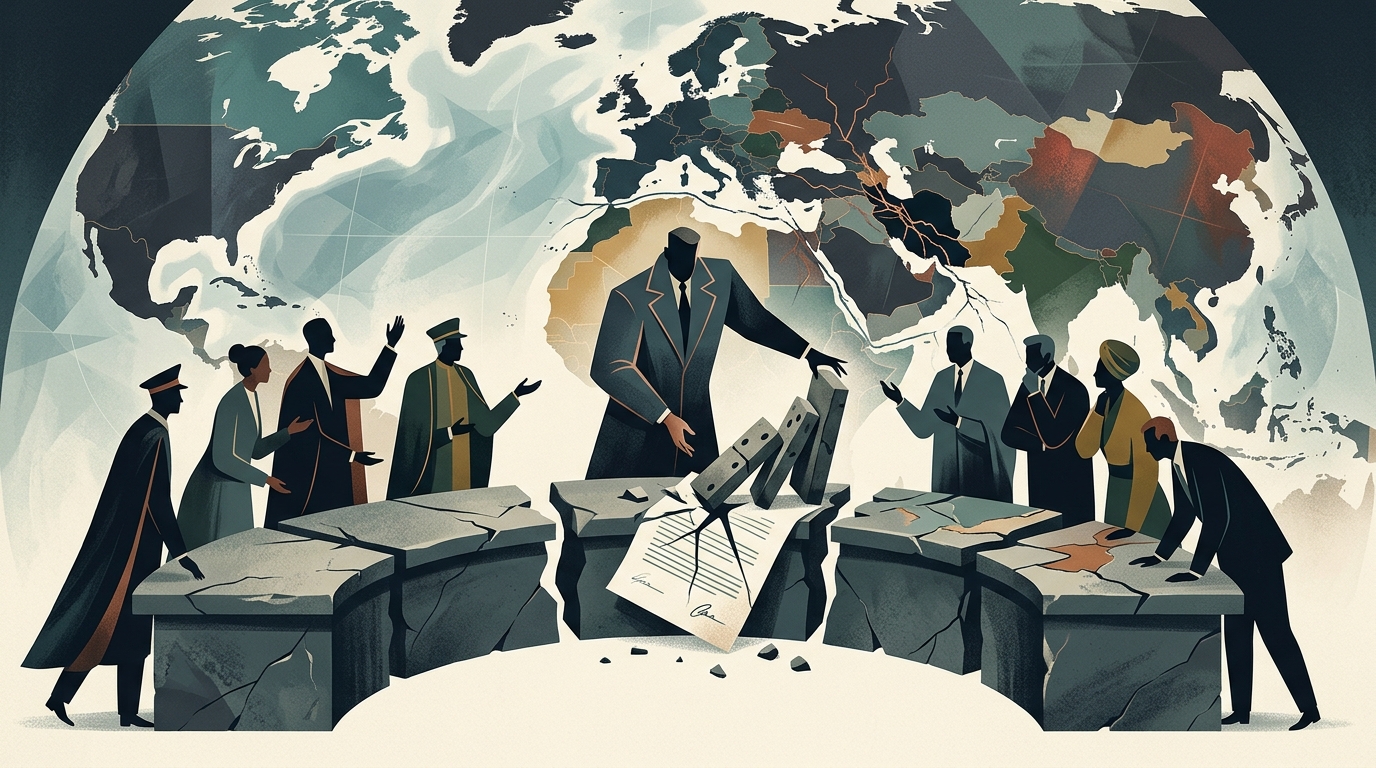
In a move anticipated by many analysts but still sending shockwaves through international capitals, Donald Trump has once again utilized Truth Social to redefine United States foreign policy. His declaration that the "truce" with Iran has ended, coupled with the clarification that talks are ongoing, marks a new, unpredictable phase in the West's confrontation with the Islamic Republic. This development comes at a moment when the Middle East is already on high alert, with regional conflicts threatening to ignite a broader conflagration.
The 'Maximum Pressure 2.0' Strategy
Trump’s approach to the Iran issue has never been linear. From withdrawing from the Joint Comprehensive Plan of Action (JCPOA) during his first term to recent attempts at a "silent truce," the objective has remained consistent: the complete capitulation of Tehran under the weight of economic sanctions and military threats. By announcing the end of the truce, Trump appears to be returning to the doctrine of "maximum pressure," but with a significant caveat. Maintaining talks suggests that Washington is not seeking—at least not yet—all-out war, but is instead trying to coerce Iran into a new deal on much harsher terms.
This tactic of brinkmanship carries immense risks. Iran, facing an economy stifled by inflation and social unrest, has shown in the past that its response to pressure is often escalation through its proxies in Lebanon, Yemen, and Iraq. The end of the truce practically means that the US may intensify sanctions on oil exports, while Tehran could accelerate uranium enrichment, bringing the world closer to the specter of a nuclear-armed Iran.
Qatar's Role as the Indispensable Mediator
Amidst this tension, Qatar emerges once again as the essential "honest broker." Doha, maintaining close ties with both Washington and Tehran, is attempting to keep the thread of communication alive. Qatari diplomats are working feverishly to ensure that the expiration of the truce does not translate into direct military conflict. Qatar's ability to host back-channel talks is perhaps the only safety valve preventing a total breakdown of order.
However, Qatari mediation faces steep hurdles. Growing distrust between the two sides makes any progress excruciatingly slow. Trump demands "a deal that will last forever," while Iran seeks guarantees that no American administration seems willing to provide in a binding manner. Qatar is tasked with squaring the circle, balancing the demands of a superpower against the survival of a regime that views concession as an existential threat.
Regional Implications and the Road Ahead
Trump's announcement is not just about US-Iran bilateral relations; it directly affects the balance of power across the entire region. Israel, under the Netanyahu government, will likely view this development as a green light for more aggressive actions against Iranian interests. Conversely, Gulf Arab states like Saudi Arabia and the UAE are watching with concern, fearing that an escalation could target their own energy infrastructure and economic stability.
- The return to uncertainty impacts global energy prices and market stability.
- The credibility of international agreements is once again called into question.
- The role of non-state actors (Hezbollah, Houthis) is expected to become more prominent.
In conclusion, Trump's move is a high-stakes gamble. If successful, it could lead to a new security architecture in the Middle East. If it fails, it could be the spark for a conflict that reshapes the world as we know it. Diplomacy via social media may be effective for domestic consumption, but on the international stage, words carry a weight often measured in blood and oil. The coming months will be decisive in determining whether the "talks" Trump mentions are a genuine opportunity or merely the smoke screen before the storm.