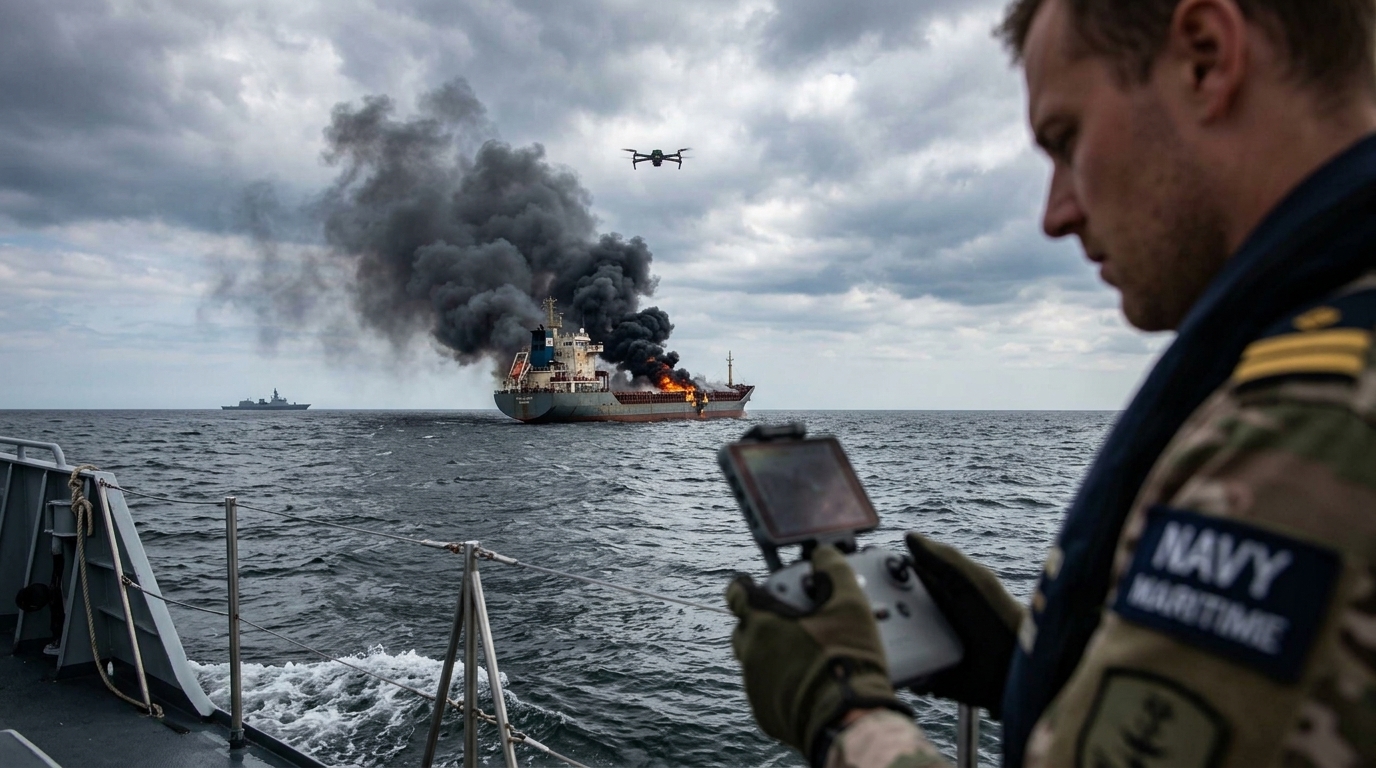
The conflict in the Black Sea escalated sharply this week as drones sank two cargo ships and severely damaged a third within the Exclusive Economic Zones (EEZ) of NATO member states. The attacks, occurring on October 5 and 6, resulted in the deaths of at least two sailors and left one missing, marking a significant escalation in what is being described as Russian "hybrid warfare."
Chronicle of the Strikes
On October 6, the Togo-flagged Alfa Watan sank, and the Palau-flagged Able was set ablaze after being targeted by multiple sea and aerial drones approximately 80 miles off the Bulgarian coast. While the crew of the Able was evacuated by a Bulgarian ferry, the fate of those aboard the Alfa Watan remains unknown. These incidents followed an attack on October 5 against the Turkish-owned Royad Mammadov in Romania’s EEZ, which also led to its sinking and the loss of two lives.
International Reactions and Allegations
Bulgarian Prime Minister Rumen Radev described the incidents as a "blatant violation of international law." European Commission President Ursula von der Leyen called the strikes "increasingly concerning" and stated that attacks on civilian shipping are "unacceptable," though she noted that circumstances are still being established. Conversely, Ukrainian President Volodymyr Zelenskyy explicitly blamed a "Russian combined attack," asserting that Moscow consistently chooses terror over normal maritime navigation.
Broader Hybrid Warfare Across Europe
These maritime strikes coincide with a growing list of incidents attributed to Russian "gray-zone" tactics targeting various European nations:
- In Romania, military divers recently neutralized drones near the Neptun Deep natural gas project.
- Germany has accused Russia of an attempted drone strike on cargo aircraft at Leipzig Airport.
- Estonia and Poland are investigating arson and sabotage against military robotics firms and satellite communication stations.
As the NATO alliance works to adapt to modern drone-dominated warfare, the immediate challenge remains whether member states can agree on a unified strategy to discourage such provocations from a nuclear-armed adversary.