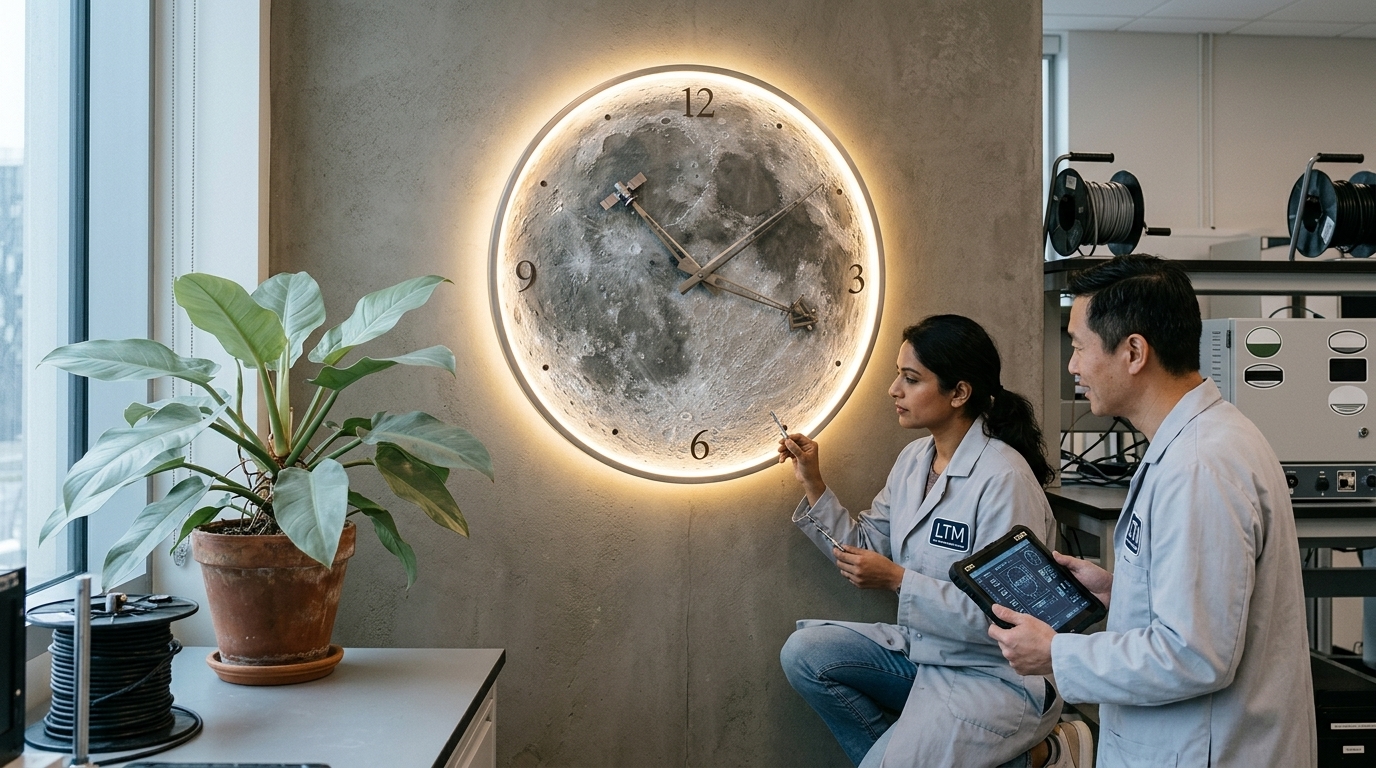
What time is it in the Sea of Tranquility when it is noon in Athens? This question is no longer theoretical, as scientists worldwide are examining the establishment of a commonly accepted lunar time, deemed a critical factor for future lunar exploration programs.
The Challenge of Relativity
On Earth, our devices are synchronized with Coordinated Universal Time (UTC). However, UTC cannot be directly applied to the Moon because time flows faster there—a phenomenon predicted by Albert Einstein in his theory of general relativity. According to scientists, two clocks synchronized on Earth would diverge by 56 microseconds per day if one were sent to the Moon.
While the difference may seem negligible, it is of critical importance for technology. As Pascale Defraigne of the Royal Observatory of Belgium explained during the 28th General Conference on Weights and Measures (CGPM) in Versailles, this precision is essential for landing spacecraft and navigating astronauts. NASA's Joel Parker added that achieving one-meter navigation accuracy on the Moon translates to a timing precision requirement of one nanosecond.
A Clock Network in Space
Major space agencies (NASA, China, India, Japan, ESA) plan to deploy navigation satellites in orbit around the Moon. For the operational safety of all users, the adoption of common regulations is considered mandatory. Currently, astronomers use Lunar Coordinate Time (TCL), but various derivative forms are used by different agencies.
Creating a new time scale brings complex questions:
- Who will be responsible for the network of atomic clocks that must be installed on the lunar surface?
- How will "zero altitude" be defined for clock calibration, given that the Moon lacks a sea level to serve as a reference point?
These issues are expected to occupy metrologists, astronomers, and international organizations in the coming years as humanity prepares for a permanent base on Earth's satellite.