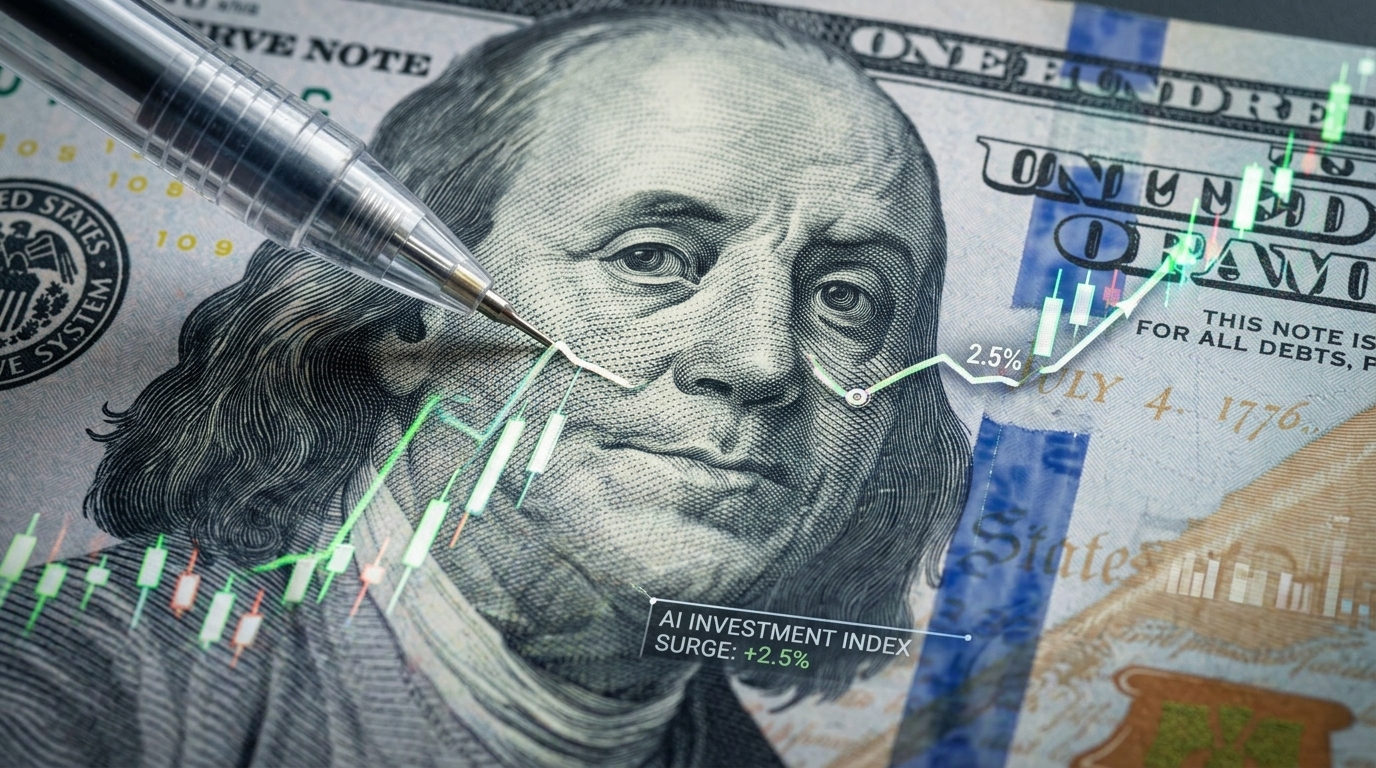
Economists are upwardly revising their forecasts for the US economy in the third quarter, citing artificial intelligence and high-income consumer spending as the primary drivers of momentum. According to the latest Bloomberg survey, US GDP is now expected to grow at an annualized rate of 2.5%, up from a previous estimate of 2%.
The AI Investment Surge
The upgrade is largely attributed to the acceleration of business investments in technology infrastructure. Total capital expenditures related to AI are projected to surpass $1 trillion within 2026, before climbing further to over $1.5 trillion in 2027.
James Knightley, chief international economist at ING, notes that these investments are the leading factor in rising corporate capital spending. Meanwhile, consumption remains a pillar of activity, though it is predominantly driven by high-income households, highlighting an uneven distribution across the economy.
Inflation and Fed Policy
Despite robust growth, inflation remains a concern. The core Personal Consumption Expenditures (PCE) index is expected to average 3.2% this year, remaining above the Fed's 2% target through 2027. Consequently, analysts predict the Federal Reserve will keep interest rates unchanged until July of next year.
Market sentiment suggests a less hawkish stance from the new Fed Chair, Kevin Warsh, with the probability of a rate hike in September now priced at less than 50%.
Growth Without Job Creation?
One of the most striking findings is the divergence between GDP growth and employment. While the economy expands, job creation estimates have been trimmed to just 66,000 per month for 2026 and 2027. This suggests that large-scale technology investments are boosting GDP through efficiency rather than headcount expansion.
Finally, the escalation of conflict with Iran remains the most significant external risk. A prolonged disruption to energy supplies could keep oil prices high, stifling growth while simultaneously fueling inflationary pressures.