

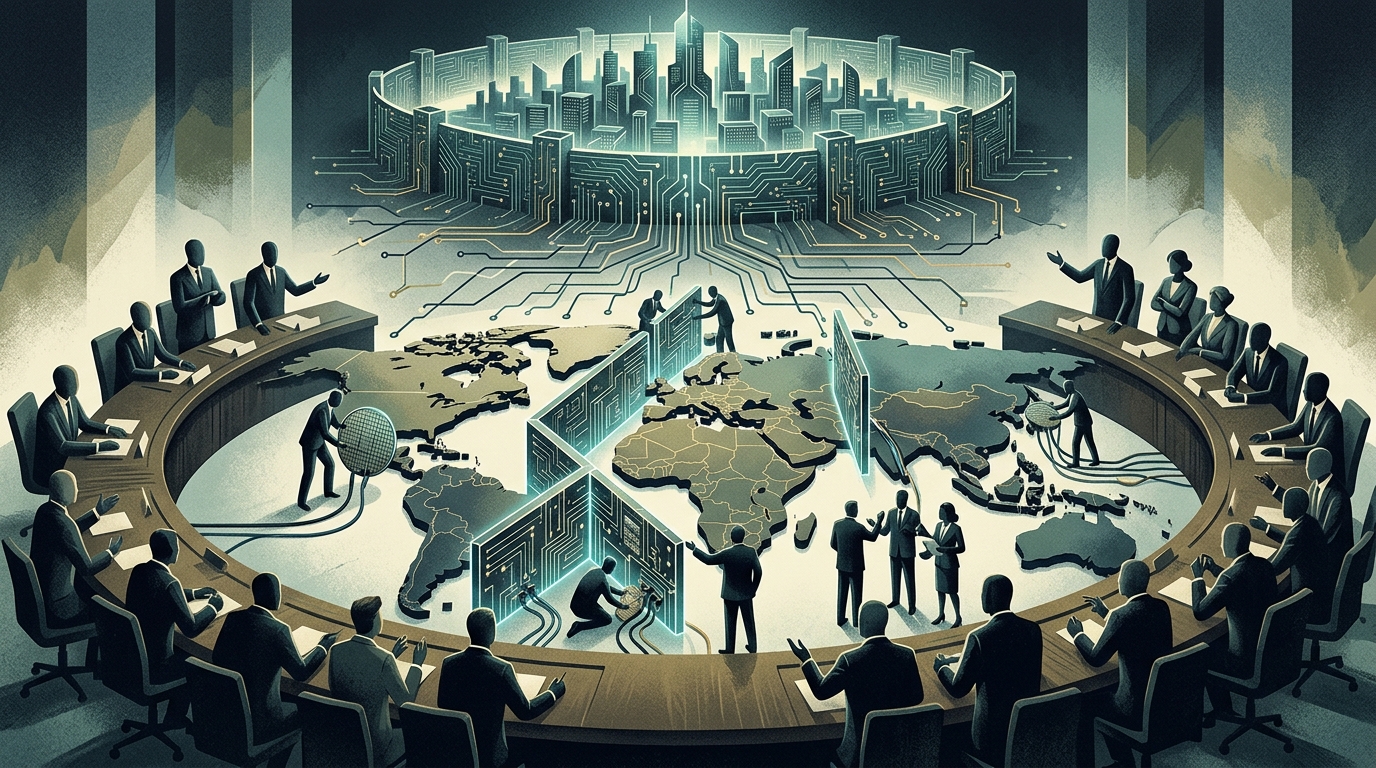
In the ancient world, the Polis was defined by its walls—not just of stone, but of laws and citizenship. Today, we are witnessing a modern reconstruction of these boundaries. The announcement by the Trump administration to suspend Microsoft and other tech giants from the Green Card program is a seismic shift. Vice President JD Vance speaks of "foreign indentured servants," a term that carries a heavy, almost archaic weight. But I wonder: are we protecting the worker, or are we strangling the very innovation that keeps the Polis competitive?
The Paradox of the Borderless Mind
While the administration tightens the grip on human talent—targeting even prestigious universities like Harvard and MIT for their use of foreign academics—the technology itself remains stubbornly indifferent to borders. We see Samuel King at Stanford designing viruses with AI, and OpenAI releasing solutions to mathematical puzzles that have long baffled the human mind. These breakthroughs don’t hold passports. Yet, the people building them are now being viewed through a lens of suspicion.
"If you do the math, for every worker that Microsoft laid off, they replaced that worker with one and a half foreign indentured servants," Vance stated.
It is a stark calculation. However, experts like Doug Rand point out a fundamental incoherence: a Green Card actually grants a worker independence. By blocking the path to residency, the state might inadvertently be keeping workers in the very state of dependence it claims to despise. Is this Phronesis (practical wisdom), or is it merely a reaction to the fear of the unknown?
The Real Monsters in the Room
We often treat AI as the primary threat to our livelihoods, but Mark Cuban offers a necessary dose of Mediterranean pragmatism. He argues that the real "job killer" isn't the algorithm; it's the skyrocketing cost of healthcare. When a family premium reaches $30,000, it is the insurance bill, not the AI agent, that prevents a company from hiring. It is far easier for a politician to blame a machine or a foreign worker than to fix a broken administrative system.
We see this friction everywhere. Anthropic releases a scanner to help open-source projects, yet it overwhelms human maintainers with a "flood" of reports. The Ethereum community enters "bunker mode" because AI might soon crack our most sacred encryptions. We are building a future of immense power, but we are failing to build the social and economic structures to house it safely.
A Call for Balance
In Greece, we know that Metron (moderation) is the key to a stable society. We must protect the dignity of the local worker, yes, but not at the cost of the intellectual diversity that fuels progress. Whether it is Denmark banning unauthorized deepfakes to protect digital identity or the Lancet study showing AI can actually strengthen the patient-doctor bond, the goal must be the same: technology in the service of the human, not the human as a casualty of the technological or political crossfire.