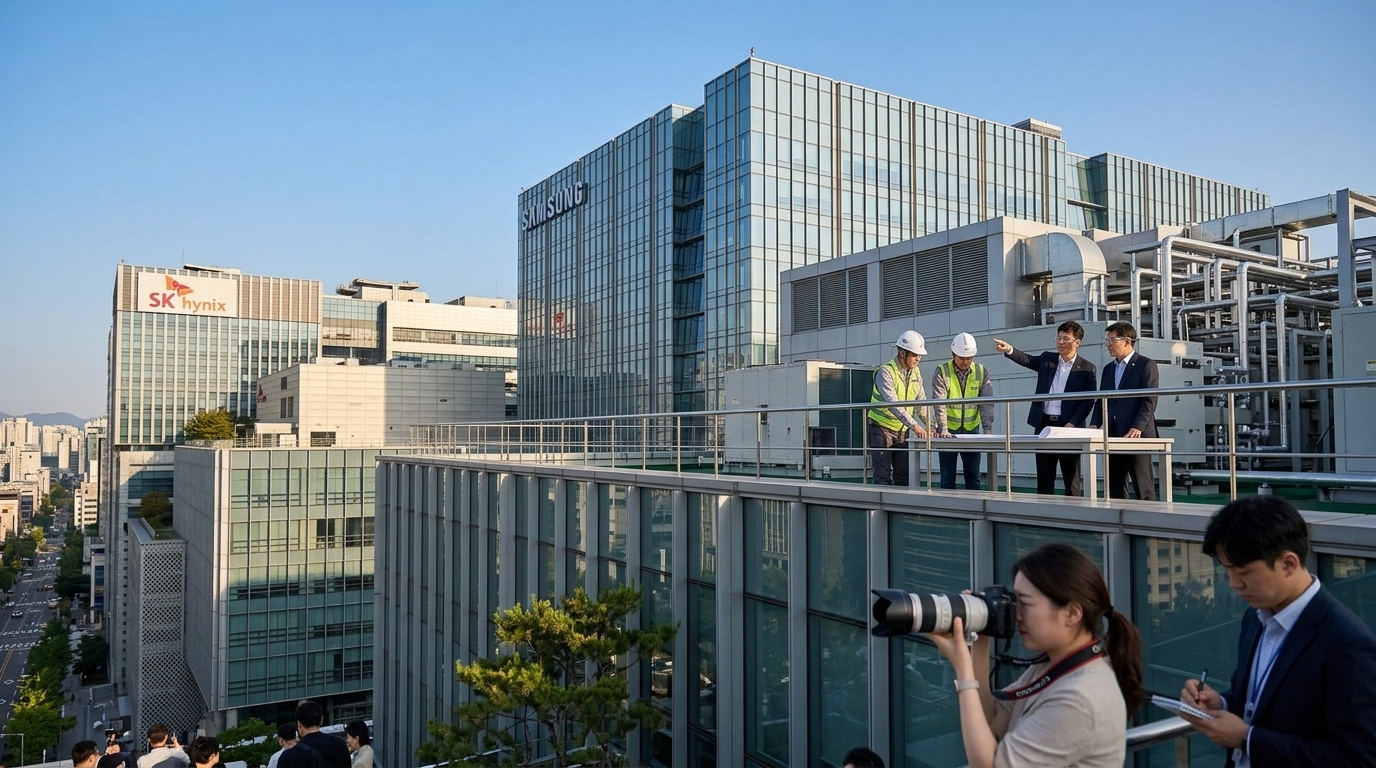
In a move that fundamentally reshapes the global geopolitical chessboard of technology, giants Samsung Electronics and SK Hynix have announced a titanic investment program totaling $1.3 trillion over the next decade. The news, which sent shockwaves through international markets, involves the creation of a gargantuan semiconductor ecosystem in the greater Gwangju area, featuring the construction of up to ten new cutting-edge chip fabrication plants (fabs).
Silicon as the New Geopolitical Currency
This is not merely a business expansion; it is an act of national survival and sovereignty. In an era where Artificial Intelligence (AI) demands ever-increasing computational power, owning the means of production for the most advanced memory (HBM) and logic chips is the modern equivalent of controlling oil fields in the 20th century. South Korea, through this 'Mega Cluster,' seeks to make itself an indispensable link in the global supply chain, shielding its economy against US protectionist trends and China's aggressive rise.
This investment is expected to create hundreds of thousands of jobs, not only in direct manufacturing but also across a vast network of suppliers, research centers, and design firms. The choice of Gwangju is strategic, as the region is being transformed into a technological hub poised to rival Silicon Valley in infrastructure and scientific talent.
The Technological Challenge: From NAND to AI-Memory
Samsung and SK Hynix are not just investing in capacity; they are investing in next-generation technology. The demand for high-density NAND chips and HBM (High Bandwidth Memory) has skyrocketed due to Large Language Models (LLMs). The new fabs will focus on production processes below 2 nanometers, utilizing Extreme Ultraviolet Lithography (EUV) technology at a scale never before attempted.
- Development of HBM4 and HBM5 memories for next-gen GPUs.
- Vertical integration to reduce costs and time-to-market.
- Integration of sustainable energy technologies to power these energy-intensive fabs.
However, the venture is not without risks. The massive requirement for electricity and water puts South Korea's national infrastructure to the test. Discussions are already underway regarding the need for Small Modular Reactors (SMRs) dedicated solely to powering these units, a decision expected to spark intense political debate.
"The scale of this investment exceeds anything we have seen in the history of the industry. It is a statement that the future of computing will be built on Korean soil," state market analysts in Seoul.
Economic Implications and Global Competition
With the US subsidizing its own domestic production via the CHIPS Act and Europe attempting to regain lost ground, the move by Samsung and SK Hynix is a resounding response. South Korea is signaling that it has no intention of surrendering its semiconductor hegemony. The $1.3 trillion figure is larger than the GDP of many developed nations, highlighting the importance of chips to the modern economy.
For investors, this long-term commitment signifies stability but also massive capital expenditures that could pressure dividends in the short term. Nevertheless, the strategic value of dominating the AI market is priceless. Gwangju will no longer be a provincial city but the heart of the digital world, where physics meets artificial intelligence at the atomic scale.
In conclusion, the next decade will be defined by whether these investments bear fruit. If Samsung and SK Hynix succeed in realizing this vision, South Korea will remain the undisputed arbiter of the digital age, controlling the flow of data and knowledge on a global scale.