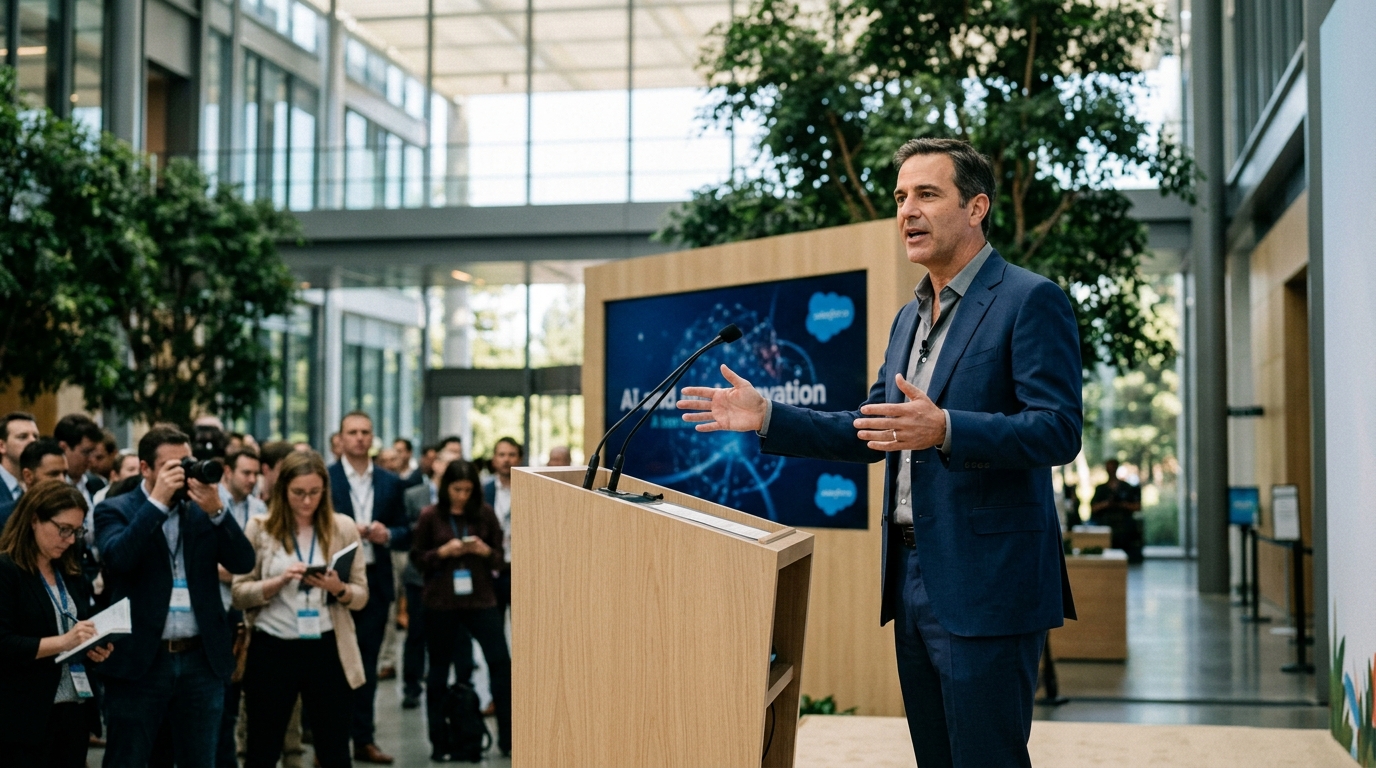
In a move poised to reshape the global software landscape, Salesforce has announced the acquisition of Fin, a premier startup specializing in autonomous AI agents, for a staggering $3.6 billion. This deal, one of the most significant in the AI sector as of mid-2026, confirms Marc Benioff’s total pivot toward the "Agentic Web"—an ecosystem where artificial intelligence doesn't just assist humans but takes autonomous action.
The Evolution from Copilots to Autonomous Agents
For the past two years, the corporate world has been saturated with "Copilots"—AI assistants that required constant human prompting and supervision. Fin, however, distinguished itself by developing technology that allows digital agents to resolve complex customer issues, manage supply chains, and execute sales cycles without human intervention. Integrating Fin into Salesforce’s Agentforce platform promises to transform CRM from a passive database into a living, automated entity.
Fin’s technology is built on a proprietary "Reasoning Engine" architecture, which allows the AI to understand a business's specific context and make decisions based on real-time data, reducing hallucinations to levels below 0.1%. This level of precision is what convinced Salesforce to commit such a massive sum, despite ongoing shareholder pressure for fiscal discipline and margin expansion.
The Ecosystem War: Salesforce vs. Microsoft
This acquisition is not merely a feature addition; it is a strategic counter-offensive against Microsoft and ServiceNow. While Microsoft bets on embedding OpenAI across Office 365, Salesforce is attempting to dominate the enterprise data layer. With Fin, Salesforce can now offer "out-of-the-box" agents for various industries—from healthcare to banking—that plug directly into the company’s Data Cloud.
- Autonomy: Fin’s agents can execute workflows that previously required dozens of human hours.
- Scalability: The ability to serve millions of users simultaneously with deep personalization.
- Integration: Seamless compatibility with Slack, enabling humans and agents to collaborate in a single environment.
Labor Market and Economic Implications
Despite Wall Street’s enthusiasm, the acquisition raises serious questions about the future of work in customer service and sales departments. If an AI agent costing a few dollars an hour can replace a team of ten, the pressure for workforce restructuring will be unprecedented. Salesforce maintains that agents will "augment" employees, allowing them to focus on higher-value creative tasks, but industry analysts remain skeptical about the net impact on headcount.
"We aren't just buying a company; we are buying the future of how business is conducted. Fin is the brain that will allow every enterprise to operate at the speed of light," said Marc Benioff during the announcement.
From a financial perspective, the $3.6 billion price tag represents a revenue multiple reminiscent of Silicon Valley’s peak valuation days. However, in the AI era, value is measured not just by current ARR (Annual Recurring Revenue), but by the ownership of algorithms that will govern tomorrow’s workflows. Salesforce is betting that Fin will be the catalyst to drive subscription revenue growth by 15-20% over the next three years.