The promise of Artificial Intelligence is often marketed as something ethereal—an intangible force residing in the "cloud," solving humanity’s most complex problems at the speed of light. However, in the community of Mount Pleasant, Wisconsin, AI has taken on a much more physical, noisy, and intrusive form. Microsoft’s flagship data center, recently hailed by CEO Satya Nadella as the "world’s most powerful AI data center," is now at the center of a legal storm that highlights the hidden costs of technological progress.
The Relentless Hum of Progress
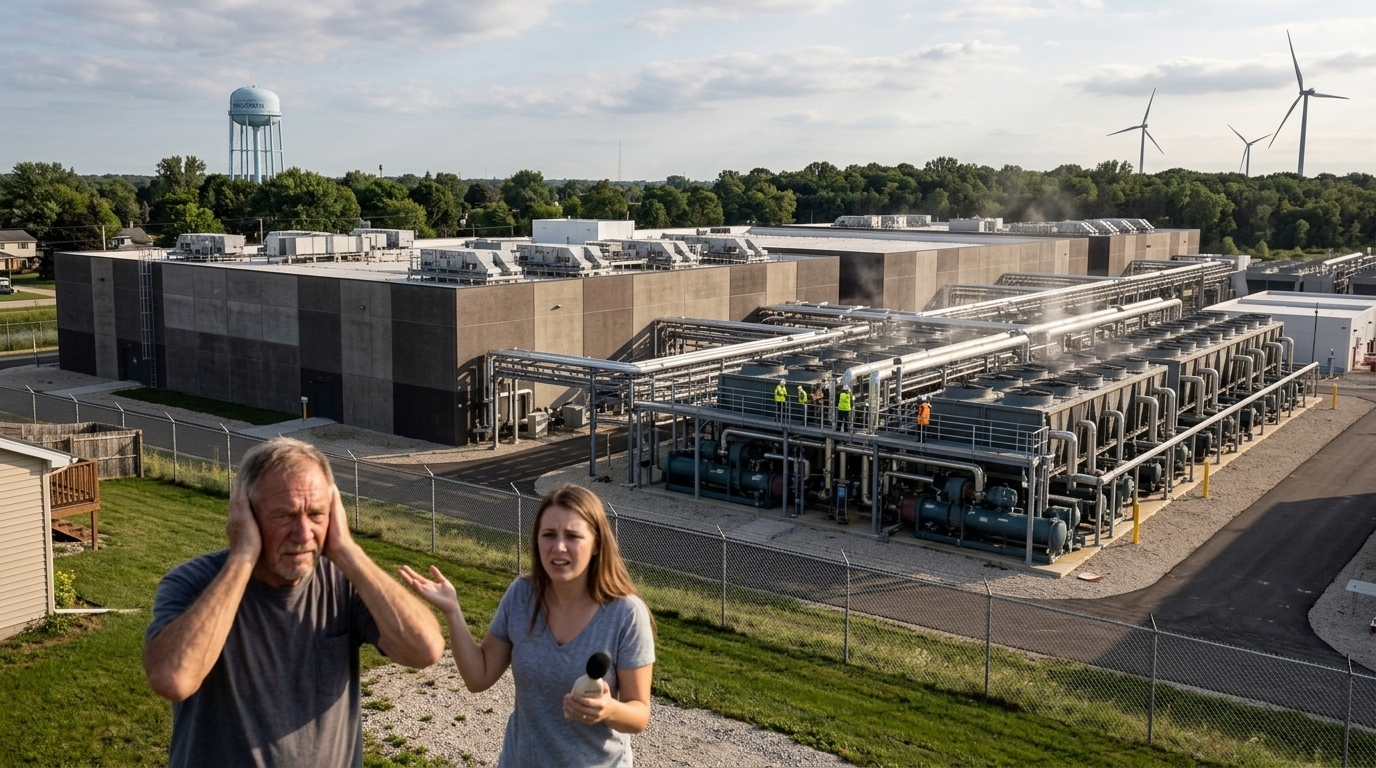
Residents living adjacent to the massive facility have filed a class-action lawsuit against the tech giant, alleging that the data center’s operations produce a constant, low-frequency noise that has rendered their lives unbearable. This isn't merely industrial background noise; it is a persistent hum that penetrates home walls, causing sleep deprivation, heightened anxiety, and a significant decline in quality of life. Plaintiffs describe the situation as a form of low-intensity "psychological warfare," where the once-tranquil countryside has been replaced by the roar of thousands of fans desperately trying to cool Microsoft’s overheating processors.
Generative AI requires immense computational power, which in turn generates staggering amounts of heat. To keep these systems operational, massive HVAC systems and cooling towers must run 24/7. In the case of Wisconsin, it appears the facility's design failed to adequately account for the acoustic impact on the surrounding area—or at least that is the claim of residents who are watching their property values plummet alongside their peace of mind.
The Haunted Legacy of Mount Pleasant
The Mount Pleasant site carries a unique political and economic history. Years ago, the area was designated for the infamous Foxconn factory, a project championed by the Trump administration as the "eighth wonder of the world," which ultimately collapsed, leaving behind empty fields and broken promises. Microsoft emerged as the savior, promising to utilize the infrastructure, invest billions of dollars, and create high-tech jobs.
However, the transition from manufacturing to digital infrastructure has brought unexpected challenges. While a factory typically operates on set shifts, an AI data center is a living organism that never sleeps. The lawsuit alleges that Microsoft failed to implement necessary noise mitigation strategies, such as sound barriers or specialized mufflers on exhaust fans, choosing instead to prioritize the rapid deployment of hardware to stay ahead in the global AI arms race.
The Dilemma: Infrastructure vs. Community
The Wisconsin issue is not an isolated incident. Across the globe—from Ireland and the Netherlands to Virginia and Singapore—local communities are beginning to revolt against the encroachment of data centers. The grievances extend beyond noise; the staggering consumption of electricity, which often strains local grids, and the requirement for millions of gallons of water for cooling systems are creating a volatile social environment.
Microsoft, along with Google and Amazon, finds itself in a precarious position. On one hand, they must satisfy the market’s insatiable hunger for AI services. On the other, the "social license to operate" is becoming increasingly difficult to maintain. A court ruling in Wisconsin could set a major legal precedent, forcing tech companies to invest significantly more in silent cooling technologies and better environmental integration—costs that will inevitably be passed down to the consumers of AI services.
Conclusion and Future Outlook
This case serves as a stark reminder that technology does not exist in a vacuum. Every bit of information processed by ChatGPT or Copilot has a physical footprint in the real world. If Microsoft and its competitors wish to continue their expansion, they must recognize that innovation cannot be forced at the expense of human health and tranquility. The "silent" AI revolution is proving to be incredibly loud, and the residents of Mount Pleasant are the first of many who may demand their right to silence.
- The class-action suit focuses on low-frequency noise pollution and health impacts.
- The facility is a multi-billion dollar strategic asset for Microsoft's AI dominance.
- Lack of transparency and rapid construction timelines are cited as key grievances.
- The verdict could redefine zoning and environmental standards for data centers globally.