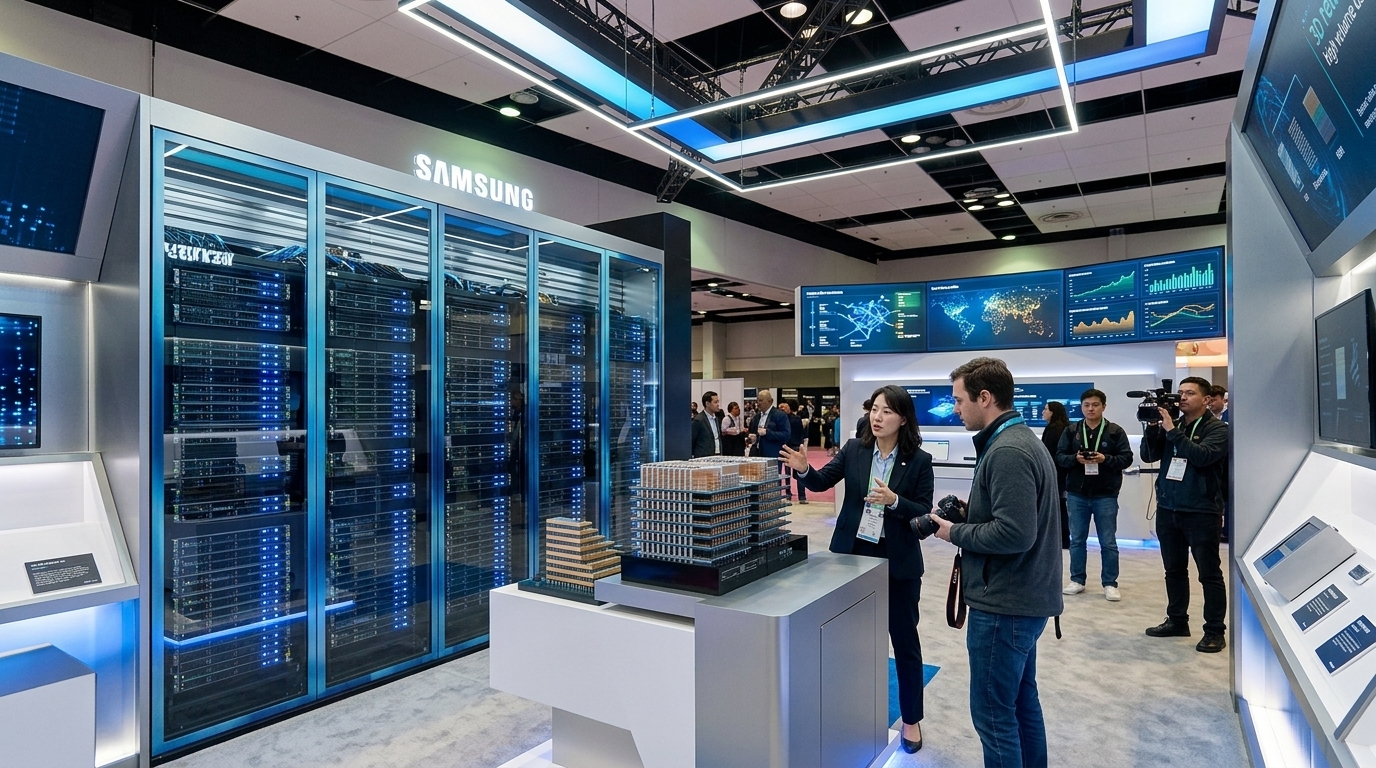
The global technology market is at a critical crossroads, and according to CNBC’s Jim Cramer, Samsung Electronics' recent performance is the "harbinger" of a broader reshuffling in the Artificial Intelligence (AI) sector. While Nvidia remains the undisputed sovereign of processors, investor attention is now shifting to those providing the essential "ingredients" for these processors to function: High Bandwidth Memory (HBM).
The Return of the Giant: Why Samsung is Changing the Game
For months, Samsung was considered the "laggard" of the AI race, as rival SK Hynix managed to secure exclusive supply of HBM3 memory chips for Nvidia. However, the market’s recent reaction to Samsung’s financial results and technological announcements indicates that the South Korean giant has found its stride. Cramer points out that the market is no longer pricing Samsung merely as a smartphone maker, but as an indispensable pillar of AI infrastructure.
Samsung announced significant progress in developing 12-layer HBM3E chips, which are critical for the next generation of AI GPUs. The company's ability to produce these components at massive scale is what frightens the competition and excites Wall Street. As Cramer notes, when a player of Samsung's magnitude enters a niche market aggressively, the dynamics of supply and demand change radically, putting pressure on prices and redistributing profits across the entire value chain.
The Broadening of the "AI Trade": Beyond Nvidia
Cramer’s analysis suggests we are in the "broadening" phase of the AI market. Until recently, investors focused almost exclusively on a few software and chip design companies. Now, the focus is turning to companies that own the means of production and the raw materials of the digital age. Samsung, with its vertically integrated production model—from foundries to final assembly—offers a level of security that "fabless" companies cannot guarantee.
- Samsung’s HBM3E chip certification by Nvidia is the "golden ticket" to dominance.
- Increased Capital Expenditure (CapEx) from cloud giants (Microsoft, Google, Meta) directly benefits memory suppliers.
- South Korea's geopolitical stability makes it a preferred partner compared to regions hit by trade wars.
Geopolitics and Technological Sovereignty
The shift toward Samsung is not just financial; it is strategic. In a world where AI is considered the new "oil," controlling the semiconductor supply chain is equivalent to national power. Samsung acts as a bridge between Western design brilliance and Eastern manufacturing prowess. Cramer argues that if Samsung manages to dominate the HBM market, it could become the arbiter of progress, influencing how quickly other companies can train their models.
"It's no longer about who has the best algorithm, but about who has the most memory chips to run it," the analysis states.
In conclusion, the "Samsung moment" described by Cramer serves as a reminder that in technology, hardware always returns to claim its share of the software's glory. For investors, this means the next phase of the AI revolution will be played out in the semiconductor fabs of Seoul as much as in the offices of Silicon Valley.