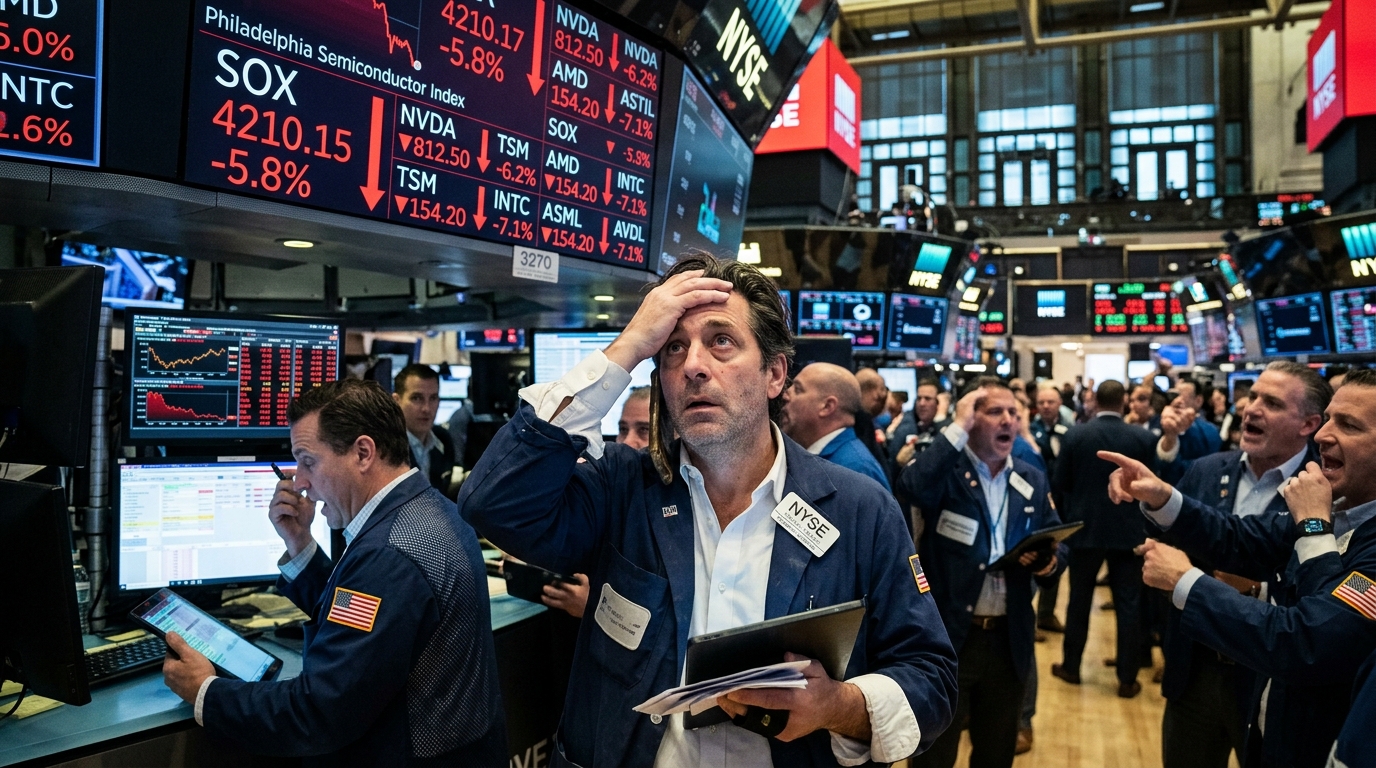
July 7, 2026, will likely be recorded as the day Wall Street decided to stare down the reality behind the Artificial Intelligence narrative. As the closing bell rang at the New York Stock Exchange, the semiconductor sector — once the market's unstoppable engine — found itself in a freefall. 'AI anxiety' is no longer a whisper in the corners of investment banks; it is a scream reflected in the crimson indices of Bloomberg terminals.
The Return on Investment (ROI) Crisis
For nearly three years, markets were fueled by the promise that AI would transform global productivity. However, on Bloomberg's 'The Close,' the conversation shifted to a much more mundane but critical question: When will we see the profits? Big Tech companies (Hyperscalers) have spent hundreds of billions of dollars on GPUs and infrastructure, but converting that raw power into sustainable software revenue remains agonizingly slow.
Mandy Xu, Head of Derivatives Market Intelligence at Cboe Global Markets, noted that volatility in the options market suggests institutional investors are rushing to hedge their downside. This is no longer a simple correction; it is a fundamental reassessment of the earnings multiples assigned to companies like NVIDIA and AMD. When valuations are built on growth rates approaching infinity, any sign of deceleration triggers a violent reaction.
The Energy Wall and TeraWulf's Perspective
One of the most intriguing aspects of today's slump concerns the physical limit of digital expansion: energy. Paul Prager, Chairman and CEO of TeraWulf, explained how electricity availability and data center capacity have become the new 'currency' of the AI economy. The shift from Bitcoin mining to providing infrastructure for AI (HPC - High Performance Computing) highlights a harsh truth: even if we have the chips, we may not have the power to run them.
- Delays in connecting new data centers to the power grid are slowing down orders for new semiconductors.
- The cost of 'green' energy is driving up the operating costs of AI models, squeezing profit margins.
- Geopolitical instability in Taiwan remains an unpredictable factor for the global supply chain.
Investor Strategy and CFRA Research Insights
Analysts from CFRA Research emphasize that we are in a phase of 'euphoria discharge.' Investors are rotating from growth stocks into more defensive positions as fears of a US economic slowdown combine with excessive tech exposure. The drop in chip stock prices does not necessarily reflect a failure of the technology itself, but rather a failure of expectations to align with the time horizons of the real economy.
"The market had priced in five years of growth within twelve months. What we are seeing today is a violent reversion to the mean," a market executive noted during the closing minutes.
In conclusion, today's turmoil highlights that AI is no longer a speculative promise but an industrial sector that must prove its worth in terms of profitability, energy efficiency, and realistic growth rates. The summer of 2026 appears to be the period of the great 'clearing' for the semiconductor ecosystem.