Elon Musk’s relationship with the traditional press has never been harmonious, but the latest episode in this long-standing vendetta marks a new, more dangerous phase. Following a report by the technology news outlet The Verge, which linked Musk’s proposals for drastic spending cuts to the undermining of international public health programs, the billionaire owner of X (formerly Twitter) launched a fierce counter-attack. His comment, which went viral within minutes, did not just challenge the data of the report; it challenged the very entity of journalism as an institution.
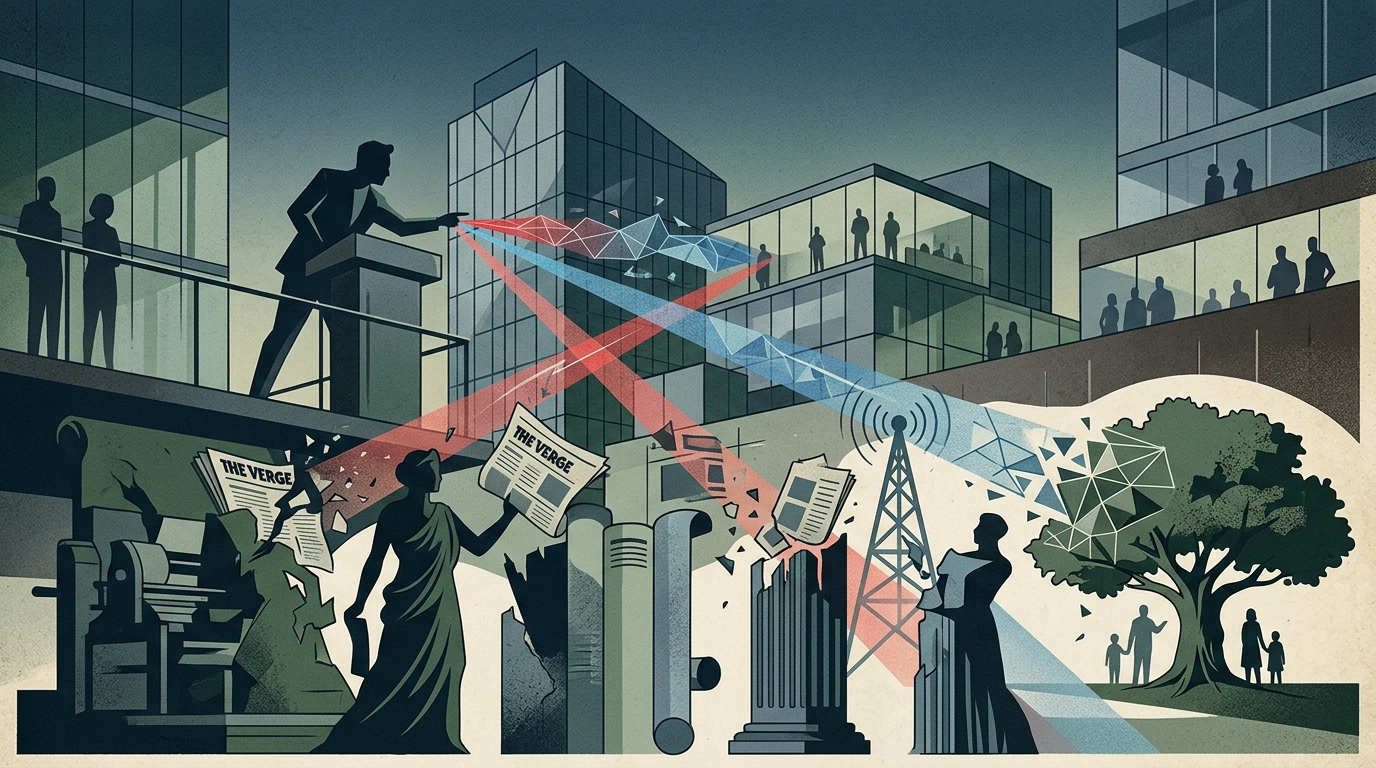
The issue at stake is not merely a disagreement over numbers. It is a clash of two diametrically opposed worldviews: on one side, traditional journalism that attempts to exercise accountability over power, and on the other, the 'direct democracy' of information championed by Musk, where truth is often sacrificed at the altar of speed and personal agenda. The attack on The Verge is the latest example of a strategy aimed at the complete delegitimization of 'legacy media' in favor of an ecosystem where Musk himself serves as the ultimate arbiter.
Anatomy of a Conflict: The Report and the Reaction
The Verge's report focused on the potential impacts of Musk’s proposals—in his capacity as a consultant for government efficiency—on programs such as PEPFAR (the U.S. President's Emergency Plan for AIDS Relief). The article argued that Musk’s obsession with cutting 'fat' from the state budget overlooks the humanitarian disaster that could be caused by withdrawing American funding from global health initiatives. Musk’s response was laconic but inflammatory: he called the outlet a 'propaganda rag' and urged his followers to trust only 'citizen journalists' on X.
This rhetoric is not new, but its intensity is increasing as Musk gains more influence in government circles. By attacking journalists covering public health issues, Musk is not just protecting his legacy; he is attempting to silence criticism before it turns into political pressure. Using his platform to personally target journalists creates a 'chilling effect,' where analysts hesitate to criticize for fear of the digital army of his followers.
Public Health vs. Economic Efficiency: A Dangerous Balance
The core question raised by this conflict is whether the Silicon Valley logic of 'disruption' and 'efficiency' can be applied to sectors concerning human survival. Musk treats international health programs as bureaucratic burdens that must be streamlined. However, public health does not operate on the terms of a startup. Cutting funding for vaccines or HIV treatments does not lead to 'optimization' but to death and the destabilization of entire regions, which in turn carries a massive long-term economic cost.
Musk’s critics point out that his ignorance of the complexities of global diplomacy and health is dangerous. When this ignorance is coupled with the power to shape public opinion through one of the world's largest social networks, the result is a toxic mix of misinformation and authoritarianism. The attack on The Verge is, therefore, an attempt to shift the conversation from the substance—the lives at stake—to the process, namely the alleged bias of the media.
The Future of News in the Musk Era
Musk’s strategy seems to be paying off, at least in the short term. Trust in traditional media is at historic lows, and he exploits this vacuum to present himself as the sole purveyor of truth. However, the 'citizen journalism' he promotes lacks the safeguards, fact-checking, and ethics that characterize (or should characterize) professional media. In Musk’s universe, information is a tool of power, not a public good.
- Targeting journalists leads to self-censorship in the tech sector.
- The devaluation of global health programs threatens international stability.
- X is transforming from a dialogue platform into a personal propaganda tool.
- The conflict highlights the urgent need for new models of independent journalism.
In conclusion, Musk’s comment was not a mere moment of frustration. It was a strategic move on the chessboard of global influence. As the lines between technology, politics, and news become increasingly blurred, the need for robust, investigative journalism is more pressing than ever. The question remains: who will watch the watchmen when the watchmen own the very means by which we communicate?