

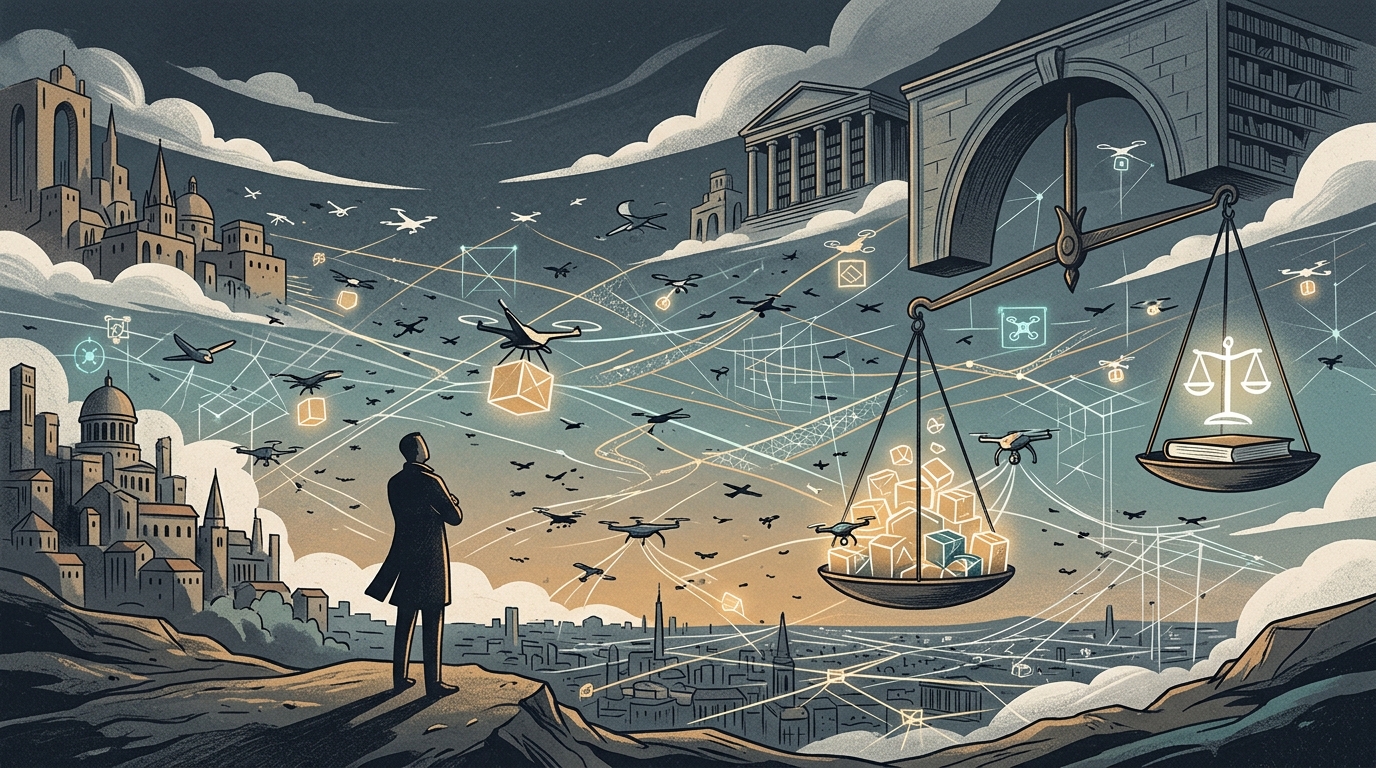
I often find myself looking up at the Mediterranean sky, a space that for millennia has belonged to the birds, the winds, and the gods of our ancestors. But today, the horizon looks different. As I read about Amazon’s plan to expand its Prime Air drone service to nearly 500 US cities and towns by the end of 2026, I cannot help but feel a sense of unease. We are witnessing the industrialization of the air itself.
The Sound of Progress?
Amazon calls it convenience; residents in Texas and Michigan call it a "flying leaf blower." Is this the future we want? A world where tens of millions of people must trade their neighborhood’s ambiance for a five-pound package delivered in thirty minutes to one hour? Beyond the noise, the safety record gives me pause. With drones crashing into cranes in Arizona and apartment buildings in Richardson, we must ask: at what point does corporate speed become public negligence? The FAA and NTSB are investigating, but the momentum of these giants often outpaces the slow wheels of justice.
The Fortress of Knowledge
While the skies are being filled, our halls of learning are being walled off. The Pentagon’s "zero tolerance" mandate for 30 university audits—targeting institutions like Harvard and MIT over foreign ties—feels like a chilling shift. I understand the need to safeguard research from exploitation, but as a Greek, I know that knowledge thrives on dialogos and exchange. When we threaten to cut federal funding within a two-week ultimatum, are we protecting innovation or merely building a fortress of suspicion? Even Christine Lagarde warns that Europe cannot afford to lose this second digital revolution, yet we seem more focused on building barriers than bridges.
Wealth from Thin Air?
Perhaps the most audacious move comes from Nvidia’s Jensen Huang, who now wants to turn "compute" into a financial asset class, much like real estate. He calls these chips "revenue-generating assets," yet critics rightly point out they have the "shelf life of lettuce." It reminds me of the ancient warnings against building on shifting sands. If the demand for AI labs like OpenAI fails to yield profit, this entire house of cards—built on GPUs as collateral—could collapse.
"We cannot afford to repeat the experience of the first digital revolution," Lagarde says.
I agree. But progress without phronesis—practical wisdom—is just noise. Whether it is the buzz of a drone over a backyard or the silence of a terminated academic partnership, we must ensure that the AI era serves the human condition, not just the quarterly report.