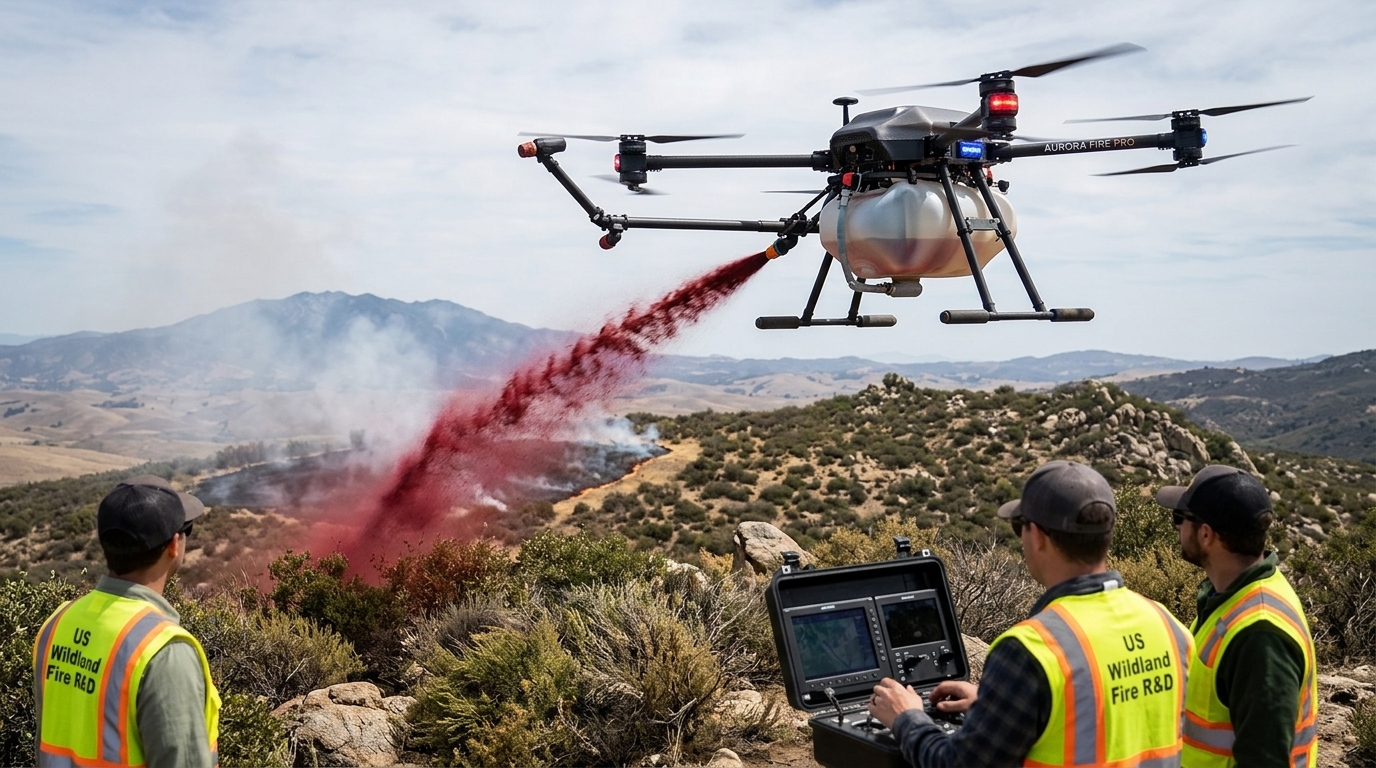
As climate change extends wildfire risks to a nearly year-round cycle in the United States, specialized drones are being tested in California and Alaska as a potential rapid-response solution. These autonomous systems are designed not to replace massive airtankers, but to extinguish small fires before they escalate into uncontrollable disasters.
Seneca’s Swarm Technology
On July 15, the California Department of Forestry and Fire Protection (CAL FIRE) conducted a field test involving five autonomous drones from Seneca. Working together as a swarm, the units deployed between 500 and 1,000 gallons of fire-suppressing foam. Each Argo-1 drone can carry approximately 100 pounds of payload.
- Drones fly autonomously to GPS waypoints set by human operators.
- Onboard sensors identify the specific heat signatures of the fire.
- The units line up to spray the fire sequentially at optimal hovering altitudes.
While limited to a 10-mile round trip, the drones are portable enough to fit in the back of a pickup truck. Seneca aims for a turnaround time of just two minutes for refilling payloads and swapping batteries, ensuring near-continuous operation.
Detection and Suppression in Alaska
In a separate initiative under the $11 million XPRIZE Wildfire competition, German firm Dryad Networks tested its Silvaguard system near Fairbanks, Alaska. This approach utilizes a network of solar-powered sensors attached to trees that detect smoke from smoldering fires. Once an alarm is triggered, an observation drone confirms the location via infrared sensors before a suppression drone arrives to drop up to 26 gallons of retardant.
Adoption and Market Outlook
While CAL FIRE is still in the evaluation phase, the Aspen Fire Protection District in Colorado has already committed to a $5 million contract for five Seneca drones over five years. With Seneca planning a full commercial launch in 2026, the focus remains on "nipping fires in the bud," providing a technological bridge for fire agencies facing increasingly volatile environments.