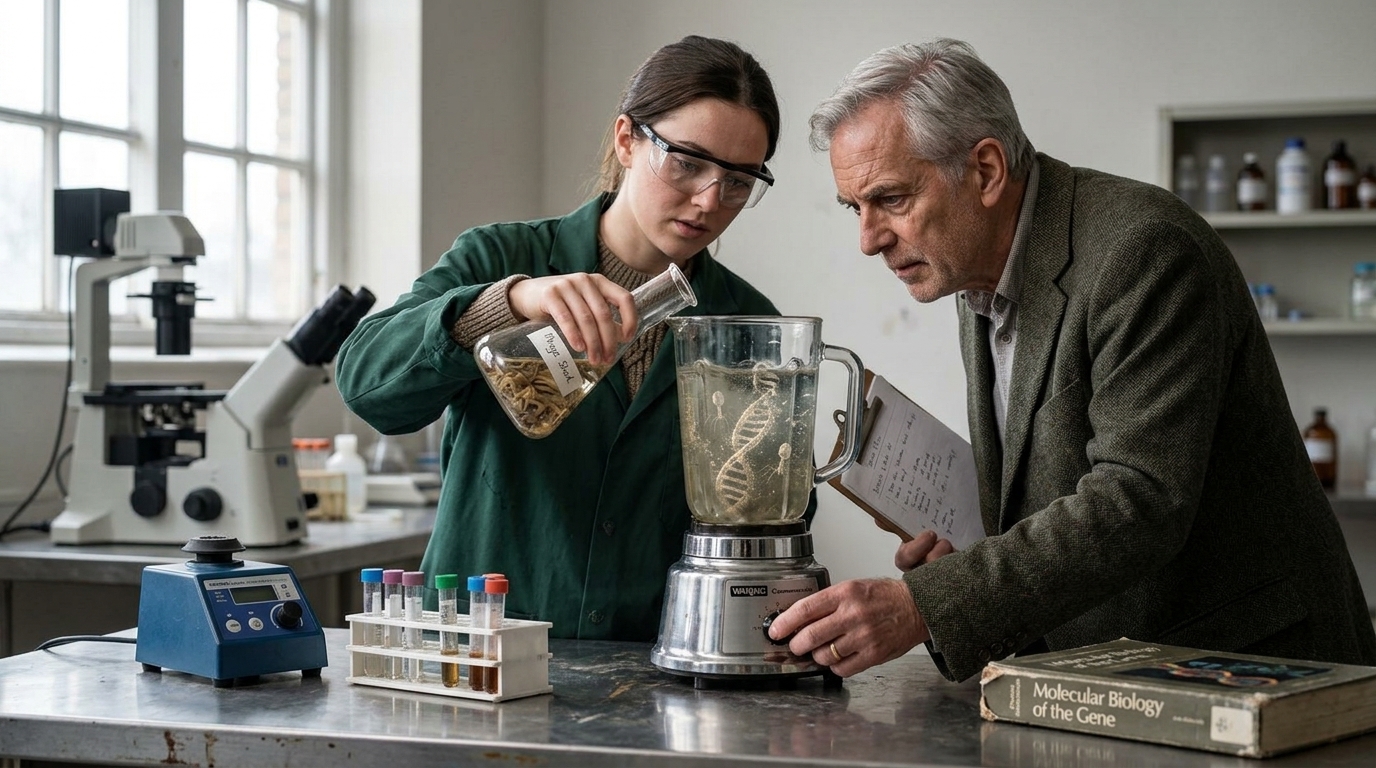
On September 20, 1952, a publication shifted the course of science. Using radioactive viruses, bacteria, and a common kitchen blender, Alfred Hershey and his 24-year-old assistant, Martha Chase, provided the definitive answer to the fundamental question of heredity.
The Battle Between Protein and DNA
In the mid-20th century, the scientific community was divided. Many believed that proteins, with their complexity of 20 amino acids, were the carriers of genetic instructions. DNA was considered too simple, consisting of only four chemical bases. Despite evidence presented as early as 1944, doubt persisted.
The "Blender Experiment"
Hershey and Chase utilized bacteriophages—viruses consisting of DNA encased in a protein shell. To distinguish between them, they used two radioactive tracers:
- Phosphorus-32: To label the DNA.
- Sulfur-35: To label the protein.
After infecting the bacteria, they used a blender to detach the external viral shells. Centrifugation revealed the truth: the radioactive sulfur (protein) remained outside the cells, while the radioactive phosphorus (DNA) had entered, directing the reproduction of new viruses.
Legacy and the Nobel Shadow
The Hershey-Chase experiment turned a disputed hypothesis into scientific certainty, paving the way for Watson and Crick's double helix model just seven months later. In 1969, Hershey was awarded the Nobel Prize in Medicine. However, Martha Chase, despite co-authoring the historic study, was not included in the honor, and her contribution remained for years in the shadow of her famous colleague.