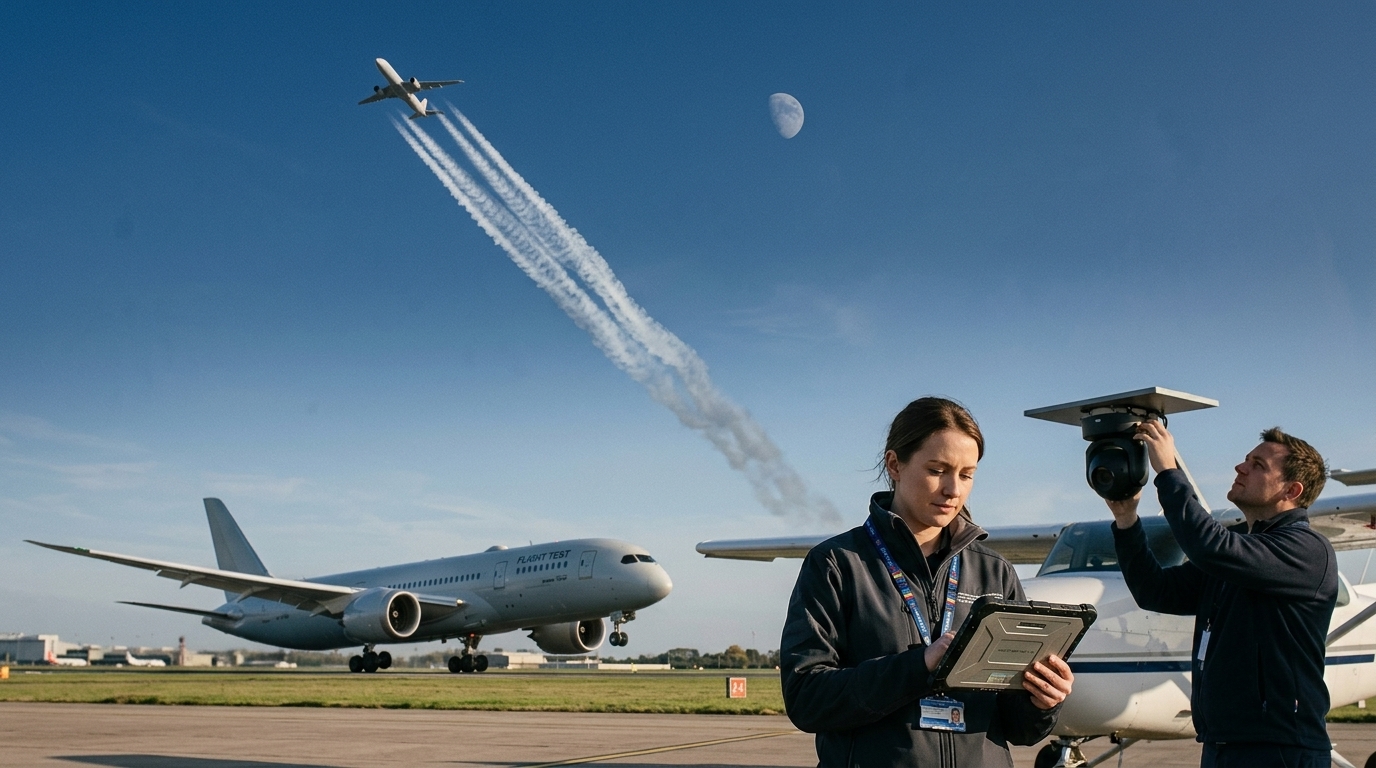
Hundreds of commercial flights crossing the northeastern Atlantic Ocean will be instructed to adjust their flight paths over the next two winters. The landmark trial aims to demonstrate how minor altitude shifts can mitigate aviation’s contribution to global warming.
Operation Blue Skies
The 30-month research program, launched Tuesday, is backed by the British government. Google UK is providing AI-powered forecasts to pinpoint regions prone to the formation of condensation trails, or contrails. These trails occur when airplanes fly through cold, humid air, causing ice crystals to form around engine soot particles and creating clouds that trap heat within the atmosphere.
The testing will take place in the Shanwick Oceanic Control Area, a major corridor for air traffic between Europe and North America. During 20 to 40 designated test days each winter, air traffic controllers will direct selected flights to deviate by up to 2,000 feet (610 meters) to avoid contrail-prone zones.
Scale and Climate Significance
Contrails are estimated to be responsible for 1% to 2% of global warming, according to research from Contrails.org. Modeling indicates that the Shanwick airspace alone accounts for roughly 5% of the total climate impact from contrails, particularly during the winter months. Paul Hodgson, Google’s technical lead for the project, noted that testing across an entire airspace—rather than with individual airlines—can demonstrate the feasibility of moving multiple aircraft simultaneously to achieve a regional reduction in contrails.
- Total funding: £5 million ($6.76 million).
- Consortium members: Google, UK Department for Transport, Met Office, NATS, Imperial College London, and the University of Cambridge.
- Scope: Approximately 10,000 flights will pass through the airspace during testing, with 1% to 5% expected to deviate.