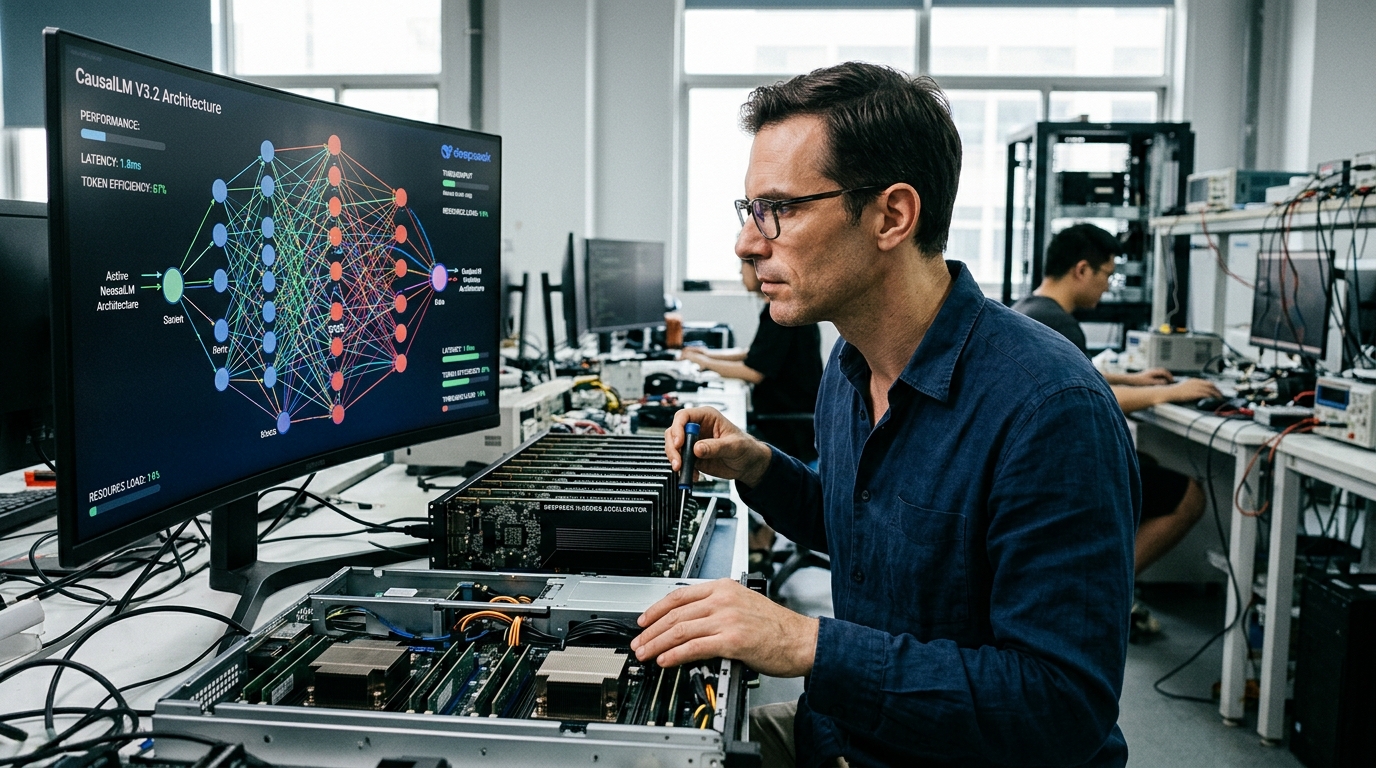
In an era where global competition for Artificial Intelligence (AI) supremacy is often measured by the sheer volume of expensive Graphics Processing Units (GPUs) a company possesses, Chinese lab DeepSeek is disrupting the status quo. The company's announcement that it has achieved an 85% increase in processing speed without utilizing the latest "flagship" chips, such as NVIDIA's H100 or Blackwell series, is more than just a technical milestone; it is a geopolitical and economic manifesto.
DeepSeek, which has already made waves with its open-source models capable of rivaling GPT-4, appears to have found the "sweet spot" between code and hardware. Their approach focuses on extreme algorithmic optimization and the use of architectures that require significantly less computational power for the same output. This means that AI can now run at high speeds on older-generation hardware or less powerful chips that bypass strict U.S. export restrictions.
The Mixture-of-Experts (MoE) Architecture and Code Innovation
The key to DeepSeek's success lies in its sophisticated implementation of the Mixture-of-Experts (MoE) architecture. Instead of the model activating all its billions of parameters for every single query, it activates only a small, relevant fraction. While the concept of MoE is not new, DeepSeek has managed to optimize the communication "kernels"—the chip's internal data transfer channels—to the point where latency is virtually eliminated.
According to technical reports, the company developed custom algorithms that allow chips to perform calculations in FP8 (8-bit floating point) format with exceptional precision. This enables more data to be transferred through the limited bandwidth of older chips, such as the NVIDIA H800, which were specifically designed for the Chinese market with throttled performance due to U.S. sanctions. DeepSeek has essentially "unlocked" capabilities previously thought impossible for this tier of hardware.
- Optimization of node-to-node communication protocols.
- Implementation of advanced data compression techniques without quality degradation.
- Development of custom software libraries that bypass standard industry bottlenecks.
The Sanction Paradox: Necessity as the Mother of Innovation
This development highlights an intriguing phenomenon: the "Sanction Paradox." When the U.S. restricted China's access to top-tier AI chips, the goal was to slow Beijing's progress. However, this move forced Chinese engineers to become exceptionally inventive at the software level. While American companies often solve power constraints by simply purchasing more and more expensive chips (brute force scaling), DeepSeek had to make its AI "smarter" with fewer resources.
"We don't need the biggest hammer if we can forge the sharpest scalpel," remarked an industry executive in Asia, commenting on DeepSeek's breakthrough.
This shift toward efficiency over raw power could fundamentally alter the industry's economics. If a company can provide GPT-4 level performance at one-tenth of the infrastructure cost, the "moat" protecting Silicon Valley's Big Tech begins to evaporate. Democratizing access to high-speed AI means smaller nations and enterprises can finally enter the arena effectively.
Economic Implications and the Semiconductor Market
For NVIDIA and other chipmakers, this news is a double-edged sword. On one hand, the demand for hardware remains insatiable. On the other, if software becomes so efficient that high-end flagship models are no longer a prerequisite for cutting-edge AI, the profit margins of semiconductor giants could face pressure. Investors are closely watching to see if this "efficiency revolution" will lead to a reduction in capital expenditure (CAPEX) from major cloud providers.
Furthermore, DeepSeek's success strengthens China's position on the global stage. The ability to produce world-class AI using hardware that is already abundant in the market renders sanctions less effective. 2026 is shaping up to be the year where code begins to outpace hardware in the battle for efficiency.
In conclusion, DeepSeek hasn't just improved AI speed; it has changed the rules of the game. The emphasis on clever architecture over brute computational force is a lesson the entire tech industry must study carefully. The future of AI may not reside in multi-billion dollar data centers, but in the elegance of a well-written algorithm.