

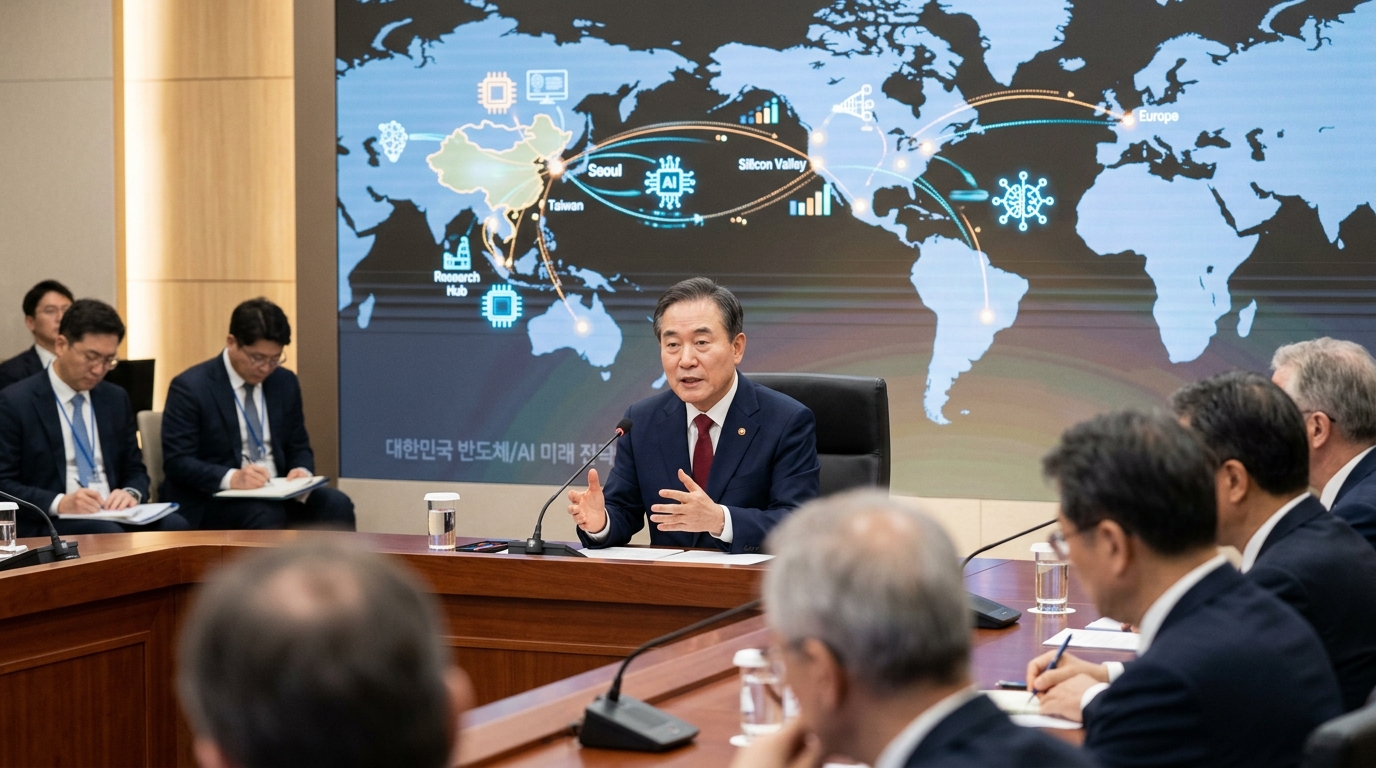
In a move that redefines the boundaries of state-led industrial policy, South Korea has unveiled a colossal investment plan totaling $1 trillion (KRW 1.4 quadrillion, cumulative with private sector contributions) aimed at achieving absolute dominance in the semiconductor and Artificial Intelligence sectors. This announcement, surfacing amidst intense geopolitical friction, signals Seoul's resolve to transition from a key player to the undisputed hub of the global technological supply chain, refusing to be a mere bystander in the 'chip wars' between the United States and China.
The Yongin Mega Cluster: Silicon's New Global Capital
The centerpiece of this ambitious roadmap is the creation of the world's largest semiconductor cluster in Yongin, near Seoul. This project is far more than a construction endeavor; it is a holistic ecosystem overhaul. President Yoon Suk Yeol's administration has pledged massive tax incentives, infrastructure subsidies, and streamlined regulatory pathways for industry titans Samsung Electronics and SK Hynix. The goal is to establish 13 new fabrication plants (fabs) and three major research facilities by 2047.
The strategic importance of this initiative lies in South Korea's urgent need to diversify its output. While the nation has traditionally dominated the memory market (DRAM and NAND), the new plan places a heavy emphasis on logic chips and AI accelerators. The meteoric rise of Generative AI has spiked demand for High Bandwidth Memory (HBM), a niche where SK Hynix currently holds a competitive edge as a primary supplier for Nvidia.
The Geopolitical Chessboard and the 'Chip 4' Alliance
This investment does not occur in a vacuum. Washington is increasingly pressuring its allies to restrict China's access to cutting-edge semiconductor technology. South Korea finds itself in a precarious position: it is fundamentally dependent on American technology and security, yet China remains its largest trading partner and hosts significant manufacturing facilities for both Samsung and SK Hynix.
The $1 trillion plan is a calculated move toward 'domestic fortressing.' By shifting the gravity of production back to the Korean peninsula, Seoul mitigates the risks of supply chain disruptions and tightening export controls. Simultaneously, it solidifies its standing within the 'Chip 4' alliance (USA, Japan, Taiwan, South Korea), demonstrating that it possesses the scale and technical prowess that make it indispensable to the Western technological bloc.
The AI Frontier and Domestic Challenges
Artificial Intelligence is no longer a peripheral promise; it is the engine of the current industrial revolution. South Korea intends to invest billions into developing indigenous AI chips, aiming to reduce reliance on foreign designers like ARM or Nvidia. Integrating AI into the semiconductor manufacturing process itself is expected to boost factory efficiency by 30%, providing a crucial cost advantage over competitors in Taiwan and the United States.
However, the roadmap faces significant internal hurdles. The astronomical demand for electricity and water required by these clusters tests the nation's environmental commitments. The government is pivoting toward nuclear energy to power these facilities, a move that remains politically sensitive. Furthermore, a chronic shortage of highly skilled talent remains an Achilles' heel, prompting the government to announce specialized training programs for 150,000 new engineers and scientists.
"This is not merely economic policy; it is a matter of national survival. In a world where silicon is the new oil, South Korea is choosing to be its global wellspring."
In conclusion, South Korea is betting its future on technological supremacy. If successful, the nation will cement itself as the ultimate arbiter of the digital age. If it falters, the sheer fiscal weight and geopolitical exposure could destabilize Asia's fourth-largest economy. The stakes are monumental, but for Seoul, the cost of inaction is far greater than the risk of this historic gamble.





